Four Frames, One Kiss: The Photograph That Became V-J Day
A sailor grabbed a stranger in white and bent her back in a kiss — and a photographer with a Leica had only seconds to catch it before it vanished into the crowd forever.
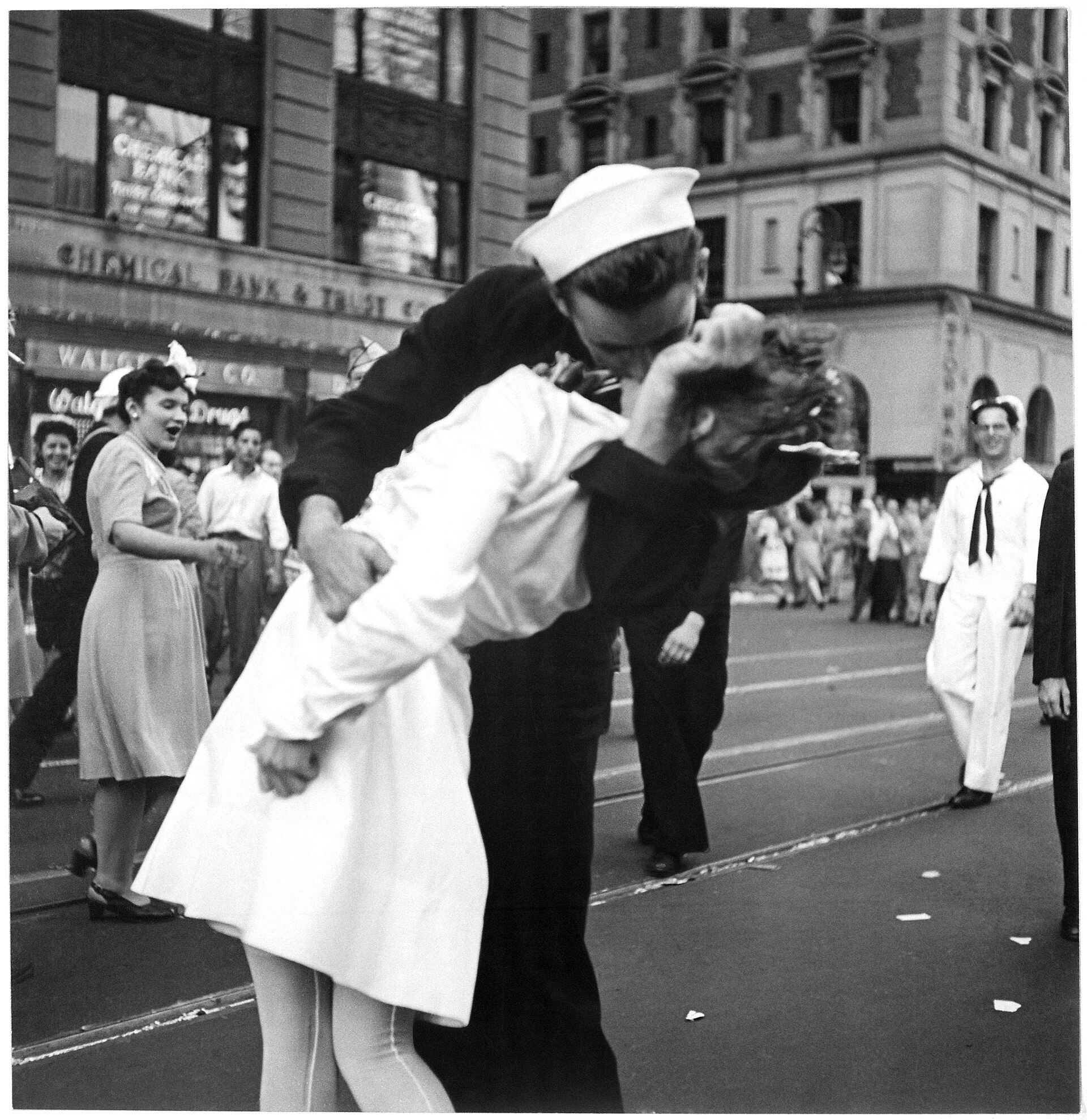
On August 14, 1945, New York City held its breath. Word was spreading through Times Square that President Harry S. Truman would soon announce, at seven o'clock, that Japan had surrendered and the Second World War was finally over. Crowds surged into the intersection where Broadway and Seventh Avenue converge, and among them moved photographer Alfred Eisenstaedt, working for Life magazine, his Leica IIIa ready for whatever the chaos might offer.
What it offered was a sailor. Eisenstaedt later recalled watching him run down the street, grabbing every woman in sight — young girls, old grandmothers, it made no difference to him. Eisenstaedt ran ahead, camera raised, unsatisfied with what he saw through the lens until, in a flash, something white caught his eye. He turned and clicked the shutter the instant the sailor kissed a nurse. He took exactly four exposures within a few seconds, and later said only one had the right balance — the sailor's figure neither too large nor too small against hers.
Eisenstaedt was candid about how much the photograph owed to costume as much as chance. If the woman had worn a dark dress, he said, or if the sailor's uniform had been white instead of navy blue, he would never have taken the picture at all. It was the stark contrast — white against dark — that gave the image its charge. Donald W. Olson and his research team later pinpointed the moment: 5:51 p.m. Eastern Time, just south of 45th Street, looking north.
A week later, Life published the photograph as a full-page image in a twelve-page spread called 'Victory Celebrations,' alongside a montage of similar scenes from Washington, D.C., Kansas City, and Miami. Neither the sailor's nor the woman's face was clearly visible, and Eisenstaedt admitted he never got their names — events were moving too fast to stop and ask. The photograph nonetheless became an overnight cultural icon, and Eisenstaedt, holding the copyright, tightly controlled how it could be reproduced.
He was not the only one who had captured the moment. U.S. Navy photojournalist Victor Jorgensen shot the same kiss from another angle, publishing his version in The New York Times the next day under the title 'Kissing the War Goodbye.' Because Jorgensen was a federal employee on duty, his photograph entered the public domain. It showed less of the famous intersection but more of the setting — the Chemical Bank and Trust building and a Walgreens pharmacy sign visible behind the couple. A woman standing astonished at the edge of Jorgensen's frame was later identified as Kay Hughes Dorius of Utah.
More from Art

The Painting With No Foreground
A single robed figure stares out at an empty grey sea — and the emptiness itself became a scandal. When it was unveiled in Berlin in 1810, no one knew quite what to do with it.

The Painter Who Chased the Light
For a few purple minutes each evening, an American exile knelt in an English garden and raced the dying sun to paint two little girls lighting lanterns. It took him two years to finish.

When a President Became a God
Look straight up inside the U.S. Capitol dome and you will find George Washington enthroned among the clouds, surrounded by goddesses — the founding father transformed into myth.

Marble Brought Back to Life
A corpse asleep, a wing barely brushing her skin — and marble somehow learns to breathe. This is the moment Antonio Canova dared to carve.

The World Turned Upside Down
Look closely at a sixteenth-century Flemish village and you'll find a man biting a pillar, another carrying daylight in a basket, and a wife slipping a blue cloak over her husband's shoulders. Every gesture is a joke — if you know the language.

The Girl in the Glass Case
She stood two-thirds life size, dressed in a real tutu and human hair — and the critics who saw her in 1881 recoiled as if she were something obscene.