Four Sisters in the Shadows
Four girls in white pinafores, two Japanese vases taller than they are, and a darkness swallowing the room's far corners — Sargent's strangest masterpiece hides a family's whole future in plain sight.
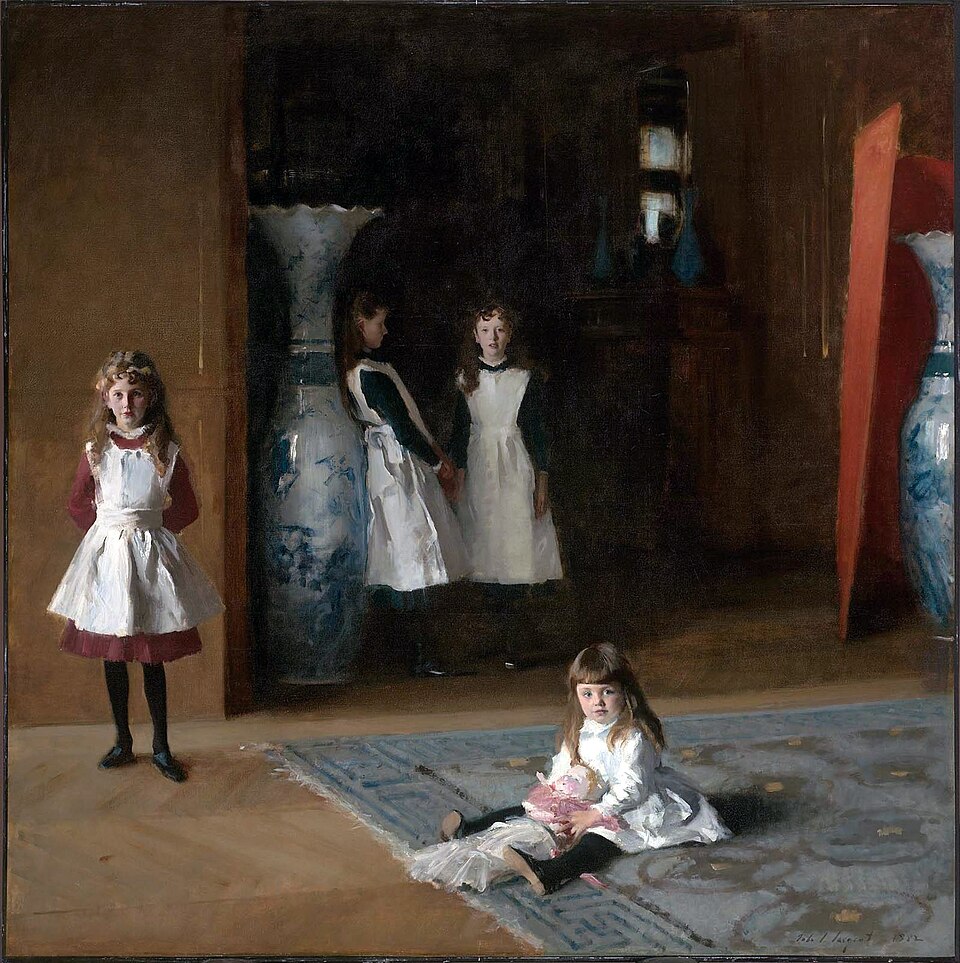
In the autumn of 1882, in a grand Paris apartment on the avenue de Friedland, John Singer Sargent set up his easel in the foyer of his friend Edward Darley Boit's home. Boit, a Boston-born lawyer turned painter, and his wealthy wife Mary Louisa Cushing — known to everyone as Isa — had five children, four of them daughters: Florence, fourteen; Jane, twelve; Mary Louisa, eight, called Isa like her mother; and Julia, four, nicknamed Ya-Ya. It is not known whether Boit commissioned the painting or Sargent proposed it himself, but the result would become one of the most quietly unsettling portraits in American art.
Sargent arranged the four sisters with a boldness unusual for group portraiture of the era. Julia, the youngest, sits on a grey-blue carpet at the painting's center, a doll in her lap. Mary Louisa stands to the left, hands clasped behind her back, facing the viewer directly. Behind them, in a dim recess of the room, stand the two eldest: Florence leaning against one of two towering blue-and-white Japanese vases, seen in profile, and Jane beside her, her face turned toward the viewer but obscured by shadow. The canvas itself is unusually square, and the composition refuses to grant equal prominence to each girl — a striking departure from convention.
The debt to Diego Velázquez's Las Meninas, which Sargent had copied years earlier in Madrid during a trip through Spain and Morocco, was noted by critics from the very first viewings, including the writer Henry James, a friend of both Sargent and Boit. The dark, deep space, the family caught in an intimate and unguarded moment, the near-abstraction of some figures into shadow — all echo Velázquez. Sargent's teacher, Carolus-Duran, had urged his students to study the Spanish master closely, and the connection between the two paintings has been considered so significant that in 2010 the Museum of Fine Arts, Boston lent The Daughters to the Museo del Prado so the works could hang together for the first time.
When the painting was first shown in December 1882 at art dealer Georges Petit's gallery on the Rue de Sèze, and then at the Paris Salon in 1883 under the title Portraits d'enfants, reactions focused on the oddness of its composition and the seemingly wooden poses of the girls. Henry James, writing in 1887, offered a comforting reading: a 'happy play-world' of children at their games. For nearly a century, that interpretation went largely unquestioned, aided by the fact that the girls' white pinafores were simply practical clothing for play.
Modern critics have seen something else entirely. Art historian Barbara Gallati has argued that placing the two eldest girls at the edge of a darkened, ambiguous doorway symbolizes their passage toward an unknown future, a visual metaphor for maturing beyond childhood's safety. Scholars have drawn comparisons to Frans Hals' brushwork, to Renoir's Madame Georges Charpentier and Her Children, and especially to Edgar Degas' The Bellelli Family for its similar psychological tension. Author Bill Brown has written of the painting's 'uncanny qualities,' suggesting that the vases and the girls blur into one another — a dialectic, he says, between person and thing.
More from Art

The Painting With No Foreground
A single robed figure stares out at an empty grey sea — and the emptiness itself became a scandal. When it was unveiled in Berlin in 1810, no one knew quite what to do with it.

The Painter Who Chased the Light
For a few purple minutes each evening, an American exile knelt in an English garden and raced the dying sun to paint two little girls lighting lanterns. It took him two years to finish.

When a President Became a God
Look straight up inside the U.S. Capitol dome and you will find George Washington enthroned among the clouds, surrounded by goddesses — the founding father transformed into myth.

Marble Brought Back to Life
A corpse asleep, a wing barely brushing her skin — and marble somehow learns to breathe. This is the moment Antonio Canova dared to carve.

The World Turned Upside Down
Look closely at a sixteenth-century Flemish village and you'll find a man biting a pillar, another carrying daylight in a basket, and a wife slipping a blue cloak over her husband's shoulders. Every gesture is a joke — if you know the language.

The Girl in the Glass Case
She stood two-thirds life size, dressed in a real tutu and human hair — and the critics who saw her in 1881 recoiled as if she were something obscene.