Four Years on His Back: Michelangelo and the Sistine Ceiling
A sculptor who insisted he was no painter spent four years suspended above a chapel floor, arguing with a pope and reinventing the human figure along the way.
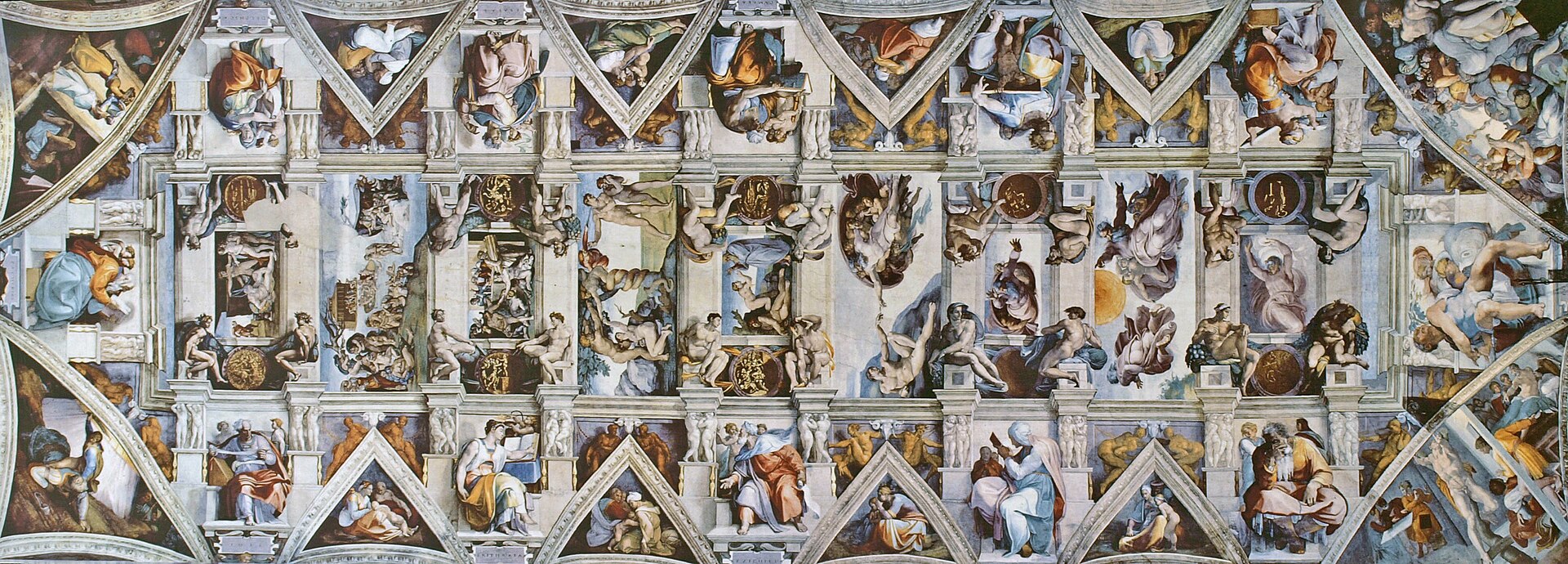
In 1506, Pope Julius II — a man so consumed by temporal power that he rode through Rome in a chariot after military victories, imitating ancient Roman triumphs — conceived a plan to redecorate the ceiling of the Sistine Chapel, the papal chapel built in the Vatican between 1477 and 1480 under Sixtus IV. The chapel's walls had already been painted two decades earlier by masters like Sandro Botticelli, Domenico Ghirlandaio, and Pietro Perugino, depicting the Life of Christ and the Life of Moses. Above them, between windows, ran painted portraits of the first 32 popes. The ceiling itself, however, was still the original work of Pier Matteo d'Amelia: a plain blue sky scattered with stars, echoing the Arena Chapel (Scrovegni Chapel) that Giotto had decorated in Padua.
That modest sky came down after a diagonal crack rendered the chapel unusable for six months in 1504. Julius II had the damaged painting removed by Piero Roselli, a friend of Michelangelo's, clearing the way for something far grander. The pope had already summoned Michelangelo to Rome in 1505 to design his tomb, only to leave the project quietly shelved. On 10 May 1506, Roselli wrote to Michelangelo on the pope's behalf, relaying doubts from the papal court architect Donato Bramante about whether Michelangelo — primarily a sculptor with limited fresco experience — could handle such a project at all; Michelangelo reportedly refused outright. That November he left for Bologna, where Julius commissioned him to cast a colossal bronze statue of the pope. Only after completing that bronze in early 1508 did Michelangelo return to Rome, expecting to resume the tomb. Instead, Julius handed him the ceiling, and on 10 May 1508 Michelangelo signed the contract to begin.
Michelangelo had resisted from the start. He considered himself a sculptor, not a painter, and even suggested his younger rival Raphael take the commission instead. But Julius was immovable, and after his own bouts of fleeing Rome and clashing tempers with the pope, Michelangelo relented.
The pope's original vision was modest: twelve large figures of the Apostles filling the spandrels. Michelangelo negotiated for something vastly more ambitious, winning permission, in his own words, 'to do as I liked.' Some historians suspect the Augustinian cardinal Giles of Viterbo shaped the theological program, but many believe Michelangelo devised it himself — his biographer Ascanio Condivi recorded that the artist read and reread the Old Testament while painting, drawing inspiration straight from scripture rather than established religious art traditions.
What emerged at the center of the vault were nine scenes from the Book of Genesis, among them the now-iconic Creation of Adam. Around and beneath these scenes, Michelangelo populated the ceiling with figures both clothed and nude, using the commission as a demonstration of his mastery over the human body in every conceivable pose — remarkable for a man who had claimed painting wasn't his craft.
More from Art

The Painting With No Foreground
A single robed figure stares out at an empty grey sea — and the emptiness itself became a scandal. When it was unveiled in Berlin in 1810, no one knew quite what to do with it.

The Painter Who Chased the Light
For a few purple minutes each evening, an American exile knelt in an English garden and raced the dying sun to paint two little girls lighting lanterns. It took him two years to finish.

When a President Became a God
Look straight up inside the U.S. Capitol dome and you will find George Washington enthroned among the clouds, surrounded by goddesses — the founding father transformed into myth.

Marble Brought Back to Life
A corpse asleep, a wing barely brushing her skin — and marble somehow learns to breathe. This is the moment Antonio Canova dared to carve.

The World Turned Upside Down
Look closely at a sixteenth-century Flemish village and you'll find a man biting a pillar, another carrying daylight in a basket, and a wife slipping a blue cloak over her husband's shoulders. Every gesture is a joke — if you know the language.

The Girl in the Glass Case
She stood two-thirds life size, dressed in a real tutu and human hair — and the critics who saw her in 1881 recoiled as if she were something obscene.