Gold, Flesh, and Flowers: The Making of The Kiss
A man's face vanishes into a woman's cheek, gold swallows the world around them, and Vienna's most scandalous painter produces his gentlest masterpiece.
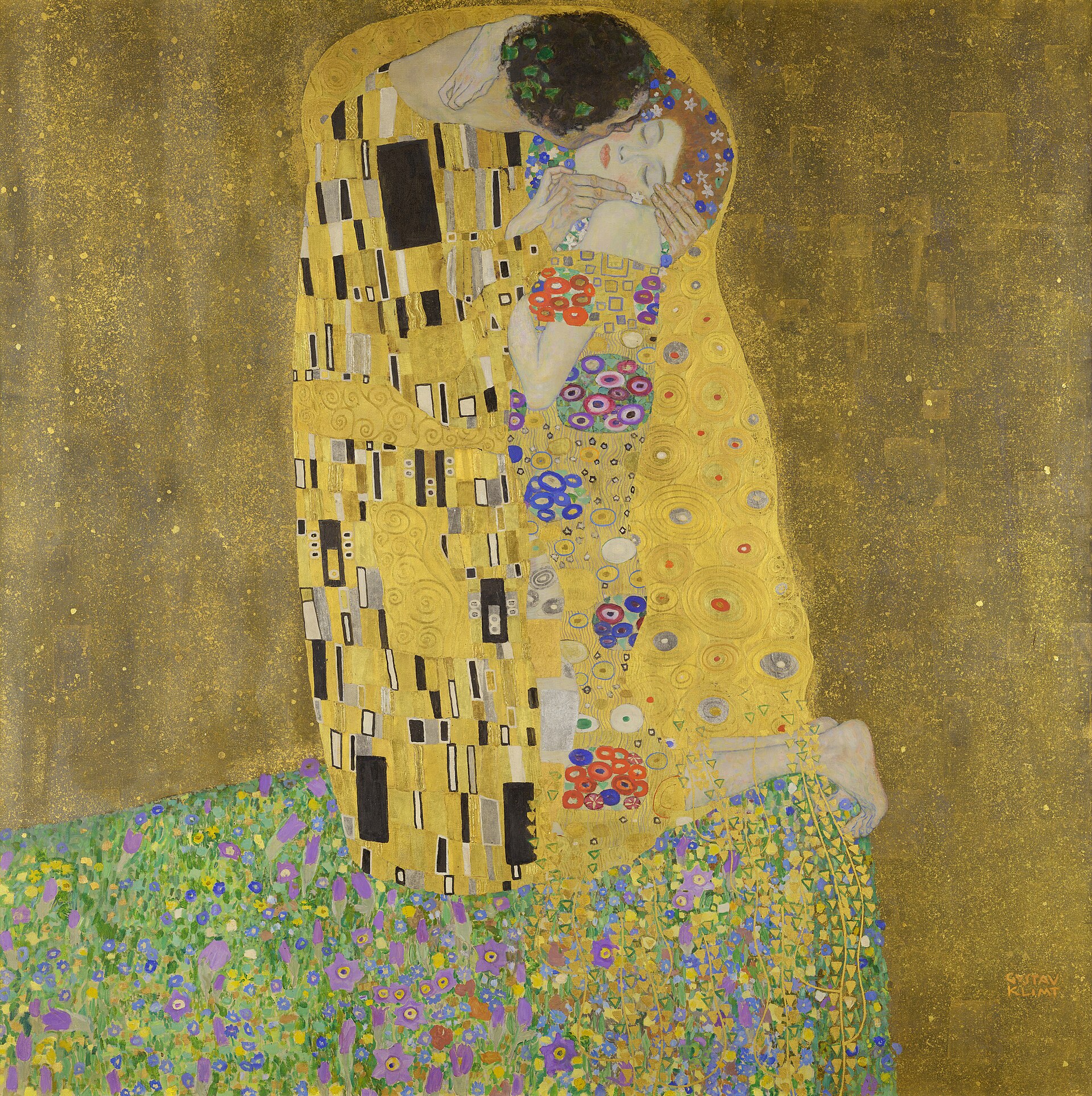
Sometime between 1907 and 1908, in the studio of a painter already notorious for outraging polite Vienna, Gustav Klimt began covering a canvas in gold leaf, silver, and platinum. He was at the height of what would later be called his Golden Period, and the work taking shape under his hands showed none of the confrontational strangeness that had made his Vienna Ceiling paintings a public scandal, condemned as pornographic and perverse. Instead, he painted two figures fused together at the edge of a flowering meadow, wrapped so tightly in gold that the line between their bodies and the world around them nearly disappeared.
When it was first shown in 1908, the painting carried a quieter title than the one history would give it: Liebespaar, the lovers. It hung in the Kunstschau, a building raised by Klimt alongside Josef Hoffmann, Otto Prutscher, and Koloman Moser to mark the sixtieth anniversary of Emperor Francis Joseph I's reign. The identity of the woman remains genuinely uncertain: some believe Klimt painted his lifelong companion Emilie Flöge, others point to a model nicknamed Red Hilda who resembles women in his other canvases, and no record survives to settle it. What is certain is that the couple stand locked together, the man's face turned fully away from the viewer, bent down to press a kiss to the woman's cheek while his hands cradle her face.
The painting's imagery did not come from nowhere. Klimt had already explored the motif of an embracing couple in his Stoclet Frieze and Beethoven Frieze, both precursors that circled the same themes of love and intimacy that recur throughout his work. But The Kiss distilled those ideas into something starker and more radiant. The woman kneels at the edge of a meadow of flowers, her bare feet marking where the natural world ends and the golden field begins. She wears a crown of flowers; he wears one of vines. Her dress flows in floral patterns, his robe is patterned with geometric shapes and understated swirls, both echoing the ornamental language of Art Nouveau and the organic forms of the Arts and Crafts movement.
The gold itself has its own history. Klimt's father had worked as a traveling gold engraver, but the specific inspiration for the leaf and metal Klimt used so lavishly traced back to a 1903 trip to Italy, where he saw the Byzantine mosaics of the Church of San Vitale in Ravenna. Their flatness, their absence of depth or perspective, seemed only to intensify their golden brilliance, and Klimt began using gold and silver leaf in his own paintings to an extent no one had attempted before. The spiraling patterns on the lovers' robes recall Bronze Age ornament and decorative tendrils reaching back before classical antiquity, while the compressed composition, with the man's head nearly touching the top edge of the canvas, breaks from Western convention in a way that reflects the influence of Japanese prints.
Art historians have never agreed on precisely who these lovers are meant to be. Some argue the scene depicts Apollo kissing Daphne, drawn from Ovid's Metamorphoses. Others see the moment from the myth of Orpheus and Eurydice, when Orpheus turns to caress his love and loses her forever; supporters of this reading point to a slight translucence in the woman's figure, as though she is already fading from view. The painting resists a single answer, and perhaps that ambiguity is part of its enduring pull.
More from Art

The Painting With No Foreground
A single robed figure stares out at an empty grey sea — and the emptiness itself became a scandal. When it was unveiled in Berlin in 1810, no one knew quite what to do with it.

The Painter Who Chased the Light
For a few purple minutes each evening, an American exile knelt in an English garden and raced the dying sun to paint two little girls lighting lanterns. It took him two years to finish.

When a President Became a God
Look straight up inside the U.S. Capitol dome and you will find George Washington enthroned among the clouds, surrounded by goddesses — the founding father transformed into myth.

Marble Brought Back to Life
A corpse asleep, a wing barely brushing her skin — and marble somehow learns to breathe. This is the moment Antonio Canova dared to carve.

The World Turned Upside Down
Look closely at a sixteenth-century Flemish village and you'll find a man biting a pillar, another carrying daylight in a basket, and a wife slipping a blue cloak over her husband's shoulders. Every gesture is a joke — if you know the language.

The Girl in the Glass Case
She stood two-thirds life size, dressed in a real tutu and human hair — and the critics who saw her in 1881 recoiled as if she were something obscene.