Halfway Through Life, Dante Walked Into the Dark Wood
On the night before Good Friday in 1300, an exiled poet imagined the only journey that could redeem him: straight through Hell.
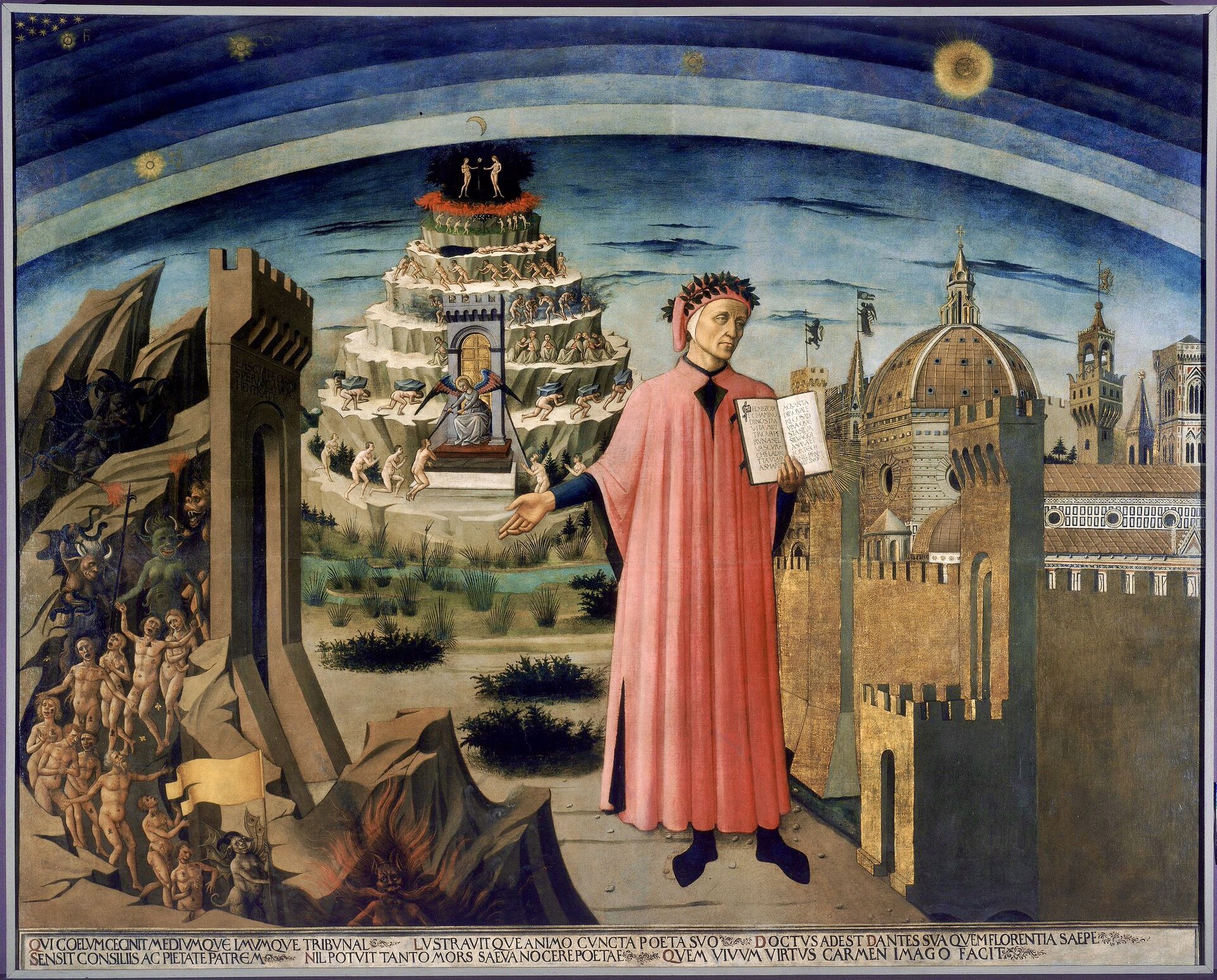
Dante Alighieri began the Divine Comedy around 1308, in exile from Florence, and finished it around 1321, shortly before his death. He would never see his city again. The poem he wrote in those years of banishment would become the towering achievement of Italian literature — and the reason Tuscan, rather than any rival dialect, became the standardized Italian language.
The story is told in Dante's own voice. Beginning on the night before Good Friday in the spring of 1300, he describes traveling through the three realms of the afterlife: Inferno, Purgatorio, and Paradiso. Each realm forms its own cantica of 33 cantos, with one introductory canto added at the start, bringing the total to exactly 100 — a number medieval readers considered sacred and complete.
Dante does not walk alone. The Roman poet Virgil, representing human reason, guides him through Hell and most of Purgatory. Beatrice — a Florentine woman Dante had loved from afar since childhood, in the tradition of courtly love — takes over as his guide through Heaven, representing divine revelation, grace, and faith. In the poem's final cantos, Saint Bernard of Clairvaux leads him the rest of the way, representing contemplative devotion to the Virgin Mary.
The number three governs everything about the poem's structure. It is written in terza rima, tercets of eleven-syllable lines rhyming ABA BCB CDC, so that each tercet contains 33 syllables — matching the 33 cantos of each cantica. Beneath the three main realms lies a further pattern of nine plus one: nine circles of Hell topped by Lucifer at the bottom, nine rings of Mount Purgatory crowned by the Garden of Eden, and nine celestial spheres of Paradise crowned by the Empyrean, the essence of God itself. Strikingly, the very last word of each of the three cantiche is the same: stelle — stars.
The poem's politics are as real as its theology. Dante belonged to the Guelphs, who generally backed the papacy against the Holy Roman Emperor, but Florence's Guelphs split around 1300 into White and Black factions. When troops under Charles of Valois entered Florence at Pope Boniface VIII's request, the Lord-Mayor Cante de' Gabrielli di Gubbio exiled the White Guelphs — Dante among them — in 1302. That exile lasted the rest of his life, and its bitterness surfaces throughout the Comedy, from prophecies of his own banishment to the eternal punishments he assigns his political enemies.
More from Mythology

The Doctor Who Sang a Nation Into Being
A country doctor rode into the forests of Karelia armed with nothing but a notebook — and rode out with the soul of a nation.

The Boat That Carried the Sun
Every sunset, the ancient Egyptians believed, the sun climbed into a boat and sailed straight into the realm of the dead — only to fight a monstrous serpent before dawn could return.

The Wild Man of the Snows
At 21,000 feet, a colonel found tracks in the snow that he blamed on a wolf — but his guides knew better, and gave the world a name that would echo for a century.

The Knight Who Went Mad for Love: Orlando Furioso
A hero so devoted to duty he was Charlemagne's greatest paladin loses his mind—not to a sword wound, but to heartbreak. To cure him, a friend must ride a flying horse to the Moon.

The Book That Turned the World Into Myth
A poet condemned to exile spent his final years in Rome finishing a poem that would outlive empires—a poem about nothing standing still, not gods, not lovers, not even the shape of a man.

Paradise Lost: Milton's Rebel Angel
A blind poet, dictating verses in the dark, dared to explain the ways of God to men — and in doing so, made Hell's ruler unforgettable.