Karnak: The Forest of Stone Columns
For over two thousand years, pharaoh after pharaoh added to a single sprawling temple without ever finishing it — what emerged is the largest ancient religious site on Earth.
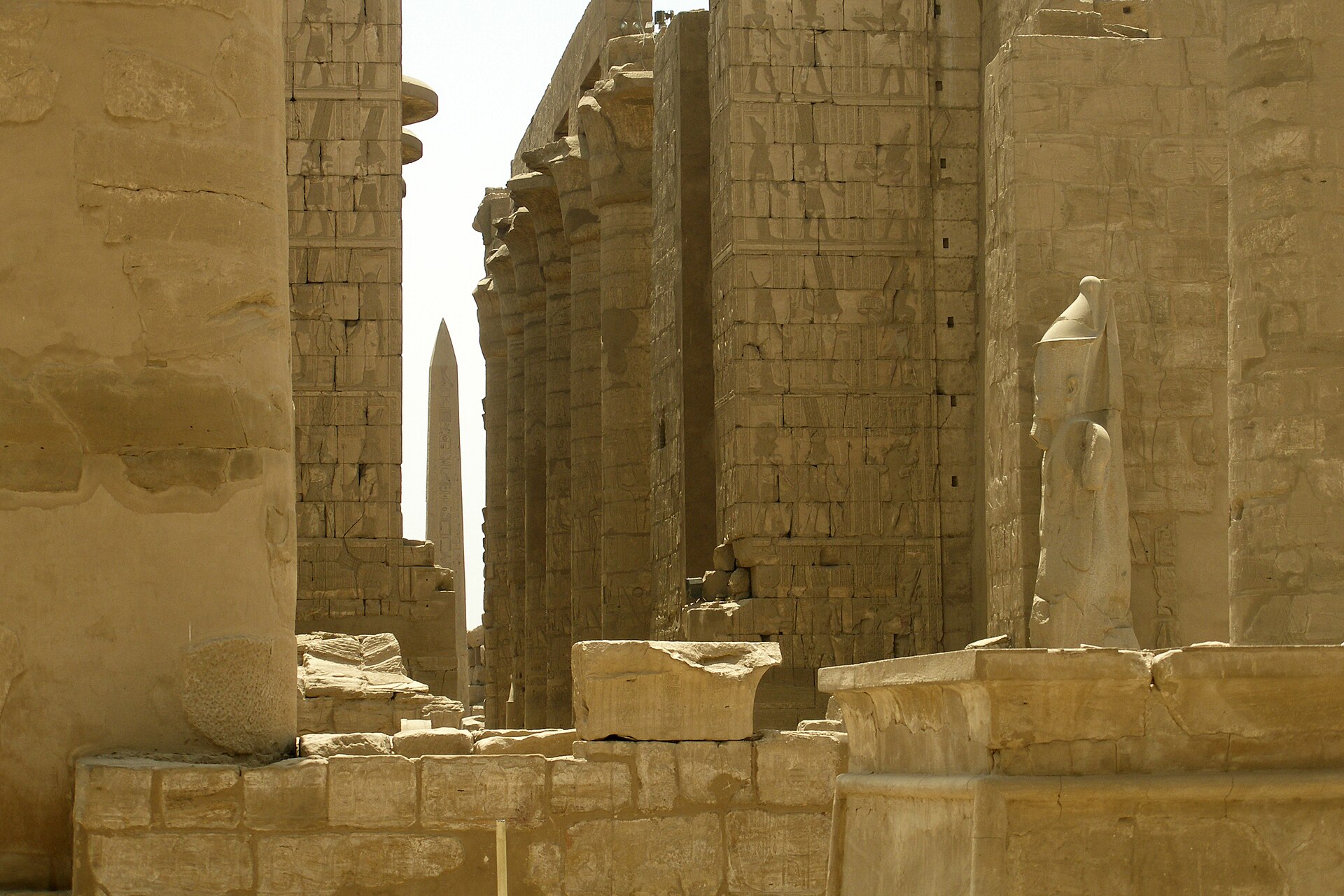
Walk into the Great Hypostyle Hall at Karnak and the first thing that happens is you lose your sense of scale. One hundred and thirty-four columns rise around you in sixteen rows, 122 of them ten metres tall, twelve others soaring to 21 metres with a diameter of over three metres. Sunlight slants between them the way it might through an actual forest, except this forest is stone, and it has stood near Luxor, Egypt, for thousands of years.
The complex began far more modestly. Construction started during the reign of Senusret I, who ruled from 1971 to 1926 BC in the Middle Kingdom, when Thebes was not yet the seat of a unified Egypt and its shrines honored the earth goddess Mut and the god Montu. The earliest known object connected to the site is a small, eight-sided column from the Eleventh Dynasty bearing the name Amun-Re — a hint of the deity who would come to dominate everything built here afterward.
Amun, sometimes written Amen, had long been the local guardian god of Thebes, associated with the ram and the goose; his name means 'hidden' or 'the hidden god'. When Thebes became capital of a unified Egypt in the Eighteenth Dynasty, Amun's temple exploded in scale. Almost every pharaoh of that dynasty added something. Thutmose I built the enclosure wall connecting the Fourth and Fifth Pylons — the oldest portion of the temple still standing in its original place. Hatshepsut raised her own monuments there as well.
In total, roughly thirty pharaohs contributed to the buildings over more than two thousand years, from the Middle Kingdom around 2000 BC through the Ptolemaic Kingdom, which ended around 30 BC. That extraordinary duration is what sets Karnak apart from nearly every other site in Egypt: individual features elsewhere might rival single elements at Karnak, but nowhere else did construction continue, layered pharaoh upon pharaoh, for so long. The result is a size, complexity and diversity of religious architecture unmatched anywhere else in the ancient world.
The complex the public now visits is only the largest of four original sections. The Precinct of Amun-Re is the part open to visitors, while the Precinct of Mut, the Precinct of Montu, and the dismantled Temple of Amenhotep IV remain closed. The Mut precinct is itself ancient, dedicated to an earth and creation deity, and was destroyed and partially restored by Hatshepsut before another pharaoh built around it, apparently to shift its orientation — with many of its stones likely carried off for reuse elsewhere.
More from Architecture

Stonehenge: The Stones That Refuse to Explain Themselves
For more than 4,500 years, a ring of leaning giants has watched the sun rise and set on the same two days each year — and no one alive can say for certain why.

The Dome That Refused to Fall
Two thousand years ago, Roman engineers poured a dome so vast that no one has dared build a bigger one from unreinforced concrete since. It still stands, open to the sky.

A Minaret Rising Over Kingsland Road
On a busy London street better known for shops and buses, the tallest minaret in Britain quietly reaches into the sky. Its story began not in Sinan's sixteenth-century Istanbul, but in 1990s Hackney.

The Bridge That Was Killed Twice
For 427 years it arched over the Neretva like a stone rainbow. Then, in a matter of days in 1993, it simply ceased to exist.

Hoover Dam: The Concrete That Tamed a River
In the scorched depths of Black Canyon, thousands of men built the largest concrete structure the world had ever seen — and finished it two years early, at a cost of over a hundred lives.

Neuschwanstein: The Castle Built for a Ghost
A king who despised his own palace built the most famous fairy-tale castle on earth — and died before he ever truly lived in it.