Klimt's Hidden Symphony
Painted directly onto plaster for a temporary exhibition, this four-ton wall of gold and myth was never meant to survive — yet it outlasted wars, exile, and a Nazi occupation.
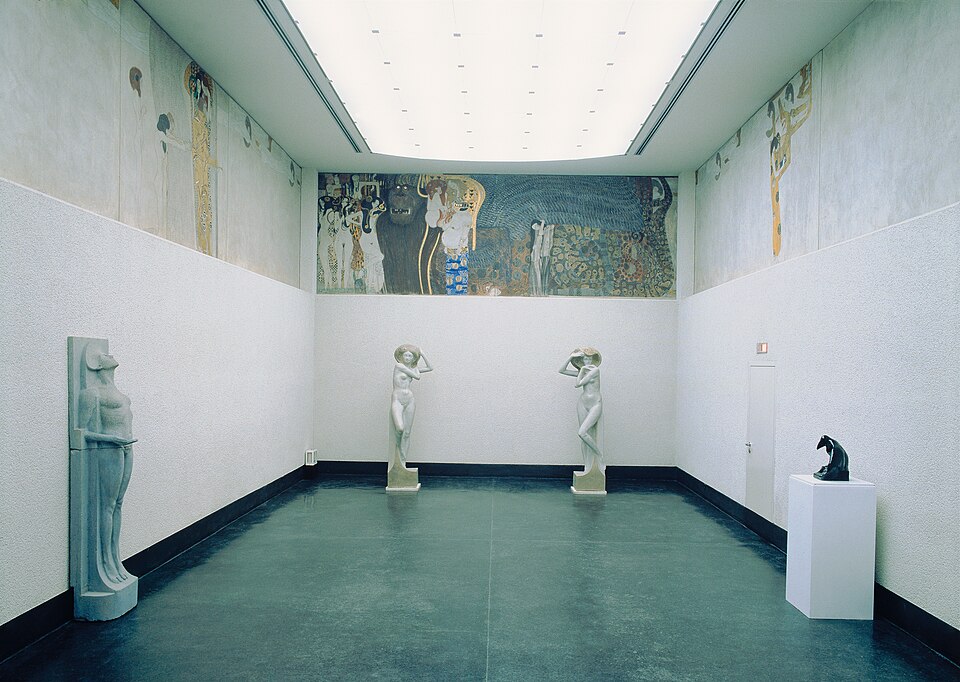
In 1902, inside Vienna's Secession Building, Gustav Klimt picked up his brushes not for a canvas but for the walls themselves. He was preparing an installation for the Fourteenth Vienna Secession exhibition, staged to honor the 75th anniversary of Ludwig van Beethoven's death. Alongside a monumental polychrome sculpture by Max Klinger, Klimt's contribution would become known as the Beethoven Frieze — a work so large it stretched 34.14 meters wide and stood 2.15 meters tall, weighing four tons in total.
Klimt painted it directly onto the walls using light materials, since the piece was intended only for the run of the exhibition. Its imagery drew from an unlikely blend of traditions — Ancient Greek, Byzantine, early medieval, and Japanese art — fused with Klimt's signature gold leaf. The whole composition took its inspiration from composer Richard Wagner's interpretation of Beethoven's Ninth Symphony, translating musical ideas into a visual narrative.
The story unfolds across the walls in three acts. On the left, floating genii drift toward a knight, urging him onward in pursuit of happiness. In the middle panel, personified threats confront the striving individual — lust and sexuality's then feared consequence: syphilis. This scene scandalized contemporary audiences and is now seen as a precursor to the confrontational eroticism Picasso would later explore in Les Demoiselles d'Avignon. The frieze ultimately resolves in a choir's embrace, echoing Beethoven's vision of a symphonic 'kiss' extended to all humanity. Klimt's original audience wasn't left to guess at these meanings — an exhibition brochure spelled out the symbolism in detail.
The frieze should have vanished with the exhibition, but in 1903 collector Carl Reininghaus bought it specifically to save it from destruction. Grateful, Klimt gave him more than 100 preparatory sketches; one eventually found its way to the Museum of Fine Arts, Boston, in 1964. In 1915, industrialist August Lederer, urged on by his wife Serena, purchased the frieze along with many of the sketches.
The piece's fate turned dark with the 1938 German annexation of Austria. Serena Lederer, widowed and Jewish, was forced to flee to Hungary, abandoning her art collection to escape Nazi persecution. The frieze itself was seized and stored in the Altaussee salt mine, where Allied forces recovered it in 1945, returning it to Serena's son, Erich Lederer.
More from Art

The Painting With No Foreground
A single robed figure stares out at an empty grey sea — and the emptiness itself became a scandal. When it was unveiled in Berlin in 1810, no one knew quite what to do with it.

The Painter Who Chased the Light
For a few purple minutes each evening, an American exile knelt in an English garden and raced the dying sun to paint two little girls lighting lanterns. It took him two years to finish.

When a President Became a God
Look straight up inside the U.S. Capitol dome and you will find George Washington enthroned among the clouds, surrounded by goddesses — the founding father transformed into myth.

Marble Brought Back to Life
A corpse asleep, a wing barely brushing her skin — and marble somehow learns to breathe. This is the moment Antonio Canova dared to carve.

The World Turned Upside Down
Look closely at a sixteenth-century Flemish village and you'll find a man biting a pillar, another carrying daylight in a basket, and a wife slipping a blue cloak over her husband's shoulders. Every gesture is a joke — if you know the language.

The Girl in the Glass Case
She stood two-thirds life size, dressed in a real tutu and human hair — and the critics who saw her in 1881 recoiled as if she were something obscene.