Knossos: The Palace That Became a Labyrinth
Beneath a hill on Crete lies nearly nine thousand years of continuous human life — and at its heart, a palace so vast and winding the Greeks turned it into myth.
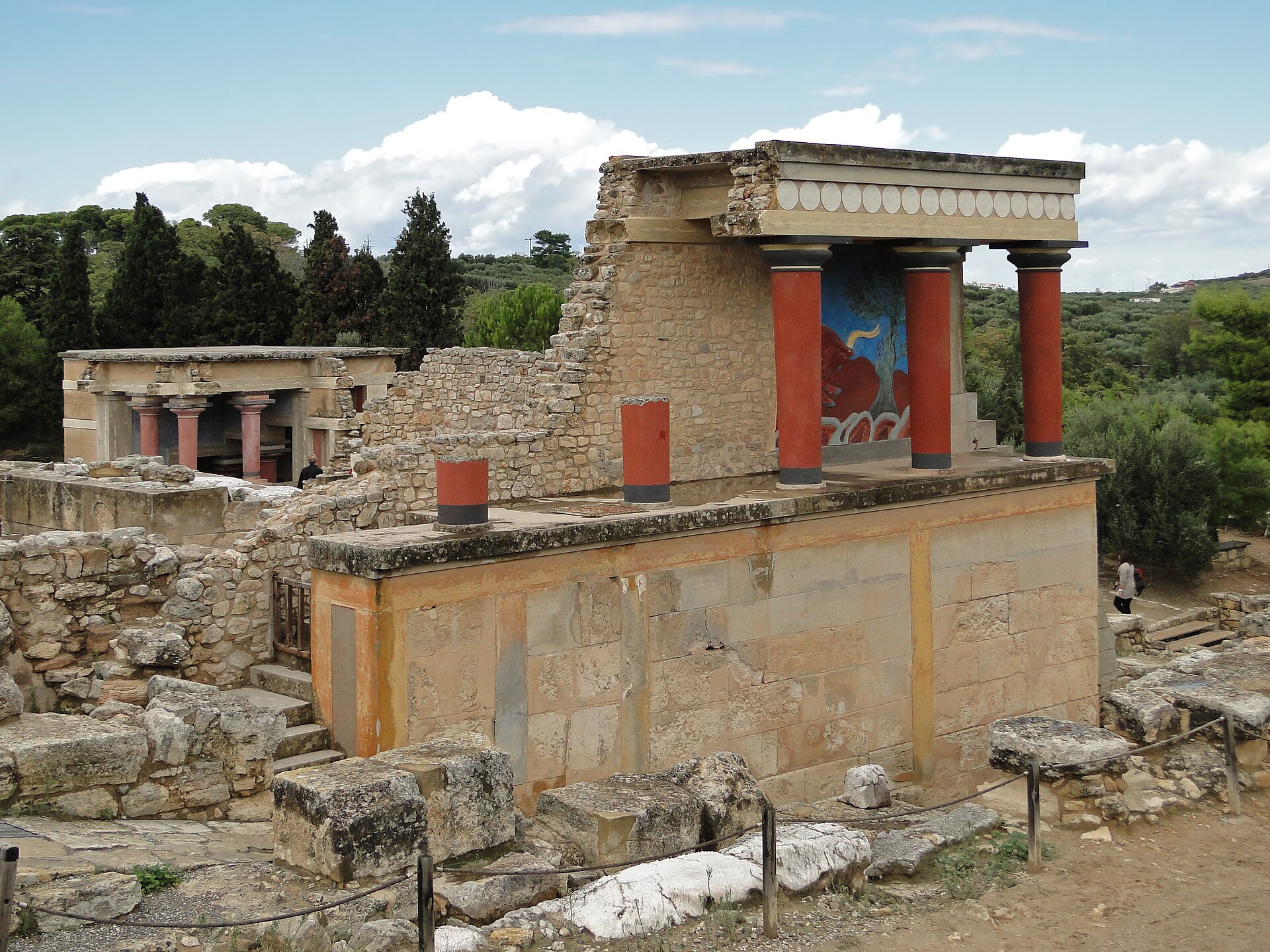
Long before Theseus supposedly faced the Minotaur in its corridors, Kephala hill in Crete was already home to people. Around 7000 BC, early Neolithic farmers settled its summit, building one of the earliest permanent communities in the Aegean. They kept animals, worked stone, made pottery and figurines, and stayed for generation after generation, leaving behind deep layers of soil packed with the residue of ordinary life.
That settlement did not vanish or get abandoned — it grew. Through the Early, Middle, Late and Final Neolithic phases, Knossos became one of the most significant places in the entire Aegean world, long before anyone had thought to build a palace there. By the Early Bronze Age, roughly 3000 to 1900 BC, the community had entered what archaeologists call the Prepalatial period: craft specialists sharpened their skills, trade networks widened, and society grew more layered and unequal.
Then, around 1900 BC, everything changed. The people of Knossos leveled the accumulated remains atop Kephala hill and raised the first palace — a structure built not simply as a residence but as an administrative and religious engine. Storerooms, sealing systems and early writing point to a sophisticated bureaucracy managing goods, labor and ritual life across the region.
That first palace did not last. Around 1700 BC, likely felled by an earthquake or a string of tremors, it collapsed. But Knossos's importance only deepened. Rather than retreat, its people rebuilt on an even grander scale, ushering in what is now called the Second Palace period, from about 1700 to 1450 BC — the true height of Minoan civilization.
The rebuilt palace was staggering in its complexity: a central court ringed by monumental entrances, grand staircases, storage magazines, reception halls, ritual chambers, light wells and drainage systems, all decorated with vivid wall paintings. The town around it swelled too, making Knossos the largest known center of Minoan life, a hub connected to networks stretching far beyond Crete's shores.
More from Archaeology

The Bronze Disc That Rewrote the Sky
Two looters with a metal detector dug up something illegal, invisible in value, and older than Stonehenge's final stones — a map of the heavens buried for over three thousand years.

The Faceless Women of the Ice Age
Long before writing, before cities, before the wheel, someone carved a woman's body into stone and ivory — and left no name, no face, no explanation.

The Pebble That Might Be Human
A palm-sized stone found on a Moroccan riverbank may be humanity's oldest attempt to see itself — or simply a trick of erosion.

The Crown That Vanished: Deshret and the Red Land
A crown worn by kings for three thousand years has never once been found in a tomb — not one. So where did it go?

The Face That Traveled Between Empires
A farm worker's shovel struck stone in 1897 and unearthed a face so striking it would be sold to France, seized as war booty, and finally traded back for a Velázquez.

The Boy in the Dark Tunnel
A schoolboy fell into black water inside an ancient tunnel and surfaced with his fingers brushing letters no one had noticed for 2,600 years.