The Bronze Disc That Rewrote the Sky
Two looters with a metal detector dug up something illegal, invisible in value, and older than Stonehenge's final stones — a map of the heavens buried for over three thousand years.

In 1999, on a wooded hilltop called Mittelberg near Nebra, Germany, Henry Westphal and Mario Renner were hunting for treasure with an unlicensed metal detector. What they pulled from the earth was a bronze disc about 30 centimeters across, coated in blue-green patina, its surface inlaid with gold: a large circle, a crescent, and scattered points of gold that looked unmistakably like stars, including a tight cluster of seven. Buried alongside it were two bronze swords, axe heads, a chisel, and fragments of spiral armbands.
Knowing full well their find belonged to the state of Saxony-Anhalt, the two men said nothing to authorities. The next day they sold the entire hoard to a dealer in Cologne for 31,000 Deutsche Marks. Over the following two years the hoard passed through several hands in Germany's black market, its price climbing toward a million marks, until word of its existence leaked into public knowledge by 2001.
In February 2002, state archaeologist Harald Meller finally caught up with it — not in a museum vault but in a police sting in Basel, Switzerland, where a couple was trying to sell it for 700,000 marks. Meller acquired the disc, and through a plea bargain, the original finders led investigators back to the Mittelberg hilltop. There, archaeologists opened a formal excavation and found traces of bronze in the soil matching residue still clinging to the artifacts — confirmation that the looters' story was true. Westphal and Renner were eventually sentenced by a Naumburg court in September 2003 to four and ten months respectively, sentences later increased on appeal to six and twelve months.
The site itself proved as remarkable as the object. Mittelberg is a 252-meter hill inside a prehistoric enclosure in the Ziegelroda Forest, about 60 kilometers west of Leipzig, an area dotted with roughly a thousand ancient burial mounds. From that hilltop, at the summer solstice, the sun appears to set directly behind the Brocken, the highest peak of the Harz mountains some 80 kilometers to the northwest — a landscape seemingly chosen for its alignment with the sky.
Dating placed the disc firmly in the Early Bronze Age. The swords and axes buried with it matched styles from around 1700–1500 BCE, and birch bark remnants in the sword hilts, radiocarbon dated to between 1600 and 1560 BCE, pinned down when the hoard was interred — though the disc itself had likely existed for generations before burial. Trace-element analysis of the gold and copper traced their origins astonishingly far: an initial analysis pointed to copper from Bischofshofen in Austria and gold from the Carpathian Mountains, but a more recent analysis found that the gold used in the disc's earliest phase actually came from the River Carnon in Cornwall, England — the same source as the tin in the bronze.
More from Archaeology

The Faceless Women of the Ice Age
Long before writing, before cities, before the wheel, someone carved a woman's body into stone and ivory — and left no name, no face, no explanation.

The Pebble That Might Be Human
A palm-sized stone found on a Moroccan riverbank may be humanity's oldest attempt to see itself — or simply a trick of erosion.

The Crown That Vanished: Deshret and the Red Land
A crown worn by kings for three thousand years has never once been found in a tomb — not one. So where did it go?

The Face That Traveled Between Empires
A farm worker's shovel struck stone in 1897 and unearthed a face so striking it would be sold to France, seized as war booty, and finally traded back for a Velázquez.

The Boy in the Dark Tunnel
A schoolboy fell into black water inside an ancient tunnel and surfaced with his fingers brushing letters no one had noticed for 2,600 years.
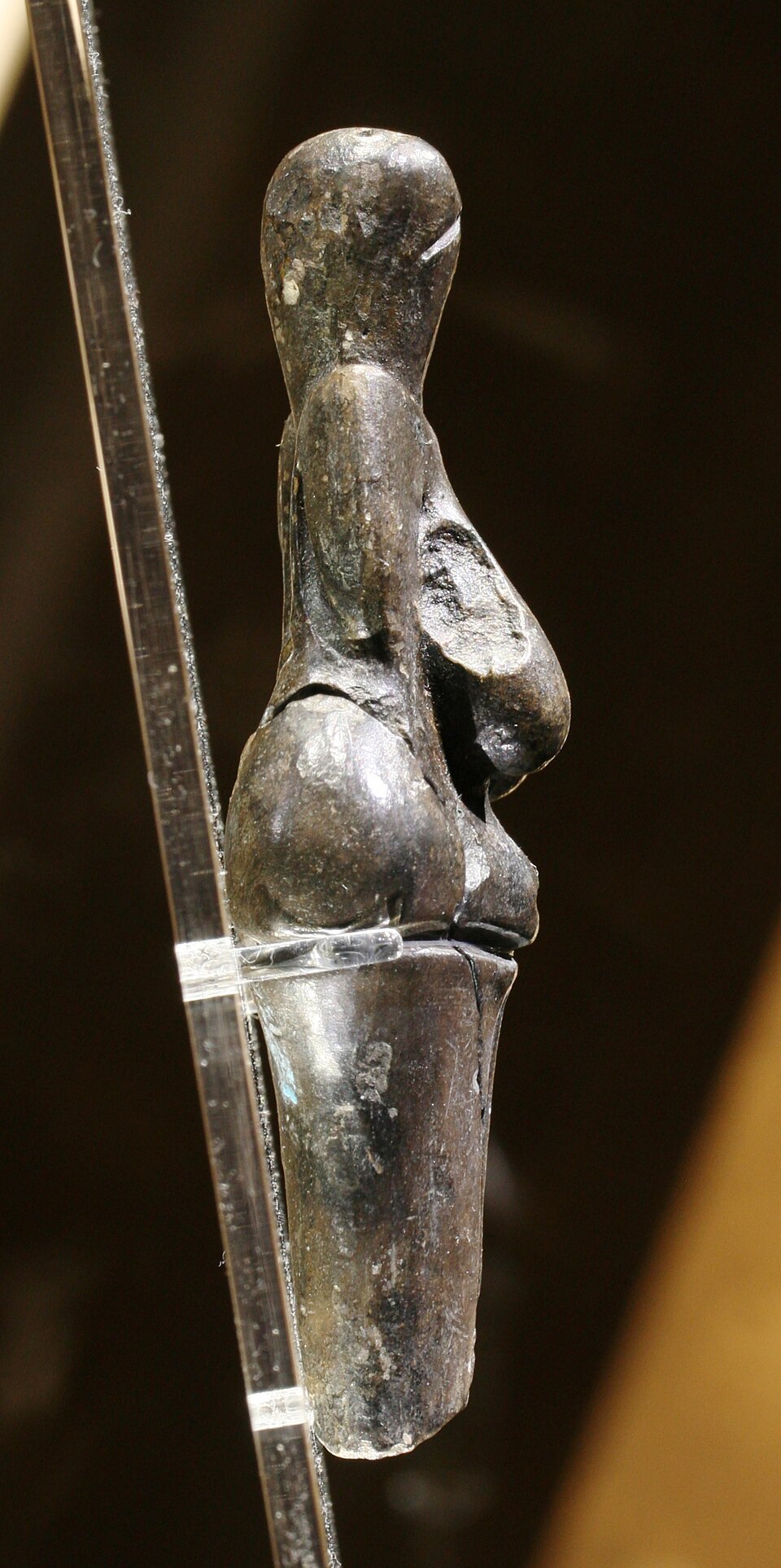
The Woman Made of Fire and Earth
Buried in ash for tens of thousands of years, a fist-sized clay woman would turn out to be older than pottery itself was thought to exist — and she still bears the fingerprint of a child.