The Woman Made of Fire and Earth
Buried in ash for tens of thousands of years, a fist-sized clay woman would turn out to be older than pottery itself was thought to exist — and she still bears the fingerprint of a child.
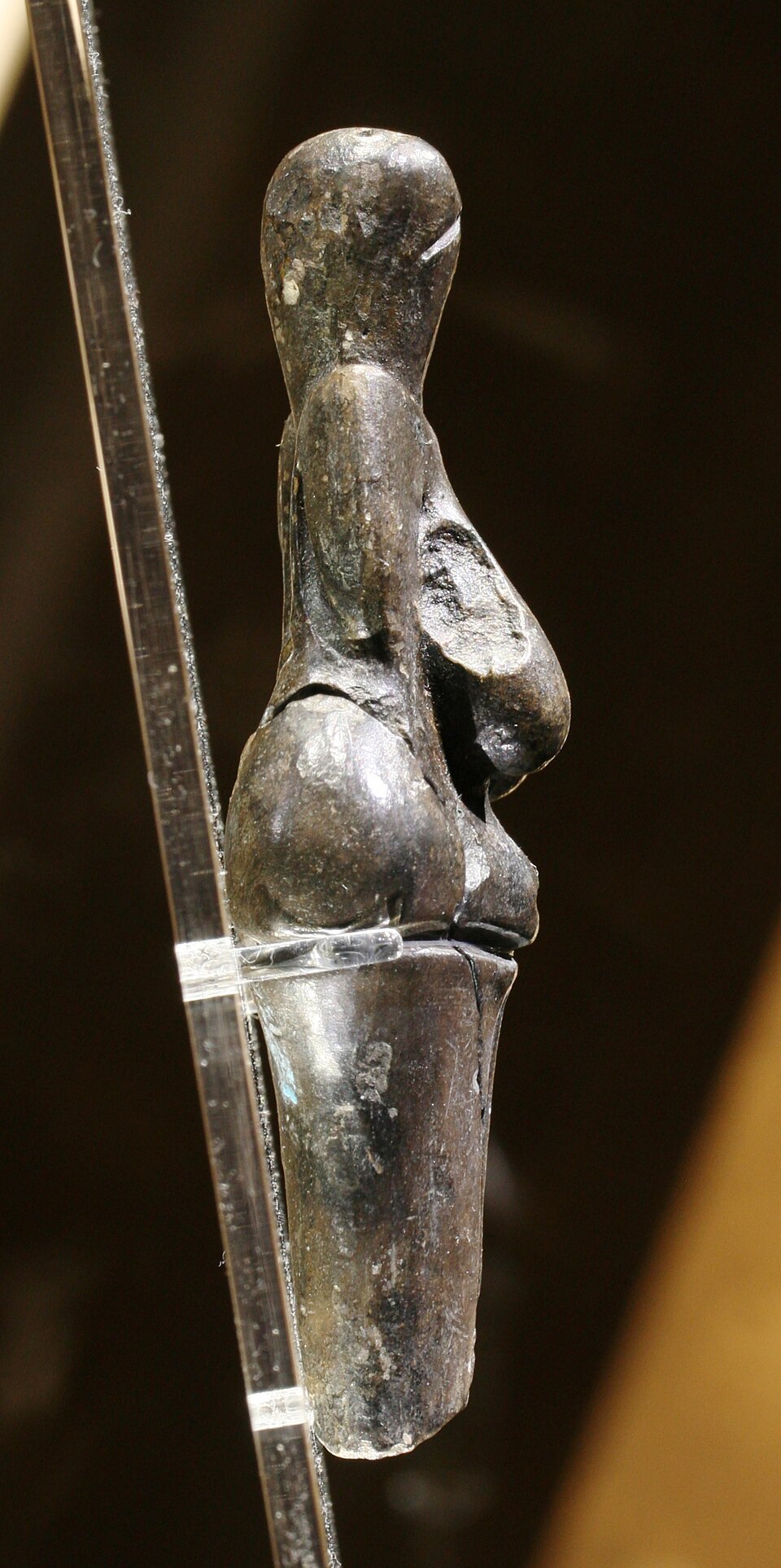
On 13 July 1925, in the shadow of Děvín mountain south of Brno, archaeologists working under Karel Absolon lifted a broken figurine from a central hearth in the ashy soil of Dolní Věstonice. It had snapped into two pieces, but there was no mistaking what it was: a nude female form, barely 111 millimetres tall and 43 millimetres wide, with heavy breasts, a swollen belly, and wide hips. Dated to between 31,000 and 27,000 years ago, in the Gravettian period, it is now understood to be among the oldest ceramic objects made by human hands anywhere in the world.
The figure follows a pattern seen across Europe in what are called Venus figurines — exaggerated hips and torsos, minimal attention to the face or limbs, forms scholars have long linked to fertility. Here the face bears carved slanting eyes, cut with a sharp flint tool. Four tiny holes once pierced the crown of the head, evidence that the statuette was originally adorned with feathers, though what kind is unknown. The holes were carved into the clay before it was fired, using a tool as fine as a quill.
How she was made reveals a careful, layered process. The sculptor started with local loess, a fine wind-deposited silt common to the Moravian landscape, mixing it with water and a temper of powdered animal bone that had first been charred and then ground. The body was built from two main sections joined to form torso and head, while the breasts and tapering legs were shaped separately and attached afterward — an additive technique requiring real planning rather than a single lump pressed into shape.
The firing itself may have carried more than a practical purpose. Temperatures of 500 to 800 degrees Celsius transformed the loess-bone paste into something hard and water-resistant, but the site around Dolní Věstonice held more than one statuette — figures of bears, lions, mammoths, horses, foxes, rhinos, and owls, along with over two thousand fired clay balls. Many of these fragments appear to have shattered deliberately, thermal-shocked in the fire, suggesting that firing clay may have been performed as ritual or spectacle for a watching community rather than simple craft.
That sense of communal presence became literal in 2004, when a tomographic scan of the figurine revealed something unexpected fired permanently into its surface: the fingerprint of a child, estimated between seven and fifteen years old. Researchers Králík, Novotný, and Martin Oliva concluded the child was an unlikely candidate for having made the piece, but their touch — perhaps handling wet clay before it went into the fire — was preserved for tens of thousands of years, a small human trace beside the object's grander purpose.
More from Archaeology

The Bronze Disc That Rewrote the Sky
Two looters with a metal detector dug up something illegal, invisible in value, and older than Stonehenge's final stones — a map of the heavens buried for over three thousand years.

The Faceless Women of the Ice Age
Long before writing, before cities, before the wheel, someone carved a woman's body into stone and ivory — and left no name, no face, no explanation.

The Pebble That Might Be Human
A palm-sized stone found on a Moroccan riverbank may be humanity's oldest attempt to see itself — or simply a trick of erosion.

The Crown That Vanished: Deshret and the Red Land
A crown worn by kings for three thousand years has never once been found in a tomb — not one. So where did it go?

The Face That Traveled Between Empires
A farm worker's shovel struck stone in 1897 and unearthed a face so striking it would be sold to France, seized as war booty, and finally traded back for a Velázquez.

The Boy in the Dark Tunnel
A schoolboy fell into black water inside an ancient tunnel and surfaced with his fingers brushing letters no one had noticed for 2,600 years.