The Faceless Women of the Ice Age
Long before writing, before cities, before the wheel, someone carved a woman's body into stone and ivory — and left no name, no face, no explanation.

In 1864, in a rock shelter above the Vézère river in southwestern France, Paul Hurault, the Marquis de Vibraye, uncovered a small ivory figure at Laugerie-Basse. It had no head, no feet, no arms — only a torso with a strongly emphasised vulva. He named it La Vénus impudique, the 'immodest Venus', deliberately contrasting it with the demure, hand-covering Aphrodite of Knidos from Greco-Roman antiquity. The name stuck, and every similar figure found afterward — across thousands of years and thousands of miles — inherited the same borrowed title.
Four years later, Salomon Reinach described a cluster of soapstone figurines unearthed in the caves of Balzi Rossi. Then in 1908, in a loess deposit in Austria's Danube valley, diggers found the limestone figure that would become the most famous of them all: the Venus of Willendorf, dated to roughly 24,000 to 26,000 years ago. From the Pyrenees to the plains of Siberia, hundreds more turned up over the following century, scattered across nearly the whole of Eurasia.
Most belong to the Gravettian period, between about 26,000 and 21,000 years ago, but the timeline stretches far wider than that single window. The Venus of Hohle Fels, carved from mammoth ivory and discovered by University of Tübingen archaeologists in September 2008, dates back at least 35,000 years — making it the earliest known sculpture of its kind and the oldest known work of figurative art. At the other end, the Venus of Monruz is about 11,000 years old, and the Çatalhöyük figurine, from the Neolithic, is roughly 8,000 years old. Materials varied: soft stone such as steatite, calcite or limestone; bone; ivory; and fired clay, which counts among the oldest ceramics ever made by human hands. In total, more than 200 such figurines are known, almost all modest in size — somewhere between 3 and 40 centimetres tall.
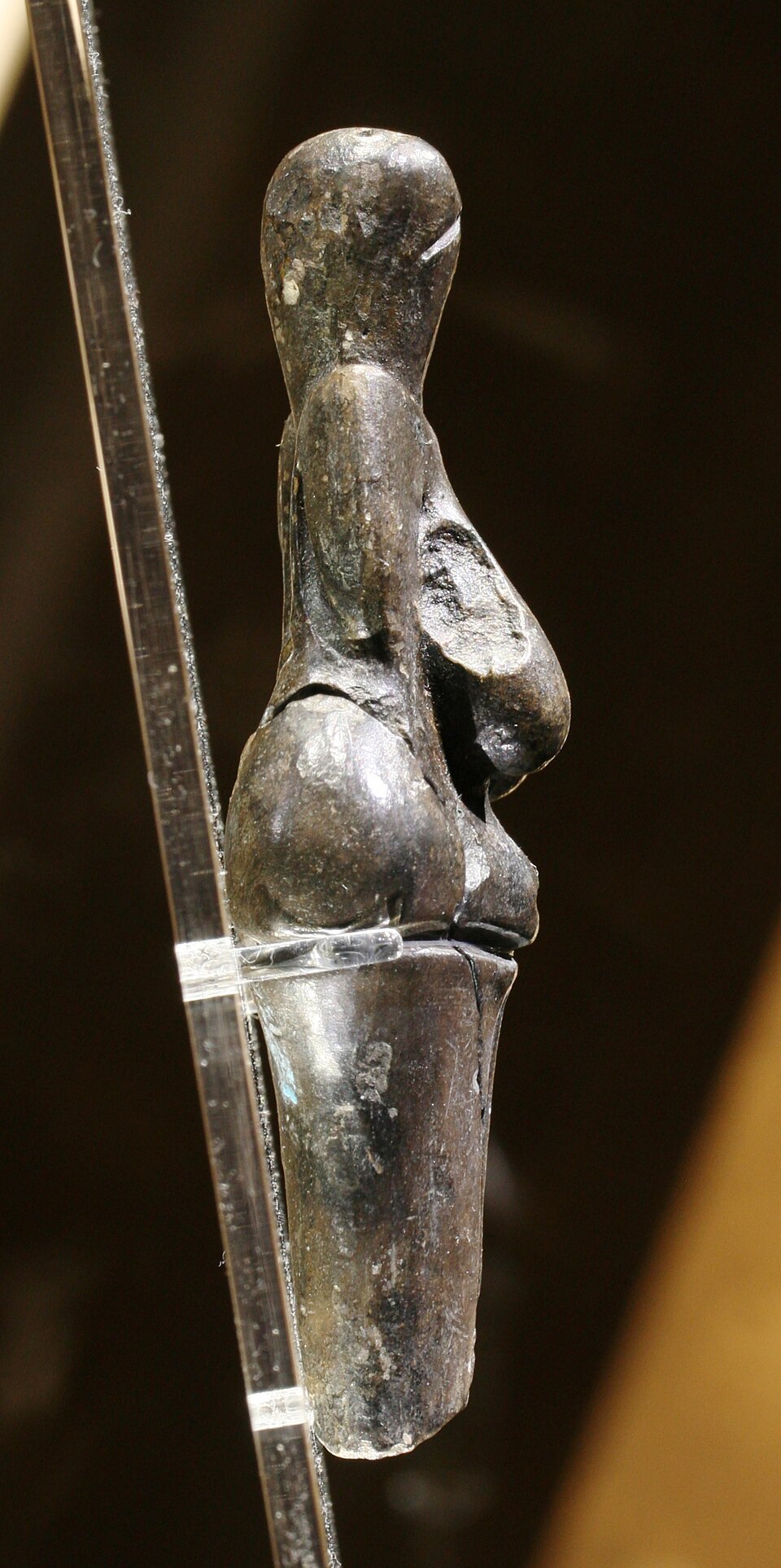
Their shapes follow a striking pattern. Hips are wide, legs taper to a point, arms and feet are frequently missing altogether, and heads are small and blank, without carved faces. Some figures exaggerate the abdomen, breasts, thighs or vulva; others, found without any of these emphasised traits, resist the pattern entirely. Hairstyles, by contrast, are sometimes rendered in careful detail, and traces of clothing or tattoos occasionally appear on the carved surface.
Among the named figures that scholars keep returning to are the Lespugue Venus, an ivory piece some 27,000 years old; the Dolní Věstonice Venus, made of fired ceramic and dated between 27,000 and 31,000 years; the Moravany Venus, ivory, about 24,800 years old; the Brassempouy Venus, ivory, roughly 22,000 years old; and the Laussel Venus, a limestone relief around 20,000 years old.
More from Archaeology

The Bronze Disc That Rewrote the Sky
Two looters with a metal detector dug up something illegal, invisible in value, and older than Stonehenge's final stones — a map of the heavens buried for over three thousand years.

The Pebble That Might Be Human
A palm-sized stone found on a Moroccan riverbank may be humanity's oldest attempt to see itself — or simply a trick of erosion.

The Crown That Vanished: Deshret and the Red Land
A crown worn by kings for three thousand years has never once been found in a tomb — not one. So where did it go?

The Face That Traveled Between Empires
A farm worker's shovel struck stone in 1897 and unearthed a face so striking it would be sold to France, seized as war booty, and finally traded back for a Velázquez.

The Boy in the Dark Tunnel
A schoolboy fell into black water inside an ancient tunnel and surfaced with his fingers brushing letters no one had noticed for 2,600 years.
The Woman Made of Fire and Earth
Buried in ash for tens of thousands of years, a fist-sized clay woman would turn out to be older than pottery itself was thought to exist — and she still bears the fingerprint of a child.