Liberty Leading the People: Delacroix's Revolution
A bare-breasted woman strides over the bodies of the dead, flag in hand — and France finds a new face for its rebellions.
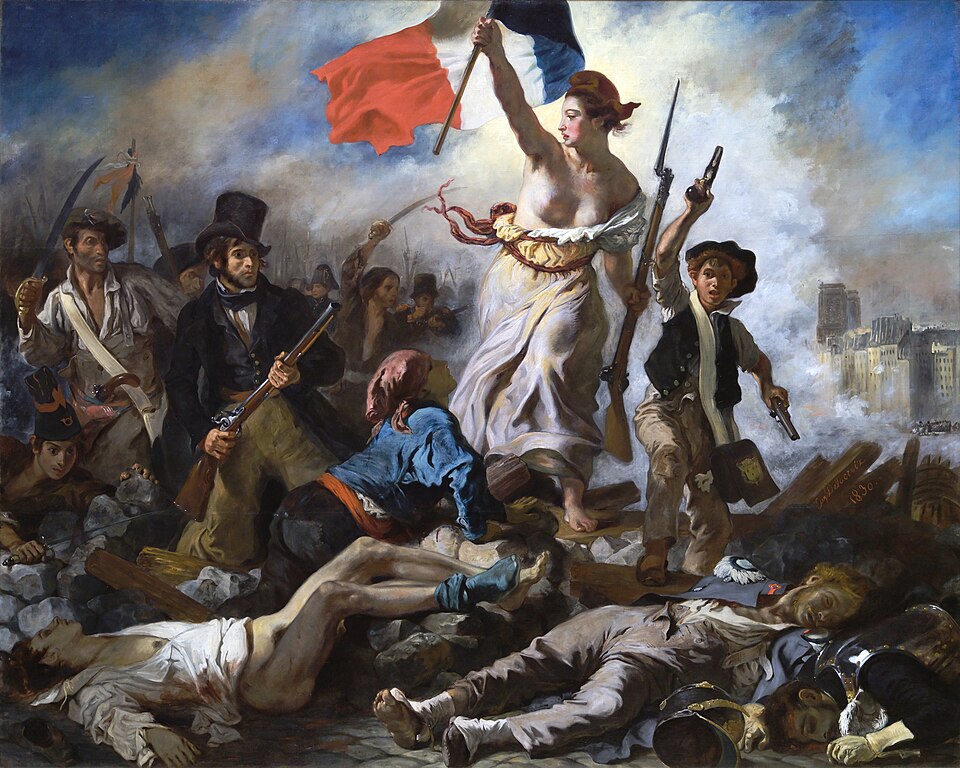
In the autumn of 1830, Eugène Delacroix sat down to write his brother a letter about his mood. 'My bad mood is vanishing thanks to hard work,' he confessed. 'I've embarked on a modern subject—a barricade. And if I haven't fought for my country at least I'll paint for her.' Paris had just lived through three days of upheaval that summer, the July Revolution, which toppled King Charles X. Delacroix, already recognized as the driving force of French Romanticism, would answer that upheaval with paint instead of a musket.
What emerged was Liberty Leading the People, first shown at the Paris Salon of 1831. At its center strides a woman personifying Liberty — barefoot, bare-breasted, a Phrygian cap on her head, a symbol dating back to the Revolution of 1789. In one hand she raises the French tricolour, restored as the national flag after these events; in the other she brandishes a bayonetted musket. Around her, fighters climb over a mound of corpses and rubble as if it were a pedestal, and in the far distance a tiny tricolour can just be made out flying from the towers of Notre-Dame.
Delacroix populated his barricade with a cross-section of French society. A young man in a top hat, dressed like the bourgeoisie, stands near a student of the École Polytechnique in his traditional bicorne. Beside them a boy brandishes a pistol in each hand, embodying the revolutionary urban worker. Their social stations differ, but Delacroix gave them all the same fierce determination in their eyes. Several of these figures likely drew inspiration from prints by Nicolas Charlet, an illustrator Delacroix believed captured the peculiar energy of Parisians better than anyone. That same pistol-wielding boy is thought to have gone on to inspire Victor Hugo's character Gavroche in Les Misérables.
The identity of the top-hatted man has never been settled. Some 19th-century commentators guessed he was the theatre director Étienne Arago; others proposed Frédéric Villot, a future Louvre curator. Modern art historians reject the once-popular idea that it was a Delacroix self-portrait, but no consensus has replaced it.
The French government bought the painting in 1831 for 3,000 francs, intending to hang it in the throne room of the Palais du Luxembourg as a pointed reminder to the newly crowned 'citizen-king' Louis-Philippe of the revolution that had put him there. The plan never fully materialized. After a few months in the palace's museum gallery, the canvas was quietly removed — its political message was judged too inflammatory for comfort. Following the June Rebellion of 1832, it was returned to Delacroix himself, who was permitted to send it to his aunt Félicité for safekeeping. Writing in 1848, the critic Champfleury noted it had been 'hidden in an attic for being too revolutionary.'
More from Art

The Painting With No Foreground
A single robed figure stares out at an empty grey sea — and the emptiness itself became a scandal. When it was unveiled in Berlin in 1810, no one knew quite what to do with it.

The Painter Who Chased the Light
For a few purple minutes each evening, an American exile knelt in an English garden and raced the dying sun to paint two little girls lighting lanterns. It took him two years to finish.

When a President Became a God
Look straight up inside the U.S. Capitol dome and you will find George Washington enthroned among the clouds, surrounded by goddesses — the founding father transformed into myth.

Marble Brought Back to Life
A corpse asleep, a wing barely brushing her skin — and marble somehow learns to breathe. This is the moment Antonio Canova dared to carve.

The World Turned Upside Down
Look closely at a sixteenth-century Flemish village and you'll find a man biting a pillar, another carrying daylight in a basket, and a wife slipping a blue cloak over her husband's shoulders. Every gesture is a joke — if you know the language.

The Girl in the Glass Case
She stood two-thirds life size, dressed in a real tutu and human hair — and the critics who saw her in 1881 recoiled as if she were something obscene.