Luncheon on the Grass: The Picnic That Scandalized Paris
A naked woman stares straight at you while two fully dressed men chat beside her — and in 1863 Paris, that stare was enough to nearly start a riot.
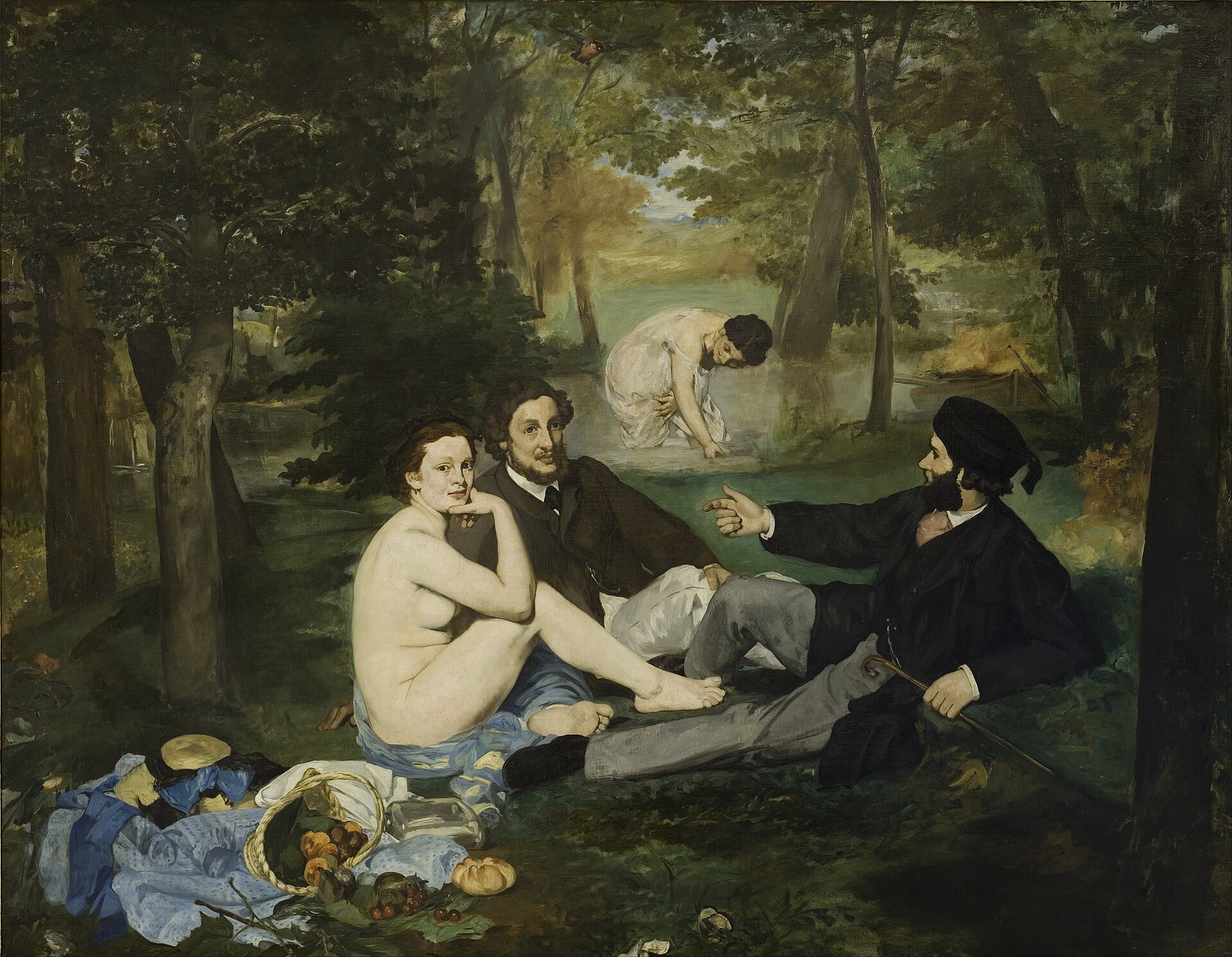
In the spring of 1863, an oil painting measuring more than eight feet wide arrived before the jury of the Paris Salon, the only public art exhibition the city had. That year the Salon received roughly 5,000 submissions, and the jury rejected about 3,000 of them — this painting among the rejected. The rejected artists protested loudly enough that Emperor Napoleon III intervened, ordering the creation of a Salon des Refuses, a Salon of the Rejected, where the public could judge for itself. There, hung between two other works by the same painter, Edouard Manet, the canvas Le Dejeuner sur l'herbe caused an uproar.
The scene itself was simple, even mundane: a nude woman sits on the grass beside two young, fashionably dressed men, her clothes tossed aside along with a basket of fruit and a round loaf of bread, arranged almost like a still life. Behind them, out of proportion with the foreground figures, a lightly clad woman bathes in a stream. What scandalized viewers was not the presence of a nude — nudity was common enough in art drawn from myth or history — but the fact that this nude was clearly a contemporary Parisian woman, staring directly and unapologetically at the viewer, in the company of men dressed for the modern street rather than for antiquity.
Manet had originally called the painting Le Bain, The Bath, and reportedly joked at one point that he might title it La partie carree. Under either name, it was in many ways a deliberately defiant work. He painted the piece at the enormous scale traditionally reserved for grand historical, religious, or mythological subjects — 208 by 264.5 centimeters — yet filled that space with an ordinary picnic. He left brush strokes visible, letting parts of the canvas look almost unfinished, and rendered his nude with a starkness that stood in sharp contrast to the flawless, polished bodies painted by academic favorites like Cabanel.
The people in the picture were not anonymous models drawn from imagination. The nude woman is thought to be Victorine Meurent, who became Manet's favorite model and later sat for his equally controversial Olympia. The man on the right combines features of Manet's own two brothers, Eugene and Gustave, while the other man was based on his brother-in-law, the Dutch sculptor Ferdinand Leenhoff. One scholar has gone so far as to call the scene Manet's family portrait — a domestic joke dressed up as an affront to public morality.
Despite its raw modern subject, the composition was rooted in art history. Manet drew the arrangement of his three foreground figures from Marcantonio Raimondi's engraving of The Judgment of Paris, itself based on a drawing by Raphael — an artist revered by the same conservative academy that rejected Manet's painting. Later scholarship traced that pose even further back, to figures on two Roman sarcophagi from the second century AD. Manet, the supposed radical, was in fact reworking a lineage of classical composition stretching back nearly two thousand years.
More from Art

The Painting With No Foreground
A single robed figure stares out at an empty grey sea — and the emptiness itself became a scandal. When it was unveiled in Berlin in 1810, no one knew quite what to do with it.

The Painter Who Chased the Light
For a few purple minutes each evening, an American exile knelt in an English garden and raced the dying sun to paint two little girls lighting lanterns. It took him two years to finish.

When a President Became a God
Look straight up inside the U.S. Capitol dome and you will find George Washington enthroned among the clouds, surrounded by goddesses — the founding father transformed into myth.

Marble Brought Back to Life
A corpse asleep, a wing barely brushing her skin — and marble somehow learns to breathe. This is the moment Antonio Canova dared to carve.

The World Turned Upside Down
Look closely at a sixteenth-century Flemish village and you'll find a man biting a pillar, another carrying daylight in a basket, and a wife slipping a blue cloak over her husband's shoulders. Every gesture is a joke — if you know the language.

The Girl in the Glass Case
She stood two-thirds life size, dressed in a real tutu and human hair — and the critics who saw her in 1881 recoiled as if she were something obscene.