Manet's Firing Squad: Painting an Emperor's Death
A borrowed throne, a betrayed emperor, and a French painter who turned a distant execution into an indictment of his own ruler. Édouard Manet never witnessed the shooting he painted five times over — yet the canvas he made would haunt an empire.
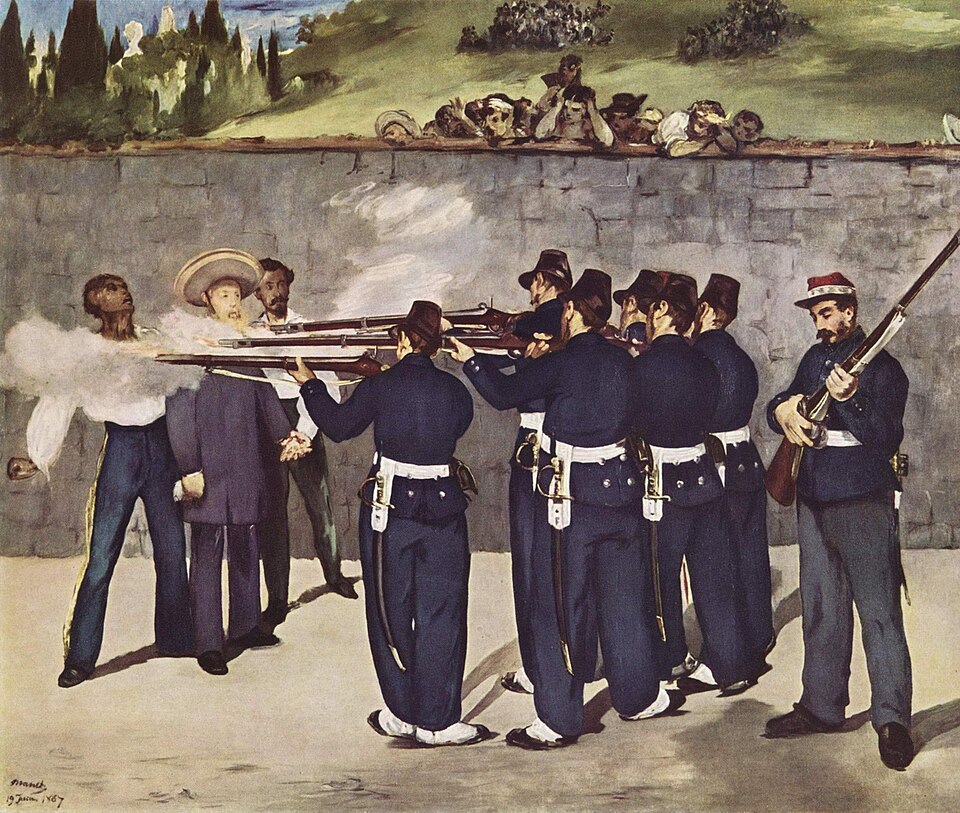
On 19 June 1867, on a hillside called Cerro de las Campanas outside Querétaro, a firing squad raised their rifles against Emperor Maximilian I of Mexico and two of his generals, Miguel Miramón and Tomás Mejía. Maximilian, born in 1832 as the second son of Archduke Franz Karl of Austria and Princess Sophie of Bavaria, had come to Mexico in May 1864 at the urging of Napoleon III, installed as emperor during the French intervention. His reign was contested from the start by forces loyal to the deposed president Benito Juárez, and when Napoleon withdrew French troops in 1866, the empire he had built collapsed around him. Captured in May 1867, Maximilian was tried by court martial and shot a month later.
In Paris, the news reached Édouard Manet, a painter sympathetic to the Republican cause associated with Léon Gambetta. He had never seen Querétaro, never watched the volley fired, but the execution struck him as an event that demanded to be painted — and painted as an accusation. Between 1867 and 1869 he returned to the subject obsessively, producing three large oil paintings, a smaller oil sketch, and a lithograph, all circling the same terrible instant.
His clearest model was Francisco Goya's The Third of May 1808, a painting of French soldiers executing Spanish civilians. Manet borrowed its structure: the tight, unnatural closeness between the riflemen and their victims, the flatness of violence rendered almost like theatre. But where Goya's soldiers were anonymous instruments of empire, Manet's version pointed a finger directly at Napoleon III.
The final large painting, completed in 1868–1869 and now in the Kunsthalle Mannheim, is signed with the date of the execution itself, 1867, rather than the year it was finished. In it, the firing squad wears uniforms nearly identical to French military dress, and the soldier preparing the coup de grâce bears features conspicuously resembling Napoleon III. The message was unmistakable: French blood, French guilt. Unsurprisingly, the painting was banned from public display in Paris during Napoleon III's reign.
An earlier, larger canvas from around 1867–1868, now fragmented and held by the National Gallery in London, met a stranger fate. Manet likely cut sections from it himself, and after his death, pieces were sold separately. It was Edgar Degas who gathered the surviving fragments back together; the National Gallery bought them in 1918, only for them to be separated again until they were finally rejoined onto a single canvas in 1992. A third, unfinished version — in which the soldiers wear the clothing and sombreros of Mexican Republicans rather than French uniforms — ended up in the Museum of Fine Arts, Boston, having been bought by Ambroise Vollard in 1909 before being donated by Mr. and Mrs. Frank Gair Macomber in 1930. A smaller study for the Mannheim picture rests in Copenhagen's Ny Carlsberg Glyptotek.
More from Art

The Painting With No Foreground
A single robed figure stares out at an empty grey sea — and the emptiness itself became a scandal. When it was unveiled in Berlin in 1810, no one knew quite what to do with it.

The Painter Who Chased the Light
For a few purple minutes each evening, an American exile knelt in an English garden and raced the dying sun to paint two little girls lighting lanterns. It took him two years to finish.

When a President Became a God
Look straight up inside the U.S. Capitol dome and you will find George Washington enthroned among the clouds, surrounded by goddesses — the founding father transformed into myth.

Marble Brought Back to Life
A corpse asleep, a wing barely brushing her skin — and marble somehow learns to breathe. This is the moment Antonio Canova dared to carve.

The World Turned Upside Down
Look closely at a sixteenth-century Flemish village and you'll find a man biting a pillar, another carrying daylight in a basket, and a wife slipping a blue cloak over her husband's shoulders. Every gesture is a joke — if you know the language.

The Girl in the Glass Case
She stood two-thirds life size, dressed in a real tutu and human hair — and the critics who saw her in 1881 recoiled as if she were something obscene.