Manet's Silent Room
A man slumps on a bed, gun still in hand—and the painter tells us nothing else. Why did Édouard Manet strip a suicide of every story we expect it to carry?
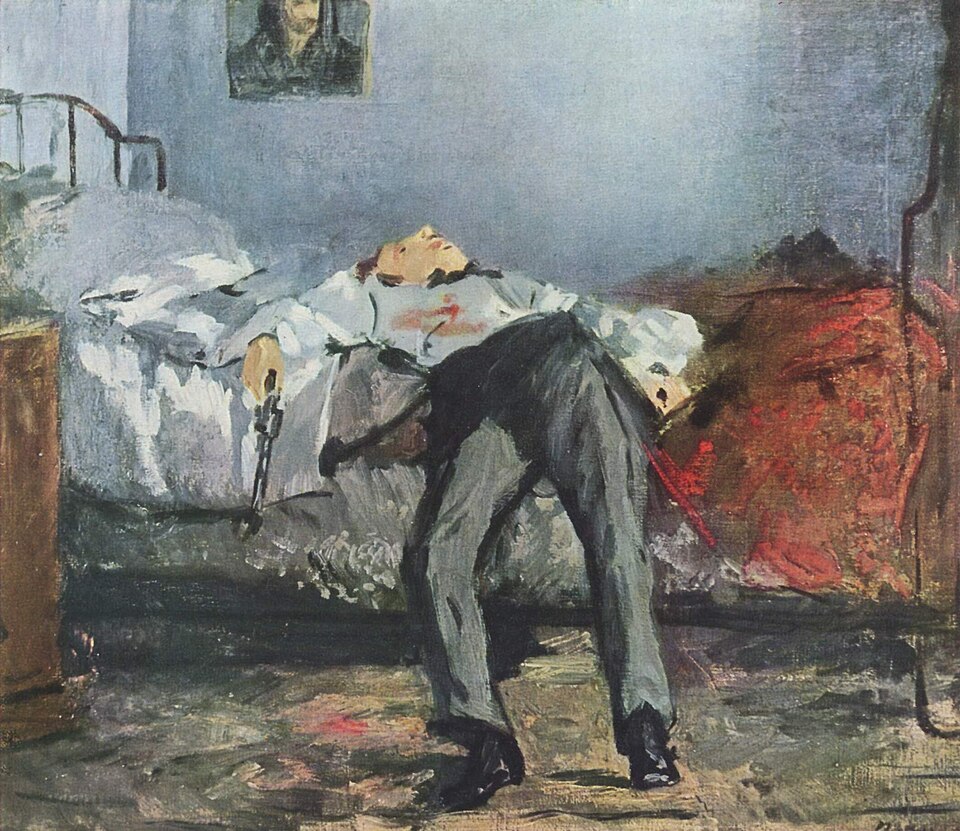
Sometime between 1877 and 1881, Édouard Manet painted a small, unsettling canvas that has never quite found its place in his body of work. Art historians, looking back across his career of café scenes, boating parties, and society portraits, have struggled to slot Le Suicidé into any clear line of development. It is an outlier, a private and difficult picture that seems to resist explanation even as it demands attention.
The scene itself is stark. A man has apparently just shot himself. He lies slouched across a bed, the gun still gripped in his hand. Around him: a few pieces of furniture, sparse and unremarkable. That is the entirety of the pictorial content. There is no grieving family, no dramatic lighting, no symbolic gesture toward eternity or judgment. Manet has removed every trapping that earlier artists relied on when depicting death by one's own hand.
This absence is the point. Scholar Ulrike Ilg, an associate professor at the University of Giessen, has linked the painting's severity to the realism of Gustave Courbet, whose Burial at Ornans (1849–50) similarly used a depiction of death stripped of sentimentality. Courbet later described that earlier work as the beginning of a new artistic direction for him—one rooted in unflinching observation rather than moral instruction. Manet, in Le Suicidé, seems to be working in that same spirit: presenting death without commentary, without a lesson attached.
The painting's raw plausibility has inevitably invited speculation that it records a real event. Because the scene feels so unstaged, so devoid of theatrical arrangement, viewers and historians alike have wondered whether Manet witnessed or knew of an actual suicide. Two candidates have been proposed. One is Alexandre, a young assistant of Manet's who took his own life in the artist's studio more than a decade before the painting was made—though Alexandre died by hanging, not by gunshot, complicating any direct connection. The other is Jules Holtzapffel, an artist whose suicide had been written about by Émile Zola in 1866. Neither connection has been confirmed; the true subject, if there ever was a specific one, remains unknown.
What is clearer is what Manet was rejecting. In the academic tradition he had trained within and later rebelled against, suicide could only be painted as history painting—embedded in a narrative of sacrifice, idealism, or heroic choice. Jacques-Louis David's The Death of Socrates (1787) is the model: Socrates calmly accepting the hemlock rather than exile, his death framed as philosophical triumph. Manet offers none of that scaffolding. There is no grand statement, no heroic frame, no named protagonist, no clear time or place.
More from Art

The Painting With No Foreground
A single robed figure stares out at an empty grey sea — and the emptiness itself became a scandal. When it was unveiled in Berlin in 1810, no one knew quite what to do with it.

The Painter Who Chased the Light
For a few purple minutes each evening, an American exile knelt in an English garden and raced the dying sun to paint two little girls lighting lanterns. It took him two years to finish.

When a President Became a God
Look straight up inside the U.S. Capitol dome and you will find George Washington enthroned among the clouds, surrounded by goddesses — the founding father transformed into myth.

Marble Brought Back to Life
A corpse asleep, a wing barely brushing her skin — and marble somehow learns to breathe. This is the moment Antonio Canova dared to carve.

The World Turned Upside Down
Look closely at a sixteenth-century Flemish village and you'll find a man biting a pillar, another carrying daylight in a basket, and a wife slipping a blue cloak over her husband's shoulders. Every gesture is a joke — if you know the language.

The Girl in the Glass Case
She stood two-thirds life size, dressed in a real tutu and human hair — and the critics who saw her in 1881 recoiled as if she were something obscene.