Marble That Weeps: Bernini's Abduction of Proserpina
A twenty-three-year-old sculptor made stone feel like flesh yielding under a god's fingers — and turned a gift between rivals into an act of political theater.
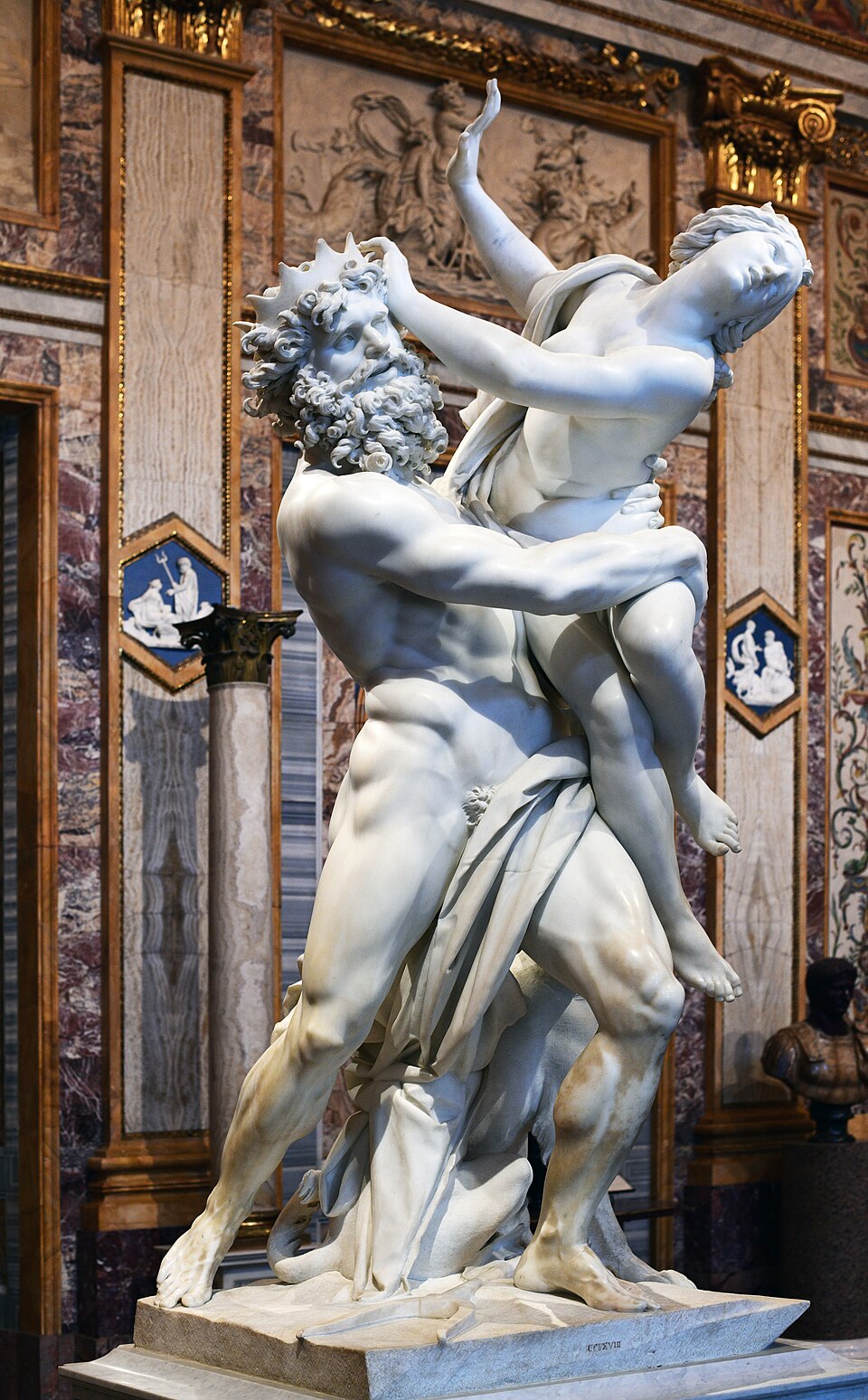
In 1621 and 1622, in a Rome still shadowed by a dead pope, a young sculptor named Gian Lorenzo Bernini carved a scene of violence and myth from a single, rare block of Carrara marble. He was only twenty-three. The result, later known as The Rape of Proserpina — more precisely, The Abduction of Proserpina — captures the instant Pluto, god of the underworld, seizes the goddess Proserpina and hauls her toward his domain, a marble Cerberus marking the threshold she is being dragged across.
The myth behind the sculpture comes from Ovid's Metamorphoses and Claudian's De Raptu Proserpinae. Proserpina, daughter of Jupiter and Ceres, goddess of agriculture, is gathering flowers when Pluto erupts from the earth in a chariot drawn by four black horses and drags her down with him — but not before her mother hears her scream. Ceres, in grief and rage, dries the earth and ruins the harvests, forcing Jupiter to broker a compromise: Proserpina will spend half the year with Pluto and half with her mother. Winter and spring, death and renewal, are born from that bargain.
Bernini chose to freeze the story at its most violent moment — Pluto's grip closing on Proserpina's thigh, her body twisting away from him, tears visible on her marble face. The figures are nearly nude, joined only by scraps of carved cloth, one draping Pluto's thigh, another Proserpina's shoulder, with the stone Cerberus fused to Pluto through that same fabric. Unlike many sculptures of the era, meant to be walked around and pieced together from multiple angles, this group reveals itself completely from a single vantage point directly in front of its base.
The commission came from Cardinal Scipione Borghese, whose uncle, Pope Paul V, had died in January 1621. It was the first in a run of major works Bernini would create for the Borghese family, followed by David and Apollo and Daphne. Finished in 1622, the sculpture was delivered to the Villa Borghese — a fitting home, since the villa's facade already bore imagery of the Proserpina myth. Bernini received at least three payments for the piece, totaling at least 450 Roman scudi.
But the sculpture did not stay there. In the summer of 1623, Scipione gave it away — to Cardinal-nephew Ludovico Ludovisi, a political rival. The reasons remain murky. It may have been an attempt to win favor after the Borghese pope's death and the rise of Alessandro Ludovisi to the papacy. It may have been payment for a political debt. The Ludovisi family had reason to resent Scipione, who had pocketed revenue from Ludovisi's own archbishopric of Bologna, and their allies, the Aldobrandini, wanted redress for grievances from the Borghese papacy. Tellingly, the very month the statue reached the Villa Ludovisi, a judge closely tied to Borghese was imprisoned — suggesting the gift may have functioned as tribute to a newly powerful family.
More from Art

The Painting With No Foreground
A single robed figure stares out at an empty grey sea — and the emptiness itself became a scandal. When it was unveiled in Berlin in 1810, no one knew quite what to do with it.

The Painter Who Chased the Light
For a few purple minutes each evening, an American exile knelt in an English garden and raced the dying sun to paint two little girls lighting lanterns. It took him two years to finish.

When a President Became a God
Look straight up inside the U.S. Capitol dome and you will find George Washington enthroned among the clouds, surrounded by goddesses — the founding father transformed into myth.

Marble Brought Back to Life
A corpse asleep, a wing barely brushing her skin — and marble somehow learns to breathe. This is the moment Antonio Canova dared to carve.

The World Turned Upside Down
Look closely at a sixteenth-century Flemish village and you'll find a man biting a pillar, another carrying daylight in a basket, and a wife slipping a blue cloak over her husband's shoulders. Every gesture is a joke — if you know the language.

The Girl in the Glass Case
She stood two-thirds life size, dressed in a real tutu and human hair — and the critics who saw her in 1881 recoiled as if she were something obscene.