Nighthawks: Edward Hopper and the Loneliness of the City
Four strangers sit under a blaze of fluorescent light on an empty street corner — and somehow, no one is talking to anyone.
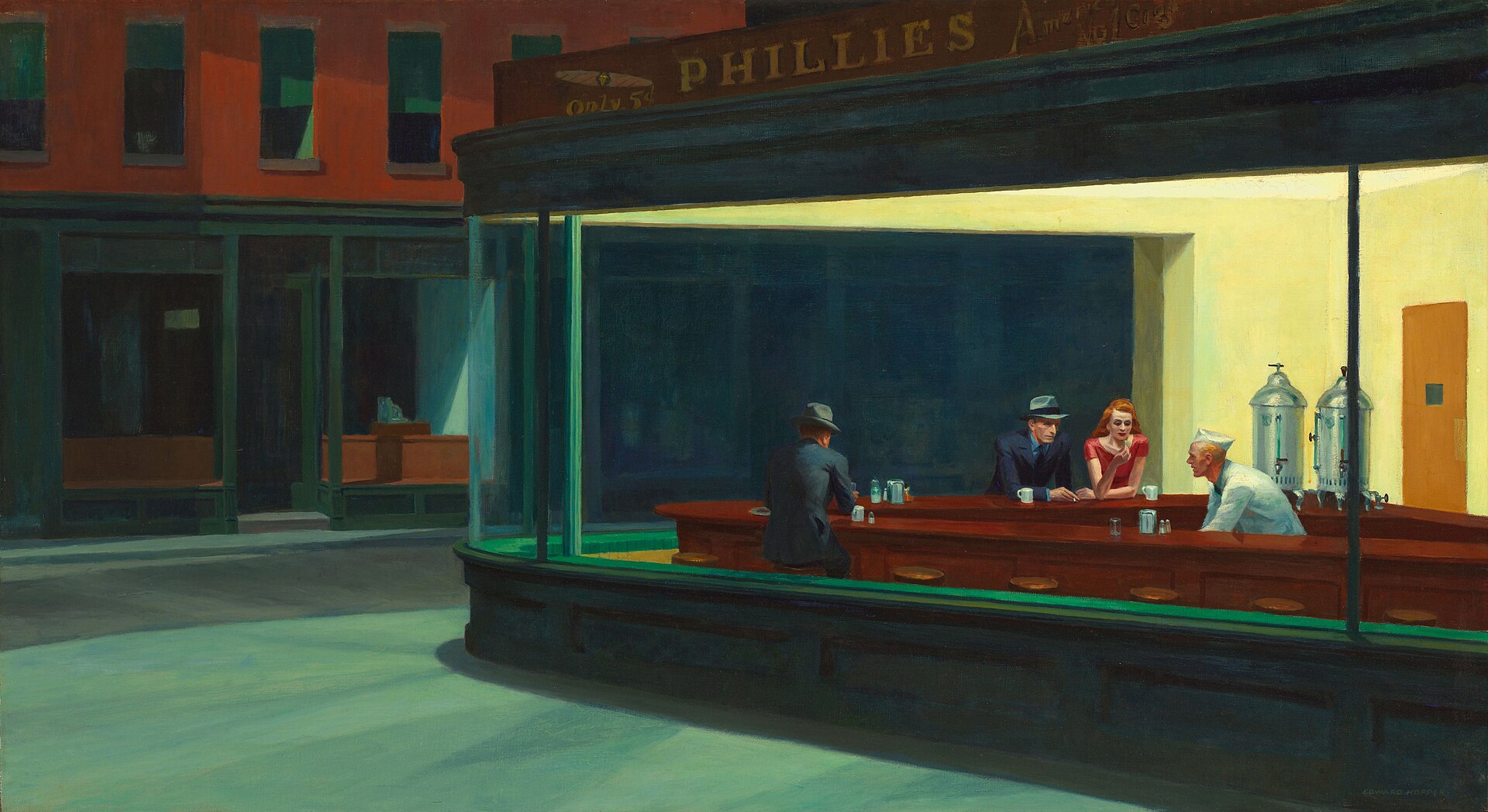
On a winter night in early 1942, Edward Hopper finished a canvas he and his wife Jo would eventually call Nighthawks — though Hopper's own handwriting on their studio journal reads 'Night Hawks,' two words. The painting shows a diner glowing at the corner of two deserted streets, its harsh interior light spilling onto empty pavement. Inside sit three customers and a counterman in white; outside, nothing moves. Hopper completed the work on January 21, 1942, in the weeks following the attack on Pearl Harbor, a moment when the country's mood had turned dark and watchful.
Jo Hopper kept the couple's habit of recording every finished painting in a shared journal — Edward would sketch it, note the technical details, and Jo would add her own description. Her notes on Nighthawks are strikingly specific: a cherry-wood counter, jade-green tiles, a blond man in white, a girl in a red blouse eating a sandwich, and a man she calls the 'night hawk' for his beak-like profile in a dark suit and steel-grey hat. A fourth figure sits with his back to the viewer, described as 'dark sinister.' Above the diner, a sign advertises Phillies five-cent cigars. Jo wrote that Edward posed for the two men using a mirror, and she posed for the girl; the picture took about six weeks to finish.
When a friend later asked Hopper whether he'd meant to paint loneliness and emptiness, he demurred: 'I didn't see it as particularly lonely.' Then he added the line that has followed the painting ever since: 'Unconsciously, probably, I was painting the loneliness of a large city.' Some have traced the diner's mood to Ernest Hemingway — either 'The Killers,' a story Hopper admired, or the more philosophical 'A Clean, Well-Lighted Place.'
Hopper said the scene was 'suggested by a restaurant on Greenwich Avenue where two streets meet,' near his own Greenwich Village studio, though he admitted he 'simplified the scene a great deal and made the restaurant bigger.' That single sentence launched decades of amateur detective work. Fans fixated on Mulry Square, where Seventh Avenue South, Greenwich Avenue, and West 11th Street collide — but a 1930s-to-1970s gas station occupied that lot, ruling it out. A writer named Jeremiah Moss later found a 1950s land-use map showing a diner that had appeared near the square sometime between the late 1930s and early 1950s, tucked beside the gas station on a slanting stretch of Perry Street. The likelier conclusion: there was probably never one single real diner identical to the painting — only a memory, simplified and enlarged.
The finished canvas went on display at Rehn's gallery, where Hopper normally sold his work. On St. Patrick's Day in 1942, Edward and Jo attended the opening of a Henri Rousseau exhibition at the Museum of Modern Art in New York, organized by Daniel Catton Rich, director of the Art Institute of Chicago. Alfred Barr, MoMA's director, was praising Hopper's earlier painting Gas that evening; Jo urged him to see Nighthawks at Rehn's. It was Rich who went instead, declared it 'fine as a Homer,' and arranged its purchase. On May 13, 1942, the Art Institute of Chicago bought Nighthawks for $3,000 — equivalent to roughly $59,000 today.
More from Art

The Painting With No Foreground
A single robed figure stares out at an empty grey sea — and the emptiness itself became a scandal. When it was unveiled in Berlin in 1810, no one knew quite what to do with it.

The Painter Who Chased the Light
For a few purple minutes each evening, an American exile knelt in an English garden and raced the dying sun to paint two little girls lighting lanterns. It took him two years to finish.

When a President Became a God
Look straight up inside the U.S. Capitol dome and you will find George Washington enthroned among the clouds, surrounded by goddesses — the founding father transformed into myth.

Marble Brought Back to Life
A corpse asleep, a wing barely brushing her skin — and marble somehow learns to breathe. This is the moment Antonio Canova dared to carve.

The World Turned Upside Down
Look closely at a sixteenth-century Flemish village and you'll find a man biting a pillar, another carrying daylight in a basket, and a wife slipping a blue cloak over her husband's shoulders. Every gesture is a joke — if you know the language.

The Girl in the Glass Case
She stood two-thirds life size, dressed in a real tutu and human hair — and the critics who saw her in 1881 recoiled as if she were something obscene.