Nocturne in Black and Gold – The Falling Rocket
A smear of gold in a foggy sky cost one man his fortune and won another only a farthing — and changed what a painting was allowed to be.
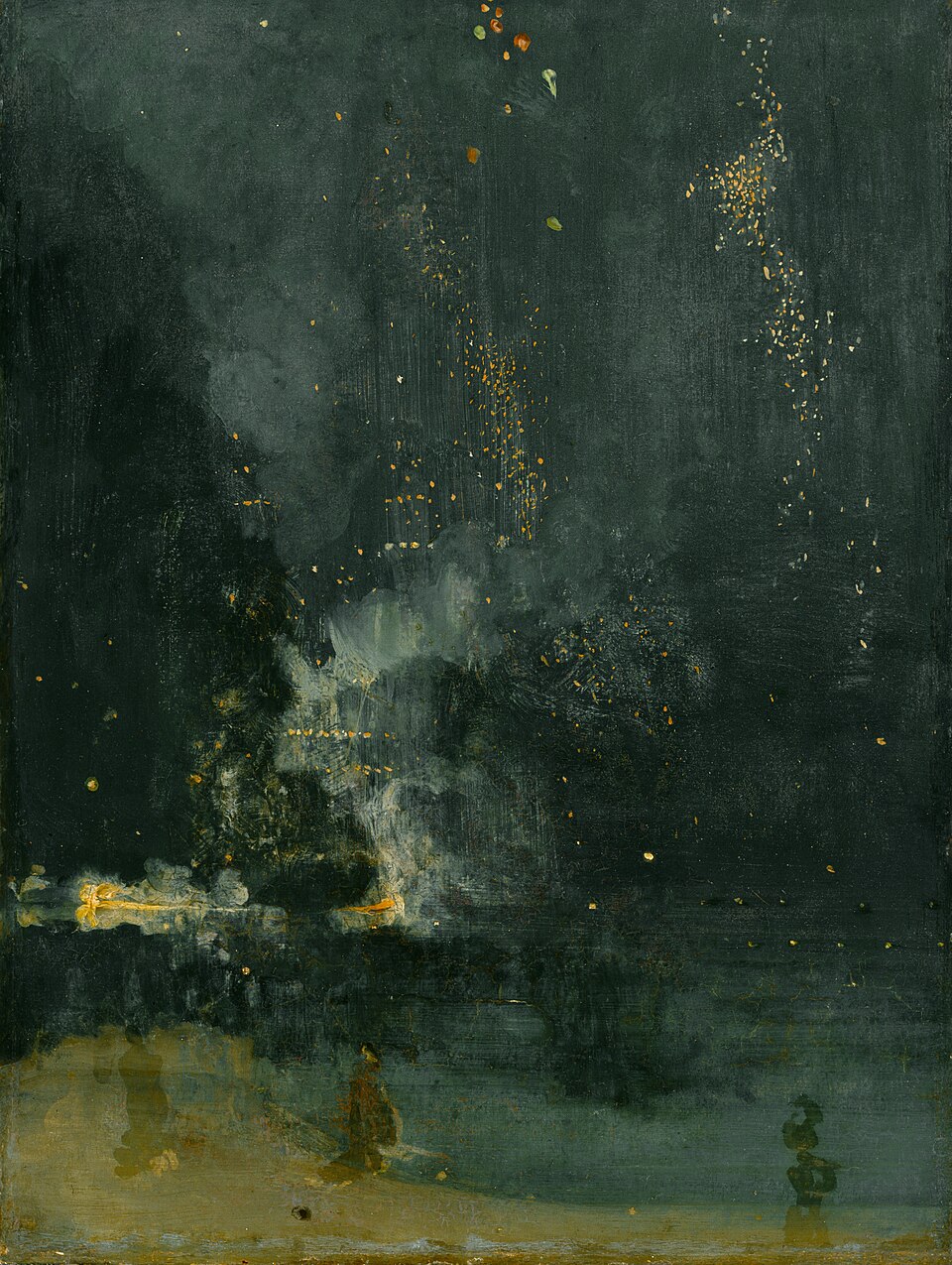
Around 1875, James McNeill Whistler stood before a canvas and painted almost nothing at all: a haze of blue-green fog, a few translucent figures, and a scatter of yellow dabs meant to suggest fireworks bursting over the Thames. He called it Nocturne in Black and Gold – The Falling Rocket, one of a series of paintings depicting London's industrial night, and one of two inspired by the Cremorne Gardens, a fashionable pleasure resort. It was, by any conventional measure, unfinished-looking — and that was exactly the point.
Whistler was not trying to paint a place. He insisted his Nocturnes were not pictures in the old sense but arrangements, scenes distilled to color and tone. Influenced by Japanese printmakers like Utagawa Hiroshige, he developed a splatter technique so refined that a single flick of paint could suggest a person or an object. Critics who dismissed this as careless missed how obsessively he worked — he was known to check his canvases in mirrors to catch the smallest flaw.
The painting's few colors — blue, green, yellow — created a muted, almost somber unity. Billowing smoke blurred the line between water and sky, and it was this fog, more than any single image, that stood in for the falling rocket of the title. To the right, Whistler signed his name in bold, straight strokes echoing Japanese characters, a signature as much a design element as an identification.```
This was Whistler's contribution to the Art for Art's Sake movement, a philosophy shaped by Théophile Gautier and Charles Baudelaire, which held that art needed no moral or narrative purpose beyond its own beauty. Whistler pushed this further than most, arguing that painting should not compete with literature by telling stories. He wanted sensation, not explanation — the truth of a fleeting night, not a factual record of it.
When the painting appeared at London's Grosvenor Gallery in 1877, the critic John Ruskin was appalled. In his publication Fors Clavigera, he accused Whistler of 'flinging a pot of paint in the public's face.' Ruskin's stature made the insult devastating: owning a Whistler suddenly became embarrassing, and the artist's finances, already fragile, worsened.
More from Art

The Painting With No Foreground
A single robed figure stares out at an empty grey sea — and the emptiness itself became a scandal. When it was unveiled in Berlin in 1810, no one knew quite what to do with it.

The Painter Who Chased the Light
For a few purple minutes each evening, an American exile knelt in an English garden and raced the dying sun to paint two little girls lighting lanterns. It took him two years to finish.

When a President Became a God
Look straight up inside the U.S. Capitol dome and you will find George Washington enthroned among the clouds, surrounded by goddesses — the founding father transformed into myth.

Marble Brought Back to Life
A corpse asleep, a wing barely brushing her skin — and marble somehow learns to breathe. This is the moment Antonio Canova dared to carve.

The World Turned Upside Down
Look closely at a sixteenth-century Flemish village and you'll find a man biting a pillar, another carrying daylight in a basket, and a wife slipping a blue cloak over her husband's shoulders. Every gesture is a joke — if you know the language.

The Girl in the Glass Case
She stood two-thirds life size, dressed in a real tutu and human hair — and the critics who saw her in 1881 recoiled as if she were something obscene.