Rain, Steam and Speed: Turner's Race Against the Sublime
A hare bolts down the tracks ahead of a thundering locomotive — which one, Turner seems to ask, truly embodies speed?
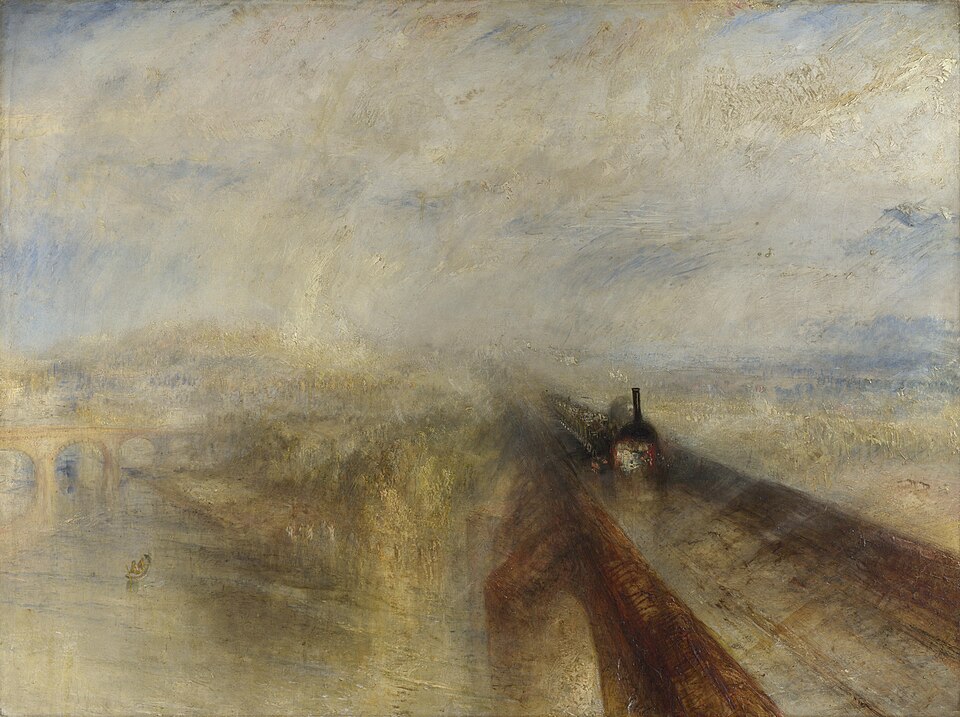
In 1844, visitors to the Royal Academy in London stood before a canvas that seemed to be dissolving before their eyes. A dark train, barely more than a smudge, plunged out of a haze of rain and steam, racing toward the viewer across a bridge that was itself only half-suggested by the artist's brush. This was Rain, Steam, and Speed – The Great Western Railway, J. M. W. Turner's tribute to the age of the machine, and it remains one of the most daring paintings of the nineteenth century.
Turner painted the work near the close of the Industrial Revolution, a period that had reshaped Britain from an agrarian society into one dominated by factories, engines, and iron rails. The railway, more than any other invention, symbolized this transformation, altering both industry and everyday social life. While most painters of his generation still turned to classical ruins and pastoral fields for inspiration, Turner looked instead at the trains roaring past him and saw something worth capturing: technology racing toward the future.
The scene is set at Maidenhead Railway Bridge, which carries the Great Western Railway over the Thames between Taplow and Maidenhead. Turner had studied this stretch of river for more than thirty years, and the bridge itself, designed by Isambard Kingdom Brunel, had only been completed in 1839. The view looks east toward London, with the golden countryside glowing on either side of the storm-wrapped train.
The locomotive resembles a Firefly-type engine, among the fastest of its day, hauling a train that seems to melt into the atmosphere. Turner deliberately blurred the solid, structural elements — the bridge, the engine, the carriages — letting them disappear into mist, rain, and steam until all three blended into one shifting field of color. In the lower left, a couple drifts in a boat, quietly reminding the viewer that a river runs beneath this modern spectacle. Inside the train, a crowd of waving figures can be glimpsed, a small detail suggesting that rail travel was, in its day, a festive and popular novelty rather than a grim necessity.
And then there is the hare, sprinting along the tracks in the lower right corner. It has become the painting's most debated detail. Turner had used the hound-and-hare motif before, in Battle Abbey; the Spot Where Harold Fell and in Apollo and Daphne, always as an emblem of speed and pursuit. Some viewers read the hare as a symbol of velocity itself, or as a marker of technology's outer limits. Others see something darker: an animal fleeing in terror from a machine that might, in an instant, crush it — nature outpaced and endangered by its own creation.
More from Art

The Painting With No Foreground
A single robed figure stares out at an empty grey sea — and the emptiness itself became a scandal. When it was unveiled in Berlin in 1810, no one knew quite what to do with it.

The Painter Who Chased the Light
For a few purple minutes each evening, an American exile knelt in an English garden and raced the dying sun to paint two little girls lighting lanterns. It took him two years to finish.

When a President Became a God
Look straight up inside the U.S. Capitol dome and you will find George Washington enthroned among the clouds, surrounded by goddesses — the founding father transformed into myth.

Marble Brought Back to Life
A corpse asleep, a wing barely brushing her skin — and marble somehow learns to breathe. This is the moment Antonio Canova dared to carve.

The World Turned Upside Down
Look closely at a sixteenth-century Flemish village and you'll find a man biting a pillar, another carrying daylight in a basket, and a wife slipping a blue cloak over her husband's shoulders. Every gesture is a joke — if you know the language.

The Girl in the Glass Case
She stood two-thirds life size, dressed in a real tutu and human hair — and the critics who saw her in 1881 recoiled as if she were something obscene.