Rembrandt's Last Embrace
In the final years of his life, an aging painter reached for a story he had returned to for decades — and this time, he painted it as if it were his own confession.
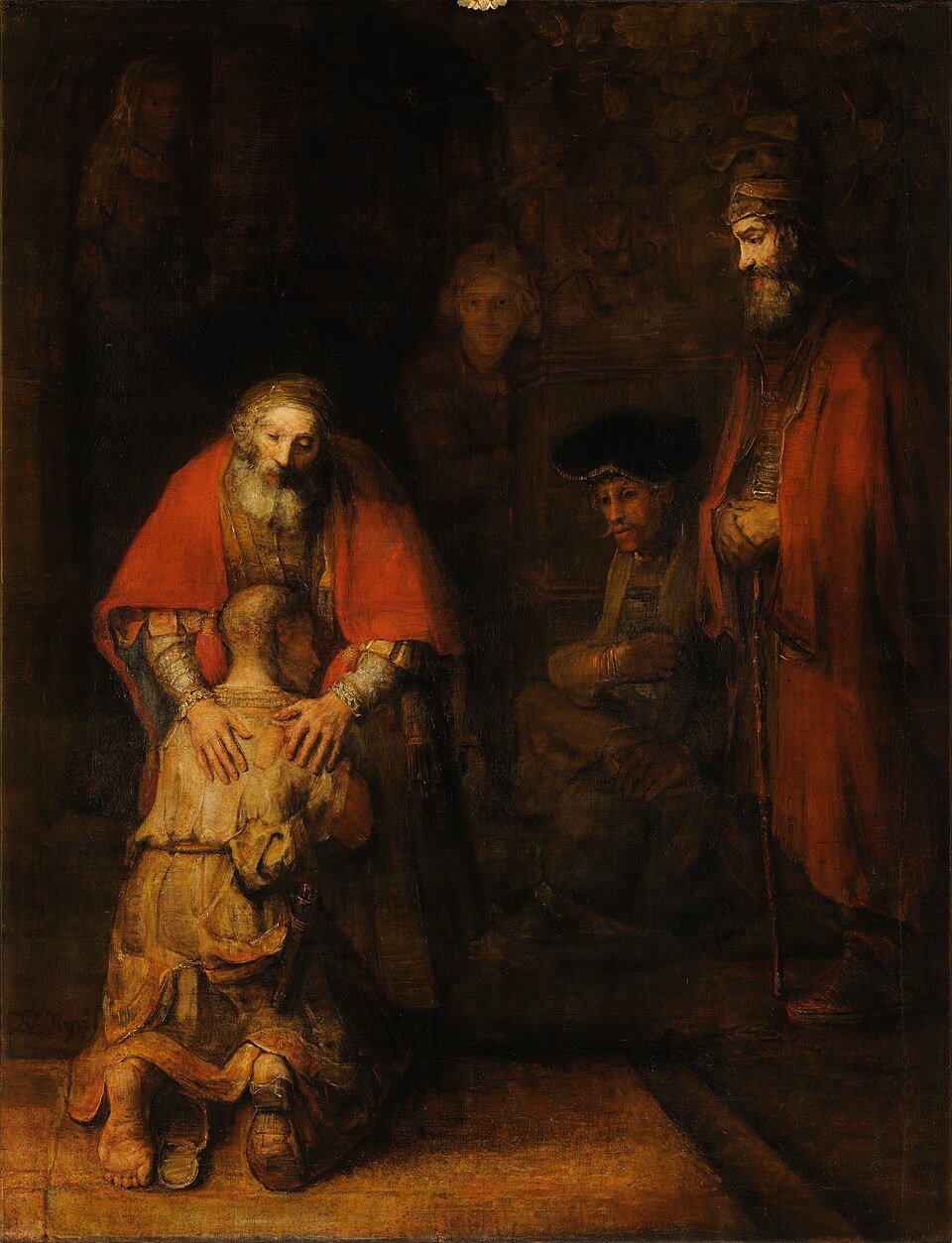
In the darkened galleries of the Hermitage Museum in St. Petersburg hangs a canvas that art historian Kenneth Clark once called forgivable to name 'the greatest picture ever painted.' It shows a single, quiet moment: a ragged son kneeling before his father, his back to the viewer, his worn feet bared to the light. This is Rembrandt's The Return of the Prodigal Son, likely completed within two years of his death in 1669, among the very last works of the Dutch master's long career.
The painting draws from the parable in the Gospel of Luke. A younger son squanders his inheritance and falls into poverty and despair, until he returns home in a wretched state, hoping only to be accepted as a servant. Instead, his father receives him with tenderness, welcoming him back as a son. Rembrandt renders the father's hands with startling asymmetry — the left hand larger and more masculine, resting firmly on the son's shoulder, the right softer and more receptive, as though the artist wanted to suggest both a father's strength and a mother's comfort in a single gesture.
Standing apart, at the right edge of the composition, is the elder brother, arms crossed in judgment. In the parable, he protests his father's mercy, pointing out that he has served faithfully for years without such a celebration, while this brother, who wasted the family's wealth on dissolute living, is welcomed with a feast. The father's answer, drawn directly from Luke's Gospel, is simple: it was fitting to celebrate, for this son was dead and is alive again, lost and now found.
Rembrandt did not arrive at this image suddenly. He had been drawn to the parable for decades, producing drawings, etchings, and paintings on the theme beginning with an etching in 1636. Some of the additional figures in the final painting — a barely visible woman at the top left, likely the mother, and a seated man dressed in clothing suggesting wealth, possibly an estate advisor or tax collector — appear to carry forward figures from these earlier works, though their exact identities remain debated among scholars.
What sets this final version apart, according to Rembrandt scholars, is its solemnity. One assessment describes the work as monumental, arguing that Rembrandt interprets the Christian idea of mercy with such gravity that the painting reads as a spiritual testament to the world, surpassing other Baroque artists in its evocation of religious feeling and human sympathy. Far from diminishing with age, the artist's realism is said to have deepened, sharpened by psychological insight and spiritual awareness.
More from Art

The Painting With No Foreground
A single robed figure stares out at an empty grey sea — and the emptiness itself became a scandal. When it was unveiled in Berlin in 1810, no one knew quite what to do with it.

The Painter Who Chased the Light
For a few purple minutes each evening, an American exile knelt in an English garden and raced the dying sun to paint two little girls lighting lanterns. It took him two years to finish.

When a President Became a God
Look straight up inside the U.S. Capitol dome and you will find George Washington enthroned among the clouds, surrounded by goddesses — the founding father transformed into myth.

Marble Brought Back to Life
A corpse asleep, a wing barely brushing her skin — and marble somehow learns to breathe. This is the moment Antonio Canova dared to carve.

The World Turned Upside Down
Look closely at a sixteenth-century Flemish village and you'll find a man biting a pillar, another carrying daylight in a basket, and a wife slipping a blue cloak over her husband's shoulders. Every gesture is a joke — if you know the language.

The Girl in the Glass Case
She stood two-thirds life size, dressed in a real tutu and human hair — and the critics who saw her in 1881 recoiled as if she were something obscene.