Salvator Mundi: The $450 Million Mystery
A battered panel sold for £45 at a London auction in 1958. Fifty-nine years later it fetched $450.3 million — and nobody agrees on who really painted it.
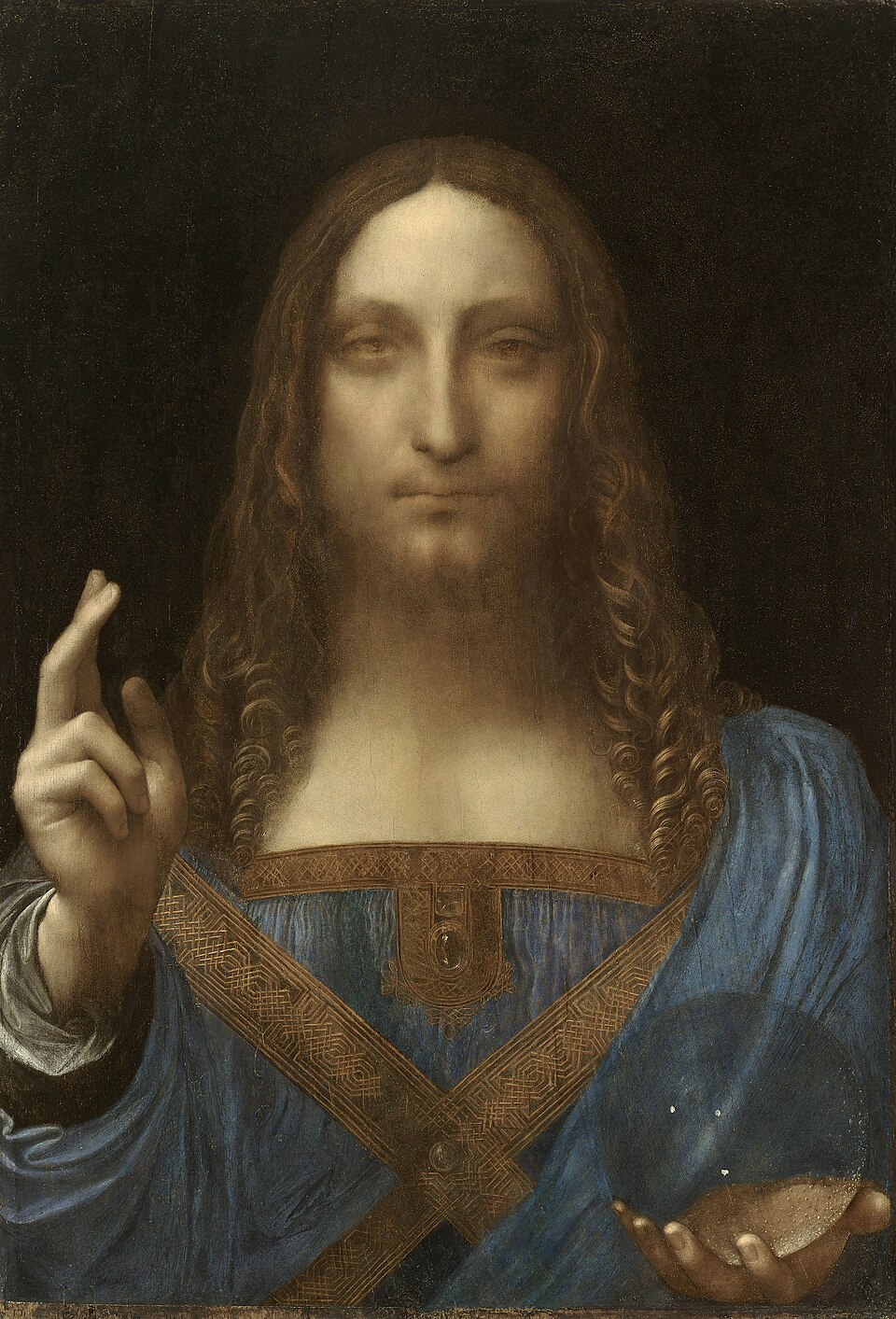
In 1958, at an auction of the estate of the descendants of British collector Francis Cook, a small walnut panel depicting Christ changed hands for just 45 pounds. Damaged by earlier restoration attempts and buried under thick layers of overpainting, it looked like nothing more than a copy — a devotional curiosity, its true authorship unrecorded. Nobody in that room could have imagined what it would become.
The painting shows Jesus Christ dressed in anachronistic Renaissance blue, his right hand raised in a gesture of blessing, his left hand holding a transparent, non-refracting crystal orb — a symbol of his role as Salvator Mundi, savior of the world, and of the celestial heavens. The image type itself predates Leonardo, rooted in Byzantine traditions of acheiropoeta, images said to be 'not made by human hands,' such as the Mandylion of Edessa and the Veil of Veronica.
In 2005, a consortium of art dealers including Robert Simon purchased the wreck of a painting, then described as 'ruined, dark and gloomy.' Over the following years they stripped away the overpainting and restored it, gradually coming to believe they were looking at a long-lost original by Leonardo da Vinci, dated roughly to 1499–1510. Christie's later noted the work was probably commissioned around 1500, shortly after King Louis XII of France conquered the Duchy of Milan and took control of Genoa — the same year Leonardo left Milan for Florence. Scholars, however, disagree on the date: Luke Syson favors c. 1499, while Martin Kemp and Frank Zöllner argue for 1504–1510 or 1507 or later.
Who commissioned it remains unresolved. Isabella d'Este, Marchioness of Mantua, is one candidate — in 1504 she asked Leonardo for a youthful Christ, though the Salvator Mundi shows a more mature face. Joanne Snow-Smith argued instead that Leonardo painted it for Louis XII and his wife, Anne of Brittany, a view echoed by the British Royal Collection in 2018. Two preparatory drapery drawings by Leonardo, held in the Royal Collection, support at least his hand in the design. The painting's trail goes cold after 1530, though it may appear in a 1525 inventory of Leonardo's assistant Salaì.
After its rediscovery, the restored panel was compared against roughly thirty known copies and variants and judged superior in quality. It was exhibited at the National Gallery, London, in 2011–2012 as part of a Leonardo exhibition. Martin Kemp, one of the world's foremost Leonardo scholars, recalled recognizing something distinctly Leonardo-like in the restored work — an unusual quality he associated with the artist's other paintings. Details such as pentimenti around the right thumb, the sfumato technique, the rendering of curled hair, and pigments consistent with Leonardo's other works all supported the attribution, according to Christie's.
More from Art

The Painting With No Foreground
A single robed figure stares out at an empty grey sea — and the emptiness itself became a scandal. When it was unveiled in Berlin in 1810, no one knew quite what to do with it.

The Painter Who Chased the Light
For a few purple minutes each evening, an American exile knelt in an English garden and raced the dying sun to paint two little girls lighting lanterns. It took him two years to finish.

When a President Became a God
Look straight up inside the U.S. Capitol dome and you will find George Washington enthroned among the clouds, surrounded by goddesses — the founding father transformed into myth.

Marble Brought Back to Life
A corpse asleep, a wing barely brushing her skin — and marble somehow learns to breathe. This is the moment Antonio Canova dared to carve.

The World Turned Upside Down
Look closely at a sixteenth-century Flemish village and you'll find a man biting a pillar, another carrying daylight in a basket, and a wife slipping a blue cloak over her husband's shoulders. Every gesture is a joke — if you know the language.

The Girl in the Glass Case
She stood two-thirds life size, dressed in a real tutu and human hair — and the critics who saw her in 1881 recoiled as if she were something obscene.