Salvator Mundi: The Lost da Vinci's Strange Journey
A battered panel painting, its Christ-face repainted beyond recognition, sold once for a few pounds and once for nearly half a billion dollars. Between those two moments lies more than 150 years of disappearance.
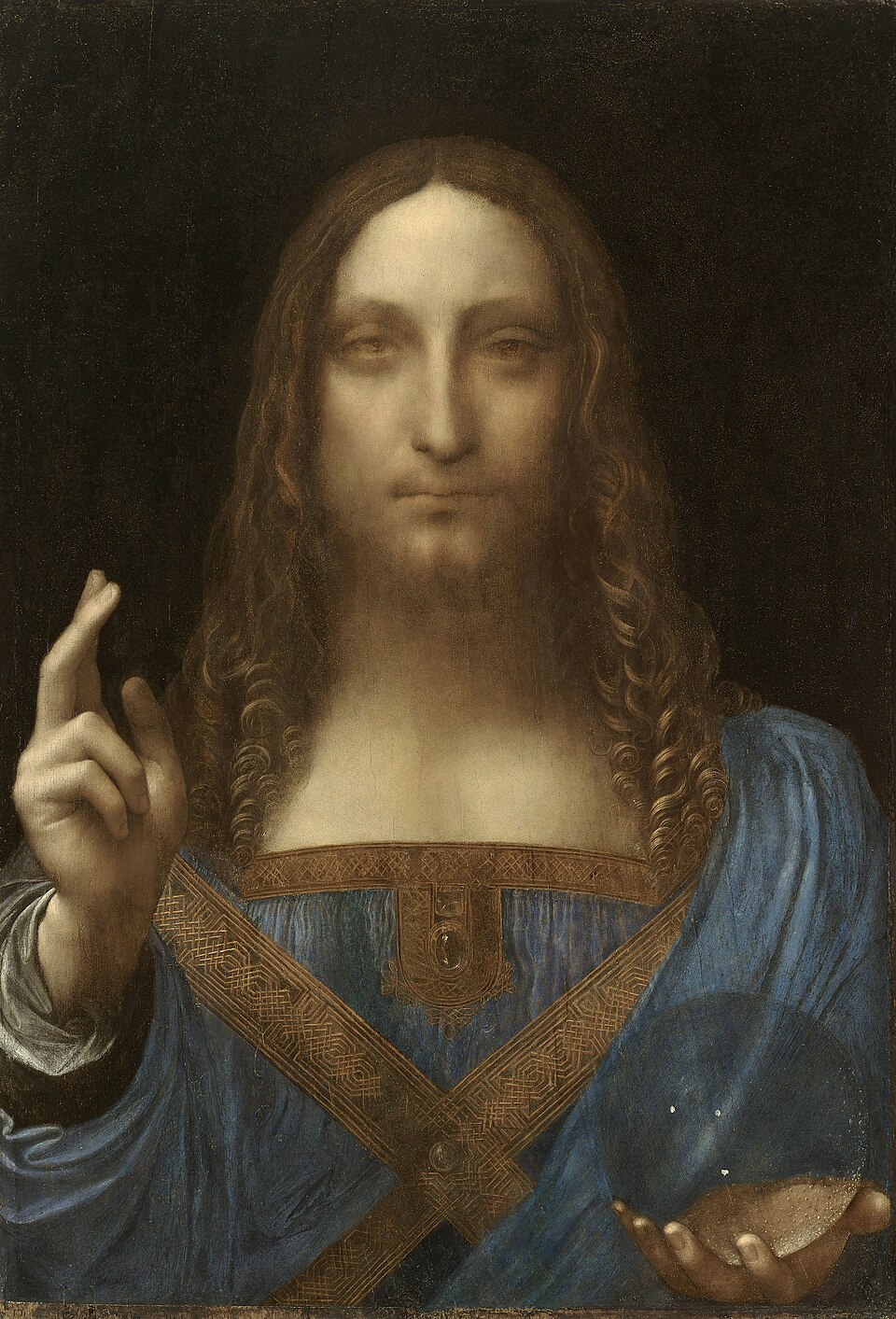
The image itself is ancient in feeling: Christ facing forward, right hand raised in blessing, left hand cradling a globus cruciger — a crystal orb topped with a cross, symbolizing dominion over the earth. It is a composition steeped in eschatological weight, a promise and a warning folded into one gesture. For centuries this theme, Salvator Mundi, Latin for Saviour of the World, belonged mostly to the North.
Painters like Jan van Eyck, Hans Memling, and Albrecht Dürer made the Salvator Mundi a familiar face of Northern Renaissance devotion. Titian painted his own versions in Italy, one of which now hangs in the Hermitage Museum. The subject was common enough, its visual grammar understood across borders: the raised hand, the orb, the steady gaze.
But one particular panel, simply titled Salvator Mundi, would come to eclipse all the others — not for its beauty alone, but for the story of its disappearance and return. In 2011 it was attributed, or reattributed, to Leonardo da Vinci himself, a claim that transformed a quiet devotional image into one of the most contested and valuable objects in the art world.
Before that moment, the painting had lived a long, obscure life. It vanished from the historical record in 1763 and did not resurface until 1900, when Sir Charles Robinson acquired it. At that time, no one thought of Leonardo. The painting was believed to be the work of Bernardino Luini, one of Leonardo's followers — a respectable but far lesser attribution.
Sir Francis Cook bought the painting for his collection at Doughty House in Richmond, London. By then, the image had suffered: Christ's face and hair had been extensively repainted, blurring whatever traces of the original hand might have remained visible. A photograph taken in 1912 preserved this altered, damaged appearance for history — a face that was, by then, more restoration than original.
More from Art

The Painting With No Foreground
A single robed figure stares out at an empty grey sea — and the emptiness itself became a scandal. When it was unveiled in Berlin in 1810, no one knew quite what to do with it.

The Painter Who Chased the Light
For a few purple minutes each evening, an American exile knelt in an English garden and raced the dying sun to paint two little girls lighting lanterns. It took him two years to finish.

When a President Became a God
Look straight up inside the U.S. Capitol dome and you will find George Washington enthroned among the clouds, surrounded by goddesses — the founding father transformed into myth.

Marble Brought Back to Life
A corpse asleep, a wing barely brushing her skin — and marble somehow learns to breathe. This is the moment Antonio Canova dared to carve.

The World Turned Upside Down
Look closely at a sixteenth-century Flemish village and you'll find a man biting a pillar, another carrying daylight in a basket, and a wife slipping a blue cloak over her husband's shoulders. Every gesture is a joke — if you know the language.

The Girl in the Glass Case
She stood two-thirds life size, dressed in a real tutu and human hair — and the critics who saw her in 1881 recoiled as if she were something obscene.