Saturn Devouring His Son: Goya's Black Walls
In a house named for a deaf man, a deaf painter carved a monster into the plaster of his own dining room — and never told anyone why.
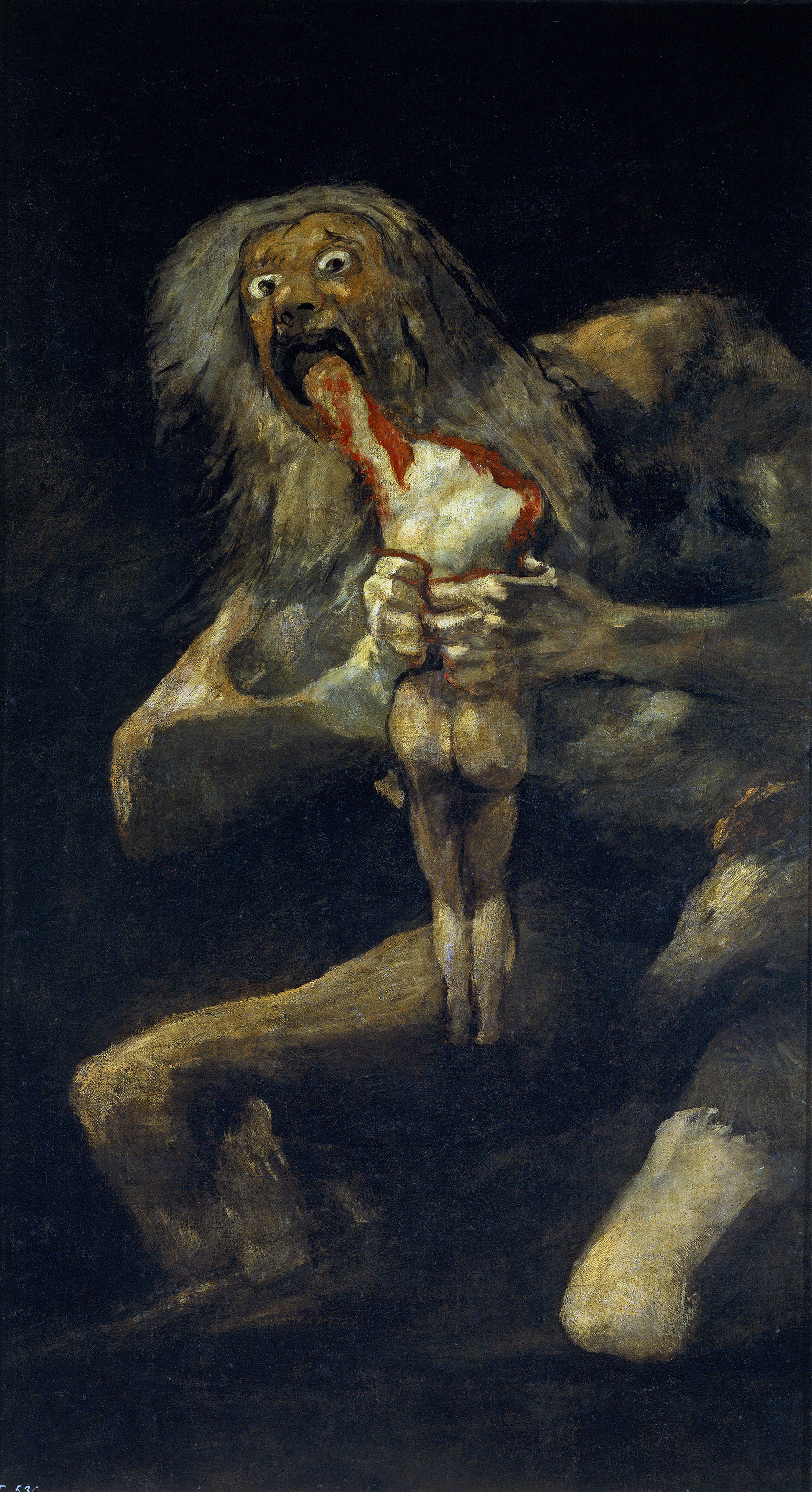
In 1819, Francisco Goya bought a two-story house on the banks of the Manzanares River near Madrid called Quinta del Sordo, the Villa of the Deaf Man. The name had belonged to a previous owner, but it fitted Goya too: a fever in 1792 had left him deaf. Some time between 1820 and 1823, before he left for exile in Bordeaux, Goya painted directly onto the plaster walls of this house, producing fourteen works that would later be called the Black Paintings.
He had not started with darkness. The rooms were first decorated with brighter, more hopeful images. Over time, Goya painted over all of them with the haunting scenes we know today — pictures made for no patron, intended for no public eye, existing only for himself inside a private house at the edge of a violent, revolutionary Spain.
Among six works in the dining room was the painting now known as Saturn Devouring His Son. Goya never named it, or any of the Black Paintings; titles were assigned after his death. The traditional reading ties it to the myth of the Titan Cronus — Saturn to the Romans — who was warned by Terra that one of his children would overthrow him, just as he had overthrown his own father, Caelus. To cheat the prophecy, Saturn ate his children the moment they were born: Vesta, Ceres, Juno, Pluto, Neptune. His wife Ops finally hid their sixth child, Jupiter, on Crete, tricking Saturn with a swaddled stone in his place. Jupiter grew up and, as foretold, overthrew his father.
The painting itself departs from the myth's gentler cruelty. In most versions, Saturn swallows his children whole and later vomits them up alive. Goya shows something far worse: a huge, wild-eyed figure gripping a human body, its head and left arm already devoured, its right arm possibly eaten too or merely pinned beneath the larger figure's thumbs. The god's mouth gapes as he prepares another bite. Light falls only on pale flesh, red blood, and the white knuckles of fingers dug into the corpse's back.
More from Art

The Painting With No Foreground
A single robed figure stares out at an empty grey sea — and the emptiness itself became a scandal. When it was unveiled in Berlin in 1810, no one knew quite what to do with it.

The Painter Who Chased the Light
For a few purple minutes each evening, an American exile knelt in an English garden and raced the dying sun to paint two little girls lighting lanterns. It took him two years to finish.

When a President Became a God
Look straight up inside the U.S. Capitol dome and you will find George Washington enthroned among the clouds, surrounded by goddesses — the founding father transformed into myth.

Marble Brought Back to Life
A corpse asleep, a wing barely brushing her skin — and marble somehow learns to breathe. This is the moment Antonio Canova dared to carve.

The World Turned Upside Down
Look closely at a sixteenth-century Flemish village and you'll find a man biting a pillar, another carrying daylight in a basket, and a wife slipping a blue cloak over her husband's shoulders. Every gesture is a joke — if you know the language.

The Girl in the Glass Case
She stood two-thirds life size, dressed in a real tutu and human hair — and the critics who saw her in 1881 recoiled as if she were something obscene.