Sixteen Pillars Above the Water
On a windswept hill outside Tbilisi stand sixteen bronze giants, part saints, part kings, watching over a sea that isn't really a sea at all.
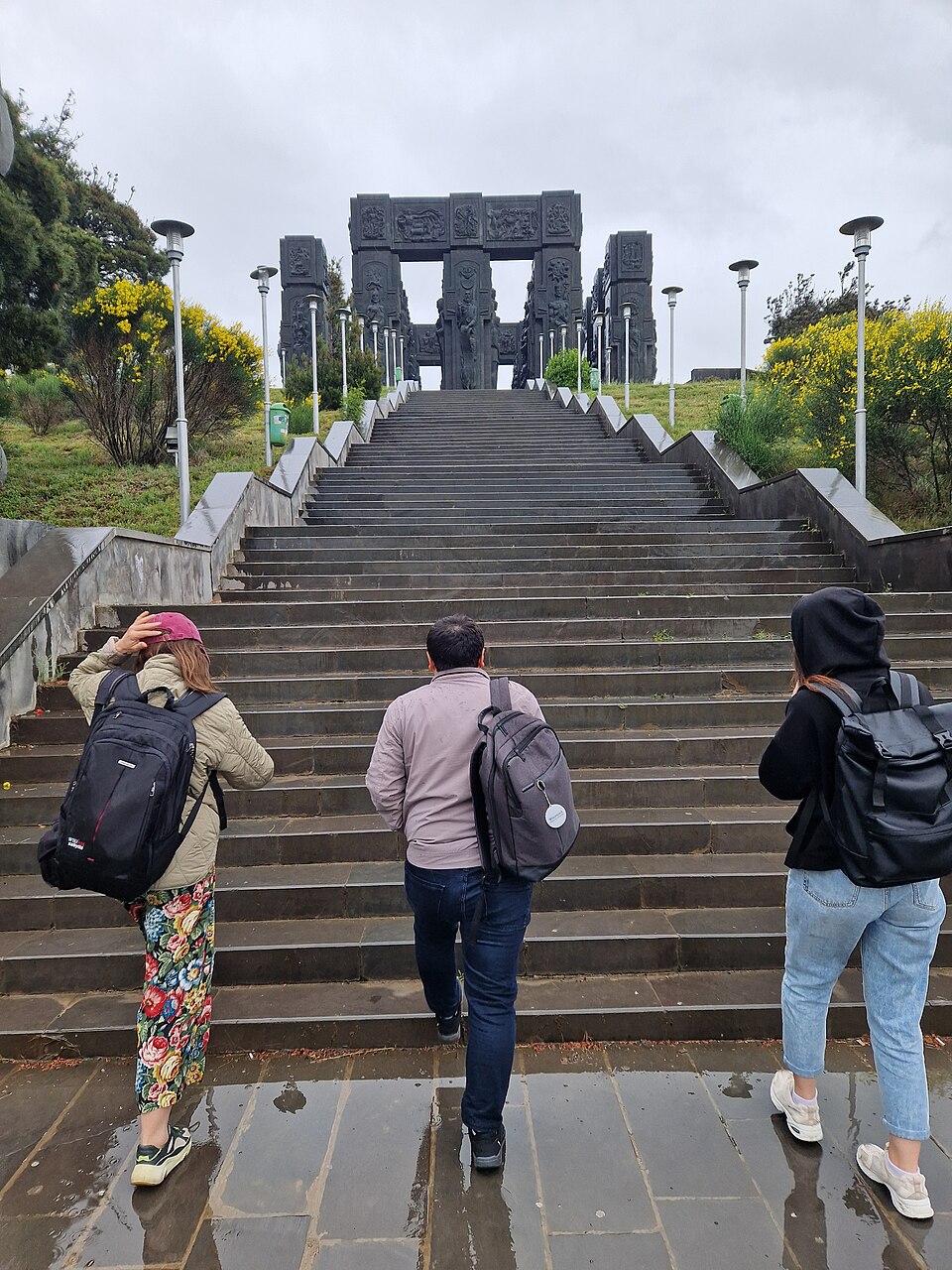
Drive north out of Tbilisi, past the Nadzaladevi District and up Unknown Heroes Street, and the city gradually falls away beneath you. What replaces it is Keeni Hill, a rise of dry grass and wind overlooking the Tbilisi Sea — actually a reservoir, but named with the affection locals reserve for water in a landlocked country. At the top of a long, punishing staircase, sixteen pillars rise between 30 and 35 meters into the sky, arranged like sentinels facing the valley below.
This is the Chronicle of Georgia, sometimes called the History Memorial of Georgia. It was the work of the sculptor Zurab Tsereteli, begun in 1985, and it remains — deliberately or not — unfinished to this day. That incompleteness has become part of its character: a monument still being written, much like the history it depicts.
Each pillar is split into two registers. The upper half is crowded with kings, queens, and heroes of Georgian history, cast in bronze and frozen in postures of rule and defiance. The lower half turns to scripture, carrying scenes from the life of Christ. The effect is a double column of memory, secular history bolted directly onto sacred story, as if the two could not be separated in the Georgian imagination.
Among the bronze work stands another symbol entirely: a grapevine cross, the emblem of Saint Nino. Nino was the woman credited with bringing Christianity to Georgia, and a small chapel beside the pillars commemorates her. Her cross — vine wood said to have been bound with her own hair, according to tradition surrounding her legacy — has become one of the most recognizable Christian symbols native to the Caucasus.
The religious weight of the site is not incidental. Georgia adopted Christianity as its state religion in 337 AD, under King Mirian III, making it one of the earliest nations in the world to do so. That conversion did not merely change what Georgians believed; it changed how they wrote. The ancient Georgian script was gradually replaced by a new alphabet, shaped by contact with Greek orthography and the Syriac writing tradition, carried along the same routes as the new faith.
More from Art

The Painting With No Foreground
A single robed figure stares out at an empty grey sea — and the emptiness itself became a scandal. When it was unveiled in Berlin in 1810, no one knew quite what to do with it.

The Painter Who Chased the Light
For a few purple minutes each evening, an American exile knelt in an English garden and raced the dying sun to paint two little girls lighting lanterns. It took him two years to finish.

When a President Became a God
Look straight up inside the U.S. Capitol dome and you will find George Washington enthroned among the clouds, surrounded by goddesses — the founding father transformed into myth.

Marble Brought Back to Life
A corpse asleep, a wing barely brushing her skin — and marble somehow learns to breathe. This is the moment Antonio Canova dared to carve.

The World Turned Upside Down
Look closely at a sixteenth-century Flemish village and you'll find a man biting a pillar, another carrying daylight in a basket, and a wife slipping a blue cloak over her husband's shoulders. Every gesture is a joke — if you know the language.

The Girl in the Glass Case
She stood two-thirds life size, dressed in a real tutu and human hair — and the critics who saw her in 1881 recoiled as if she were something obscene.