Snow White: Blood, Snow, and a Mirror That Never Lied
A queen pricks her finger over fresh snow and makes a wish that will outlive her — but the fairy tale that follows is stranger and darker than the one most people remember.
The story begins with an image so simple it feels like a spell: a queen sits sewing by an open window while snow falls outside. She pricks her finger, and three drops of blood land on the white snowfall against a black windowsill. Struck by the colors, she wishes aloud for a daughter with skin white as snow, lips red as blood, and hair black as ebony. She gets her wish, names the child Snow White, and then dies giving birth to her.
The Brothers Grimm first wrote this tale down and published it in 1812, in the first edition of their collection, as Tale 53. Its original German title was Sneewittchen, a partial Low German phrase, later modernized to Schneewittchen. The Grimms kept revising the story for decades, finishing their definitive version in 1854, which appeared in the 1857 edition of their fairy tales — the version most familiar today. English readers first met her in 1823 under the title 'Snow-Drop.'
A year after the queen's death, Snow White's father remarries. The new queen is beautiful but vain, and she owns a magic mirror that she consults every morning: 'Mirror, mirror on the wall, who is the fairest of all?' For years the mirror confirms her beauty — until Snow White turns seven and surpasses her stepmother. The mirror, which never lies, says so plainly, and the queen's heart curdles with envy.
The queen orders a huntsman to kill the girl in the forest and bring back her lungs and liver as proof, intending to eat them with salt. The huntsman raises his dagger but cannot go through with it when Snow White begs to be spared, promising never to return. He kills a boar instead, and the queen, deceived, has its organs cooked and eats them.
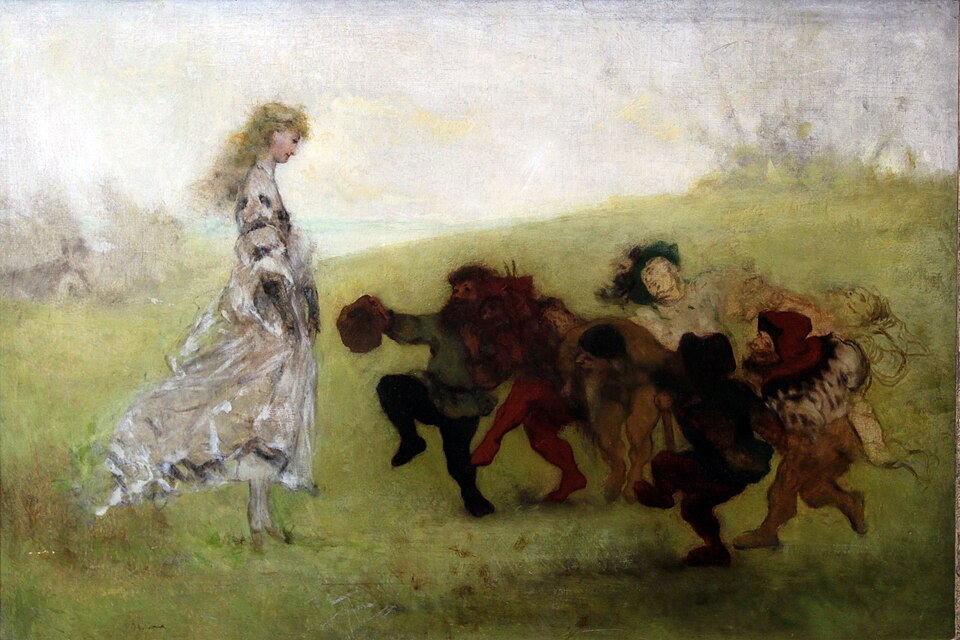
Alone in the forest, Snow White finds a small cottage belonging to seven dwarfs. She eats their food, drinks their wine, and falls asleep in one of their beds. When the dwarfs return and find her, she explains her stepmother's plot, and they let her stay as a housekeeper, warning her to let no one inside while they work in the mountains.
More from Mythology

The Doctor Who Sang a Nation Into Being
A country doctor rode into the forests of Karelia armed with nothing but a notebook — and rode out with the soul of a nation.

The Boat That Carried the Sun
Every sunset, the ancient Egyptians believed, the sun climbed into a boat and sailed straight into the realm of the dead — only to fight a monstrous serpent before dawn could return.

The Wild Man of the Snows
At 21,000 feet, a colonel found tracks in the snow that he blamed on a wolf — but his guides knew better, and gave the world a name that would echo for a century.

The Knight Who Went Mad for Love: Orlando Furioso
A hero so devoted to duty he was Charlemagne's greatest paladin loses his mind—not to a sword wound, but to heartbreak. To cure him, a friend must ride a flying horse to the Moon.

The Book That Turned the World Into Myth
A poet condemned to exile spent his final years in Rome finishing a poem that would outlive empires—a poem about nothing standing still, not gods, not lovers, not even the shape of a man.

Paradise Lost: Milton's Rebel Angel
A blind poet, dictating verses in the dark, dared to explain the ways of God to men — and in doing so, made Hell's ruler unforgettable.