Sunlight and Sunday Dancing: The Making of Renoir's Moulin de la Galette
A windy Montmartre garden, a dance floor dappled with light, and a cast of real Parisians who would soon vanish into history — all frozen by one Impressionist's brush.
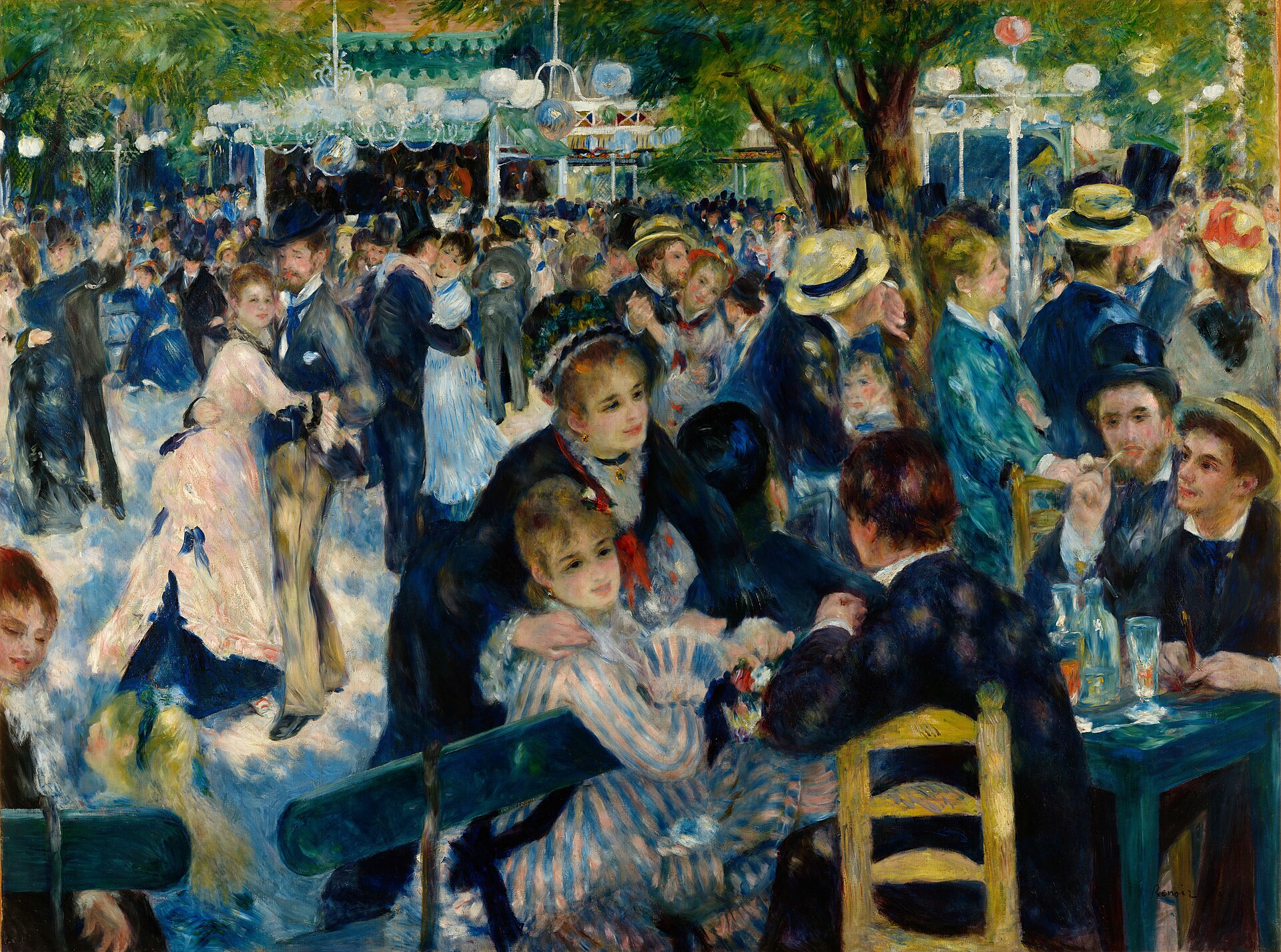
In May 1876, Pierre-Auguste Renoir set out to paint something he had watched countless times: the ordinary joy of working-class Parisians dancing on a Sunday afternoon at the Moulin de la Galette in Montmartre. There, dressed in their best, they spent the day drinking, dancing, and eating the flat cakes called galettes that gave the mill its name. Renoir wanted to capture not a portrait or a landscape but a living moment — the flicker of sunlight through leaves, the blur of motion, the texture of a crowd at ease.
To do it, he needed a studio close to the mill, and he found one in an abandoned cottage on the rue Cortot, with a garden his friend Georges Rivière called a 'beautiful abandoned park'. Several of Renoir's major works from this period, including La balançoire, were painted in that same garden. The property survives today as the Musée de Montmartre.
Rivière, a civil servant and close friend of Renoir, documented the painting's creation in his memoir Renoir et ses amis, and even identified many of the people depicted in the crowd. Renoir had hoped his favorite sixteen-year-old model, Jeanne Samary, would pose as the central figure, but she was preoccupied with a local love affair and declined. Instead, her sister Estelle posed in the blue-and-pink striped dress. The two girls, along with their parents and two younger sisters, came to the mill every Sunday — entry was free for girls, and not all who came were models of virtue.
Other faces in the canvas belonged to real people from Renoir's circle: painters Pierre-Franc Lamy and Norbert Goeneutte, and Rivière himself, appear seated near Estelle. Further back, among the dancers, are Henri Gervex, Eugène Pierre Lestringuez, and Paul Lhote. At the center of the dance floor, the Cuban painter Don Pedro Vidal de Solares y Cardenas dances in striped trousers with a model named Margot, who reportedly found him too reserved and tried to loosen him up with polkas and slang songs. Margot would die of typhoid just two years later; Renoir nursed her until the end and paid for both her treatment and her funeral.
More from Art

The Painting With No Foreground
A single robed figure stares out at an empty grey sea — and the emptiness itself became a scandal. When it was unveiled in Berlin in 1810, no one knew quite what to do with it.

The Painter Who Chased the Light
For a few purple minutes each evening, an American exile knelt in an English garden and raced the dying sun to paint two little girls lighting lanterns. It took him two years to finish.

When a President Became a God
Look straight up inside the U.S. Capitol dome and you will find George Washington enthroned among the clouds, surrounded by goddesses — the founding father transformed into myth.

Marble Brought Back to Life
A corpse asleep, a wing barely brushing her skin — and marble somehow learns to breathe. This is the moment Antonio Canova dared to carve.

The World Turned Upside Down
Look closely at a sixteenth-century Flemish village and you'll find a man biting a pillar, another carrying daylight in a basket, and a wife slipping a blue cloak over her husband's shoulders. Every gesture is a joke — if you know the language.

The Girl in the Glass Case
She stood two-thirds life size, dressed in a real tutu and human hair — and the critics who saw her in 1881 recoiled as if she were something obscene.