Swords in the Sky: Raphael's Vision of Attila and the Pope
A barbarian king stands before an unarmed old man, and somehow the invasion of Italy stops there. Six decades later, a young painter would turn that vanished moment into one of the most audacious frescoes in the Vatican.
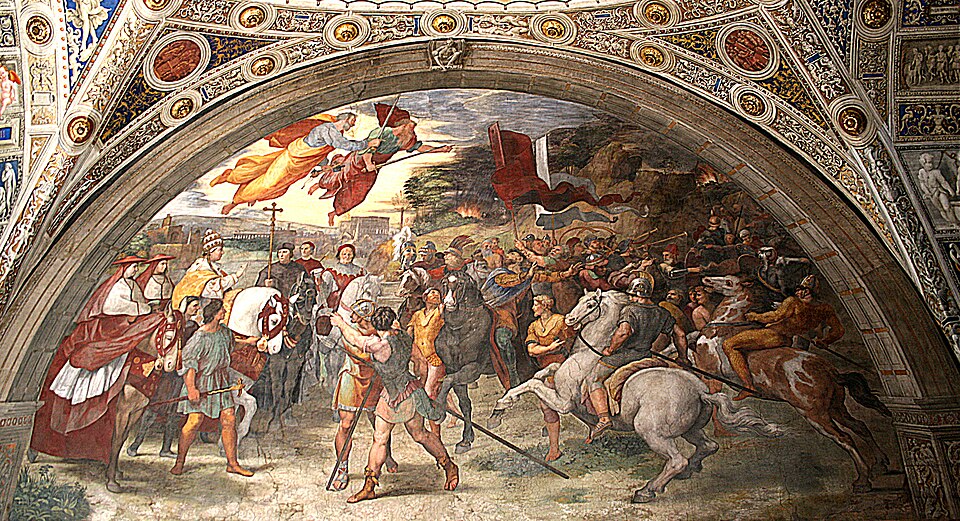
In 452, Attila the Hun had already carved a bloody path across northern Italy, and Rome braced for annihilation. Pope Leo I, who had reigned since 440, rode out to meet the Hun king near Mantua, an area long tied to Christian memory. He carried no army, only the hope of persuasion. Against every expectation, Attila withdrew, and the threatened sack of Rome never came.
Historians have long debated why. Some argue the Huns were starving or diseased, worn down after their northern Italian campaign, though there is no firm evidence of famine in that region. Others propose a simpler explanation: winter was approaching, and Attila's forces, however fearsome, could not risk the season without adequate supplies, so they left while they still had provisions to spare.
But belief offered its own explanation, and it is this one that Raphael chose to paint. In his telling, it was not hunger or weather that turned Attila back, but the intervention of Saints Peter and Paul, who appear in the sky above the two rulers bearing swords. The martyrs, whose righteous lives had already spread the Gospel across the Roman world, are shown lending Leo their spiritual authority, as if reminding Attila that a power greater than his own stood watching.
Raphael painted this scene from 1513 to 1514, as part of a much larger commission to decorate the rooms of the Apostolic Palace now known as the Stanze di Raffaello. The fresco fills the Stanza di Eliodoro, named for another of the room's paintings, The Expulsion of Heliodorus from the Temple. The Pope had hired the young Raphael as chief architect for the Vatican, a striking opportunity for a painter still young, though already more accomplished than his own father had been. His appointment led to the destruction of earlier frescoes in those rooms, clearing the way for the works that still cover the walls today.
The composition itself carries a political charge. Raphael originally gave Leo I the face of Pope Julius II, the reigning pontiff at the time the work began. But when Julius died, Raphael altered the painting to resemble the new pope, Leo X, who appears twice in the fresco: once as a cardinal, once as pope himself. The choice tied a fifth-century act of averted disaster directly to the Church's living leadership, a message aimed as much at Raphael's own contemporaries as at any student of ancient history.
More from Art

The Painting With No Foreground
A single robed figure stares out at an empty grey sea — and the emptiness itself became a scandal. When it was unveiled in Berlin in 1810, no one knew quite what to do with it.

The Painter Who Chased the Light
For a few purple minutes each evening, an American exile knelt in an English garden and raced the dying sun to paint two little girls lighting lanterns. It took him two years to finish.

When a President Became a God
Look straight up inside the U.S. Capitol dome and you will find George Washington enthroned among the clouds, surrounded by goddesses — the founding father transformed into myth.

Marble Brought Back to Life
A corpse asleep, a wing barely brushing her skin — and marble somehow learns to breathe. This is the moment Antonio Canova dared to carve.

The World Turned Upside Down
Look closely at a sixteenth-century Flemish village and you'll find a man biting a pillar, another carrying daylight in a basket, and a wife slipping a blue cloak over her husband's shoulders. Every gesture is a joke — if you know the language.

The Girl in the Glass Case
She stood two-thirds life size, dressed in a real tutu and human hair — and the critics who saw her in 1881 recoiled as if she were something obscene.