Tears of the First Rebel
A beautiful young man lies naked on the ground, weeping with rage while angels soar above him — this is not a saint, but the Devil himself, caught in the moment after his fall.
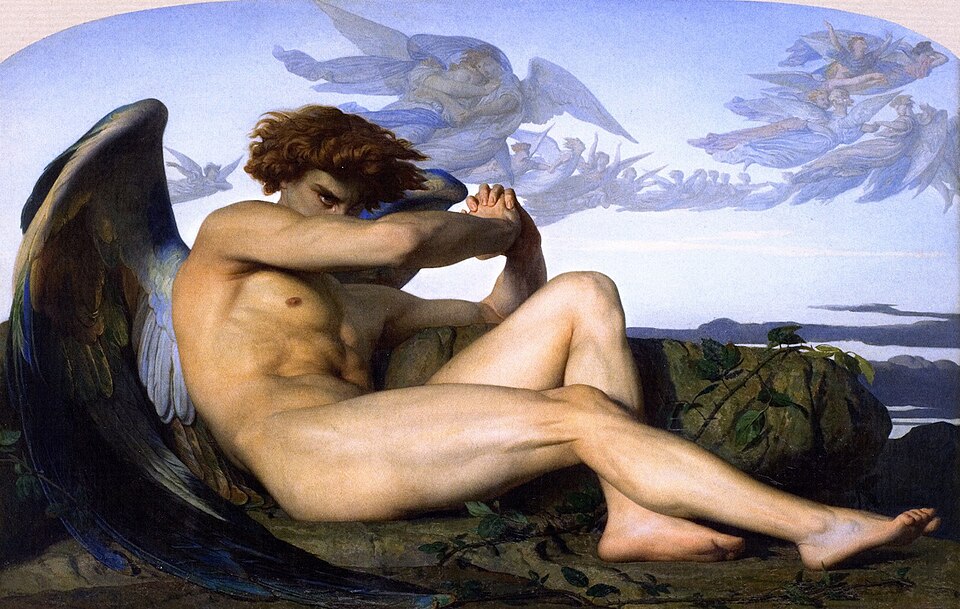
In 1847, at the Villa Médicis in Rome, a twenty-four-year-old French painter set his brush to a subject almost no one in French art had dared to touch directly: the fall of Lucifer from Heaven. Alexandre Cabanel had won the second Grand Prix de Rome in 1845 while studying at the National School of Fine Arts in Paris, a prize that allowed him to move to Italy for a few years to refine his craft. Like every resident artist there, he was obligated to send paintings back to Paris at regular intervals, proof of his progress under the Roman sky. The Fallen Angel was his second such official envoi.
What he sent back was startling. Instead of a conventional biblical or mythological scene, Cabanel painted the exact instant of expulsion — the moment an angel becomes the Devil. His Lucifer is not a monster but a beautiful young man, his body arranged with the same grace a sculptor might give a Greek god or hero. He lies on the ground, nude, his hands crossed before him, tears visibly running from his eyes. His face is only partly visible, shadowed by his own arm, but the glare that escapes from behind it is unmistakably furious.
Above him, the sky tells the rest of the story without a single word. Angels fly upward, away from him, toward the light, all moving in the same direction he now faces but can never follow. Their presence is deliberately less detailed than his — hazy, luminous, a chorus affirming the glory of the God who has just cast him out. The contrast is the entire argument of the painting: glory ascending, and beauty falling.
Cabanel paid enormous attention to the wings, the one clear mark of the angel's former nature. At the scapulars they are mostly white, dappled with touches of blue and gold, but the primary feathers darken into a rich navy that bleeds into the shadowed foreground, as if his own former radiance is being swallowed by the ground he now belongs to. Near his feet and trailing behind his legs, a thorny vine curls through the composition — a small, sharp detail hinting at suffering yet to come.
This was, unmistakably, a Romantic painting, and Cabanel leaned into every convention the movement offered: heightened emotion, physical perfection, a moral drama frozen in a single theatrical pose. The Fallen Angel is often read as showing rage mixed with something more vulnerable — a flicker of disbelief, almost betrayal, at the punishment handed down by the very power he once served faithfully. Before his rebellion, after all, this being had been a loyal angel; the tears suggest a creature who has not fully accepted what he has become.
More from Art

The Painting With No Foreground
A single robed figure stares out at an empty grey sea — and the emptiness itself became a scandal. When it was unveiled in Berlin in 1810, no one knew quite what to do with it.

The Painter Who Chased the Light
For a few purple minutes each evening, an American exile knelt in an English garden and raced the dying sun to paint two little girls lighting lanterns. It took him two years to finish.

When a President Became a God
Look straight up inside the U.S. Capitol dome and you will find George Washington enthroned among the clouds, surrounded by goddesses — the founding father transformed into myth.

Marble Brought Back to Life
A corpse asleep, a wing barely brushing her skin — and marble somehow learns to breathe. This is the moment Antonio Canova dared to carve.

The World Turned Upside Down
Look closely at a sixteenth-century Flemish village and you'll find a man biting a pillar, another carrying daylight in a basket, and a wife slipping a blue cloak over her husband's shoulders. Every gesture is a joke — if you know the language.

The Girl in the Glass Case
She stood two-thirds life size, dressed in a real tutu and human hair — and the critics who saw her in 1881 recoiled as if she were something obscene.