The Altar That Left Its Mountain
A staircase nearly 20 metres wide once climbed toward the gods above the city of Pergamon. Today that staircase stands in Berlin.
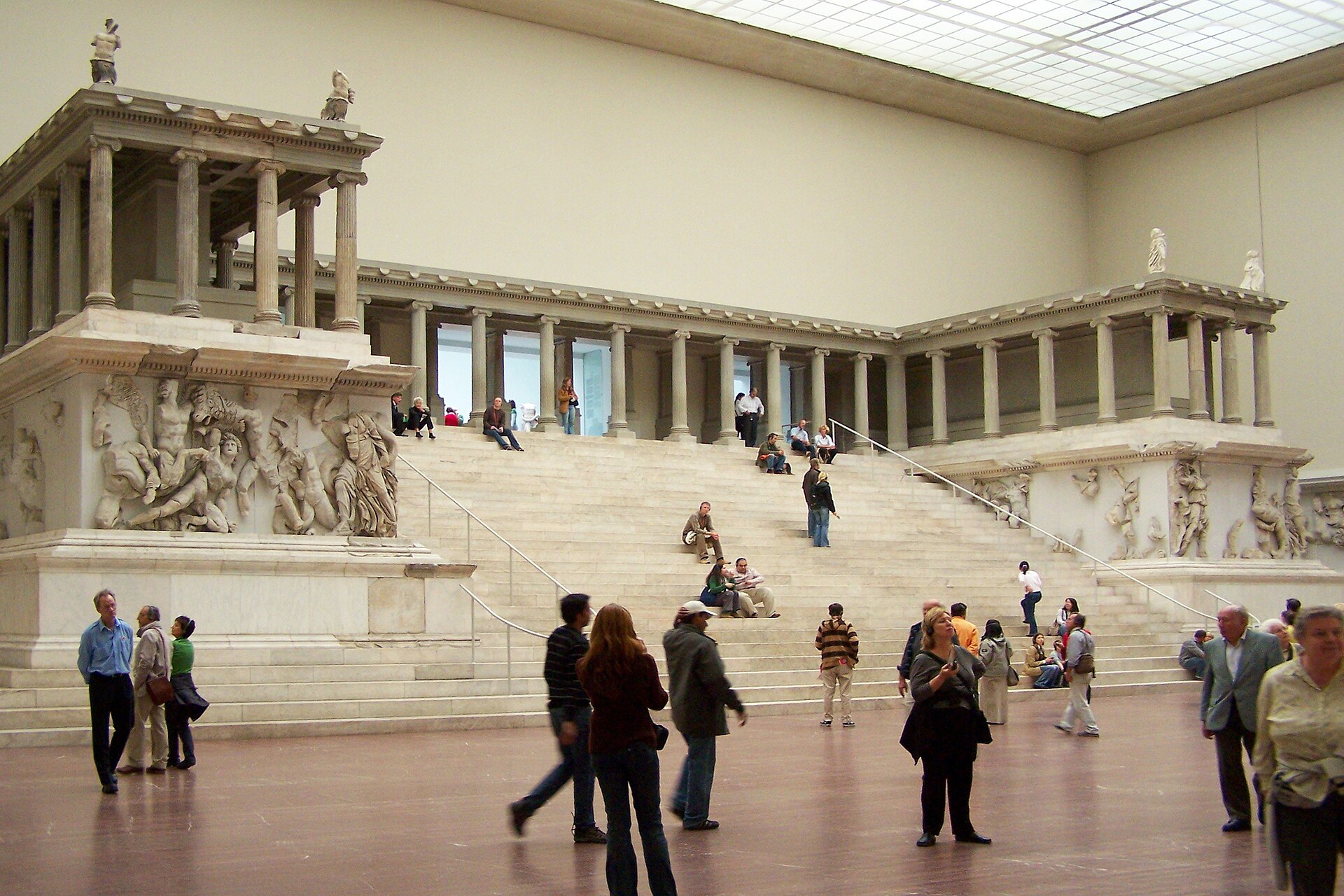
On a terrace high above the Anatolian plain, the kings of Pergamon built something meant to be seen from the valley below: a monumental altar whose front stairway alone stretched almost 20 metres wide, its full footprint measuring 35.74 by 33.4 metres. It was raised during the first half of the 2nd century BC under King Eumenes II, ruler of a small but ambitious Hellenistic kingdom, and three ancient classical lists counted it among the Seven Wonders of the Ancient World.
The kingdom itself had humble beginnings. Founded by Philetaerus in the early 3rd century BC as part of the Seleucid Empire, Pergamon broke free under Attalus I, who declared himself king after defeating the Celtic Galatians in 228 BC. His son, Eumenes II, further curbed Galatian power and ruled alongside his brother Attalus II, who would succeed him. In 188 BC, Eumenes II struck the Treaty of Apamea as an ally of Rome — a deal that shrank Seleucid influence across Asia Minor. Flush with new standing, the Attalids wanted the world to see their importance, and monumental architecture was their language.
The altar's outer base carried a towering high-relief frieze depicting the Gigantomachy — the mythic battle between the Olympian gods and the Giants. A smaller, less well-preserved frieze lined the inner court walls surrounding the actual fire altar at the top of the stairs, telling the story of Telephus, legendary founder of Pergamon and son of Heracles and Auge. Scholars have noted a telling detail: while Rome's founder Romulus was nursed by a she-wolf, Telephus — ancestor of the Attalid line — is shown suckled by a she-lion, a quiet visual claim of superiority over Rome.
For a long time it was thought the altar commemorated a specific victory, perhaps Eumenes II's 184 BC triumph over the Tolistoagian Celts and their leader Ortiagon. But closer study of its construction and friezes undercut that theory — Pergamene victory monuments looked nothing like this. The Gigantomachy frieze avoids direct references to real campaigns almost entirely, save for a 'Star of Macedonia' on one Giant's shield and a Celtic oblong shield in a god's hand. The struggle reads instead as a cosmic, ethical drama, dedicated — the fragmentary inscription suggests — to gods who had bestowed favors, likely Zeus and his daughter Athena, who occupy prominent positions in the frieze.
Dating remains debated. A pottery shard found in the altar's foundation dates to 172/171 BC, meaning construction came later. One influential theory, proposed by Bernard Andreae in 2001, holds that the altar was built between 166 and 156 BC as a general victory monument celebrating Pergamon's triumphs over the Macedonians, Galatians, and Seleucids, designed by the sculptor Phyromachos. Because so much money went to warfare until 166 BC, work likely began only after peace arrived.
More from Art

The Painting With No Foreground
A single robed figure stares out at an empty grey sea — and the emptiness itself became a scandal. When it was unveiled in Berlin in 1810, no one knew quite what to do with it.

The Painter Who Chased the Light
For a few purple minutes each evening, an American exile knelt in an English garden and raced the dying sun to paint two little girls lighting lanterns. It took him two years to finish.

When a President Became a God
Look straight up inside the U.S. Capitol dome and you will find George Washington enthroned among the clouds, surrounded by goddesses — the founding father transformed into myth.

Marble Brought Back to Life
A corpse asleep, a wing barely brushing her skin — and marble somehow learns to breathe. This is the moment Antonio Canova dared to carve.

The World Turned Upside Down
Look closely at a sixteenth-century Flemish village and you'll find a man biting a pillar, another carrying daylight in a basket, and a wife slipping a blue cloak over her husband's shoulders. Every gesture is a joke — if you know the language.

The Girl in the Glass Case
She stood two-thirds life size, dressed in a real tutu and human hair — and the critics who saw her in 1881 recoiled as if she were something obscene.