The Altarpiece That Healed With Horror
To reach a sick ward in sixteenth-century Alsace, you first had to look at a corpse riddled with sores — and find comfort in it. This is the story of an altarpiece built not for beauty, but for the dying.
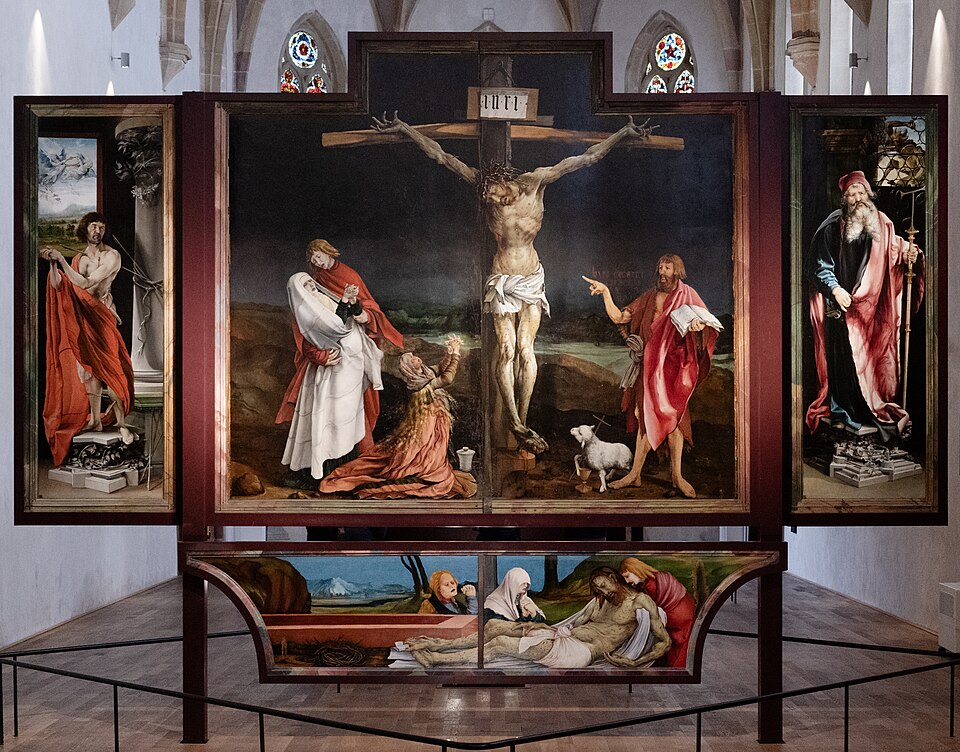
In the monastery hospital of Issenheim, near Colmar, the monks who cared for plague sufferers and victims of ergotism needed more than medicine. Between 1512 and 1516, they commissioned an altarpiece that would meet their patients where their bodies already were: in agony. The German sculptor Nikolaus Hagenauer carved its wooden figures, while the painter Matthias Grünewald covered its panels with images so visceral they remain, five centuries later, among the most unsettling works in Western art.
Most days, the altarpiece stayed closed, showing its most brutal face. At the center, Christ hangs crucified, his body emaciated, his skin pitted with what look unmistakably like plague sores. This was not incidental realism. The Antonine monks who ran the hospital specialized in treating skin diseases and the agony of Saint Anthony's fire, and Grünewald painted a savior who bore the same wounds as the patients staring up at him. Flanking the crucifixion are Saint Sebastian, pierced by arrows, invoked against plague, and Saint Anthony himself, taunted by a monstrous creature yet unmoved — the patron protector of those suffering ergotism.
Around the cross, grief plays out in human terms. The Virgin Mary collapses in anguish into the arms of John the Apostle, wrapped in white cloth. Mary Magdalene kneels in prayer at Christ's side. On the other side stands John the Baptist, accompanied by a lamb symbolizing sacrifice — his presence historically impossible, since he was beheaded years before the crucifixion, but included deliberately as the last prophet to herald the Messiah. Latin words attributed to him, drawn from the Gospel of John, appear beside his figure: he must increase, but I must decrease. Below this scene, the predella shows the Lamentation, Christ's body laid before the open tomb, mourned by Mary, Mary Magdalene, and John.
On important feast days, especially those honoring the Virgin, the monks opened the outer wings to reveal an entirely different mood. The Annunciation appears on the left, Gabriel arriving to tell Mary she will bear the son of God, set within a chapel to mark its sacredness. The central panels merge a Concert of Angels with the Nativity into a single vision: Christ's arrival on earth as an infant destined to battle evil, embodied in angels of unsettling, distorted appearance. Symbols crowd the scene — an enclosed garden for Mary's womb, a thornless rose bush for her freedom from original sin, a fig tree for a mother's milk, and humble domestic objects like a bed and chamber pot underscoring Christ's human nature.
The right wing answers with the Resurrection: Christ rising from the tomb, ascending in blinding light that transforms his crucified face into the face of God. Resurrection and Ascension are compressed into one radiant image, a deliberate counterpoint to the horror sealed behind the closed wings.
More from Art

The Painting With No Foreground
A single robed figure stares out at an empty grey sea — and the emptiness itself became a scandal. When it was unveiled in Berlin in 1810, no one knew quite what to do with it.

The Painter Who Chased the Light
For a few purple minutes each evening, an American exile knelt in an English garden and raced the dying sun to paint two little girls lighting lanterns. It took him two years to finish.

When a President Became a God
Look straight up inside the U.S. Capitol dome and you will find George Washington enthroned among the clouds, surrounded by goddesses — the founding father transformed into myth.

Marble Brought Back to Life
A corpse asleep, a wing barely brushing her skin — and marble somehow learns to breathe. This is the moment Antonio Canova dared to carve.

The World Turned Upside Down
Look closely at a sixteenth-century Flemish village and you'll find a man biting a pillar, another carrying daylight in a basket, and a wife slipping a blue cloak over her husband's shoulders. Every gesture is a joke — if you know the language.

The Girl in the Glass Case
She stood two-thirds life size, dressed in a real tutu and human hair — and the critics who saw her in 1881 recoiled as if she were something obscene.