The Angel's Wing and the Young Master's Eye
Long mistaken for another painter's work, this quiet garden scene turned out to hold the first fingerprints of a genius. Look closely at the angel's wings — someone later couldn't resist making them bigger.
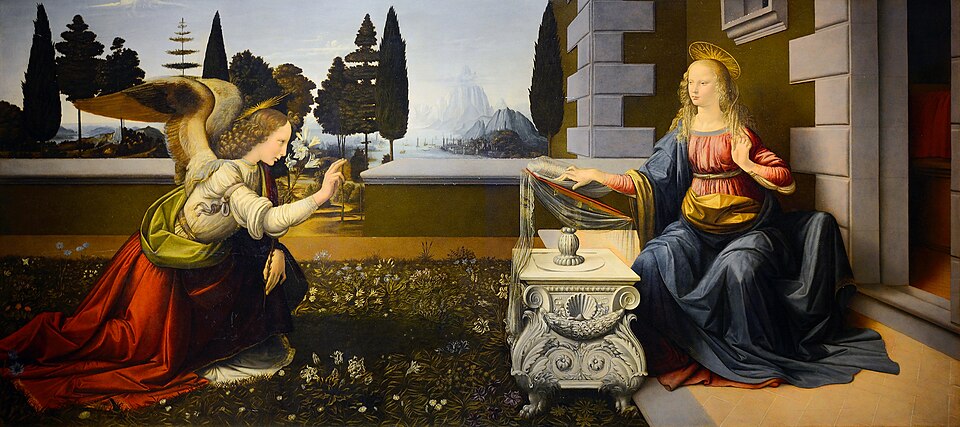
In a Florentine workshop sometime between 1472 and 1476, a young apprentice named Leonardo da Vinci painted his earliest surviving major work. He was training under Andrea del Verrocchio, and the painting he produced — oil and tempera on a broad poplar panel — took up a subject every Florentine artist of the century seemed drawn to: the Annunciation, the moment the angel Gabriel tells Mary she will bear a son named Jesus, the 'Son of God,' whose reign would never end.
The scene follows Luke's gospel, but Leonardo set it apart from the many other versions Florentine painters had produced, including several by Fra Angelico. He placed Mary and Gabriel in an open courtyard, with a sweeping Tuscan landscape and seascape stretching behind them. He used chiaroscuro to soften the figures' forms, letting light and shadow do the work later generations would call sfumato. The architecture obeys the strict rules of linear perspective, converging toward a central vanishing point — though scholars have noted odd touches, like Mary's oddly extended right arm, possibly a trace of Leonardo's early interest in optics and how the painting would have been seen from a side altar.
The details reward close looking. The marble table before Mary likely echoes the tomb of Piero and Giovanni de' Medici in the Basilica of San Lorenzo, a work Verrocchio himself was sculpting around that time. A gauzy, semi-transparent veil covers the book of scripture Mary is reading, a nod to the prophecies of the Old Testament. The Latin letters on the page, drawn from a medieval scribal lexicon, spell nothing in particular — Mary seems to be absorbed less in reading than in contemplating the very shapes of the letters, a mystical mode of spiritual attention. Gabriel holds a Madonna lily, symbol of both Mary's virginity and the city of Florence itself.
Leonardo, ever the observer of nature, is thought to have painted Gabriel's wings after the wings of a real bird in flight. Later, though, another hand lengthened them dramatically, altering the angel's silhouette from what the young Leonardo had intended.
Who actually commissioned the piece remains uncertain. The painting eventually surfaced at the Olivetan monastery of San Bartolomeo near Florence, leading scholars to guess that the monks there may have ordered it for their sacristy following the church's renovation in 1472.
More from Art

The Painting With No Foreground
A single robed figure stares out at an empty grey sea — and the emptiness itself became a scandal. When it was unveiled in Berlin in 1810, no one knew quite what to do with it.

The Painter Who Chased the Light
For a few purple minutes each evening, an American exile knelt in an English garden and raced the dying sun to paint two little girls lighting lanterns. It took him two years to finish.

When a President Became a God
Look straight up inside the U.S. Capitol dome and you will find George Washington enthroned among the clouds, surrounded by goddesses — the founding father transformed into myth.

Marble Brought Back to Life
A corpse asleep, a wing barely brushing her skin — and marble somehow learns to breathe. This is the moment Antonio Canova dared to carve.

The World Turned Upside Down
Look closely at a sixteenth-century Flemish village and you'll find a man biting a pillar, another carrying daylight in a basket, and a wife slipping a blue cloak over her husband's shoulders. Every gesture is a joke — if you know the language.

The Girl in the Glass Case
She stood two-thirds life size, dressed in a real tutu and human hair — and the critics who saw her in 1881 recoiled as if she were something obscene.