The Angel That Outran the Nazis
A small monoprint of a wide-eyed angel crossed borders, hid in a national library, and outlived the man who loved it most.
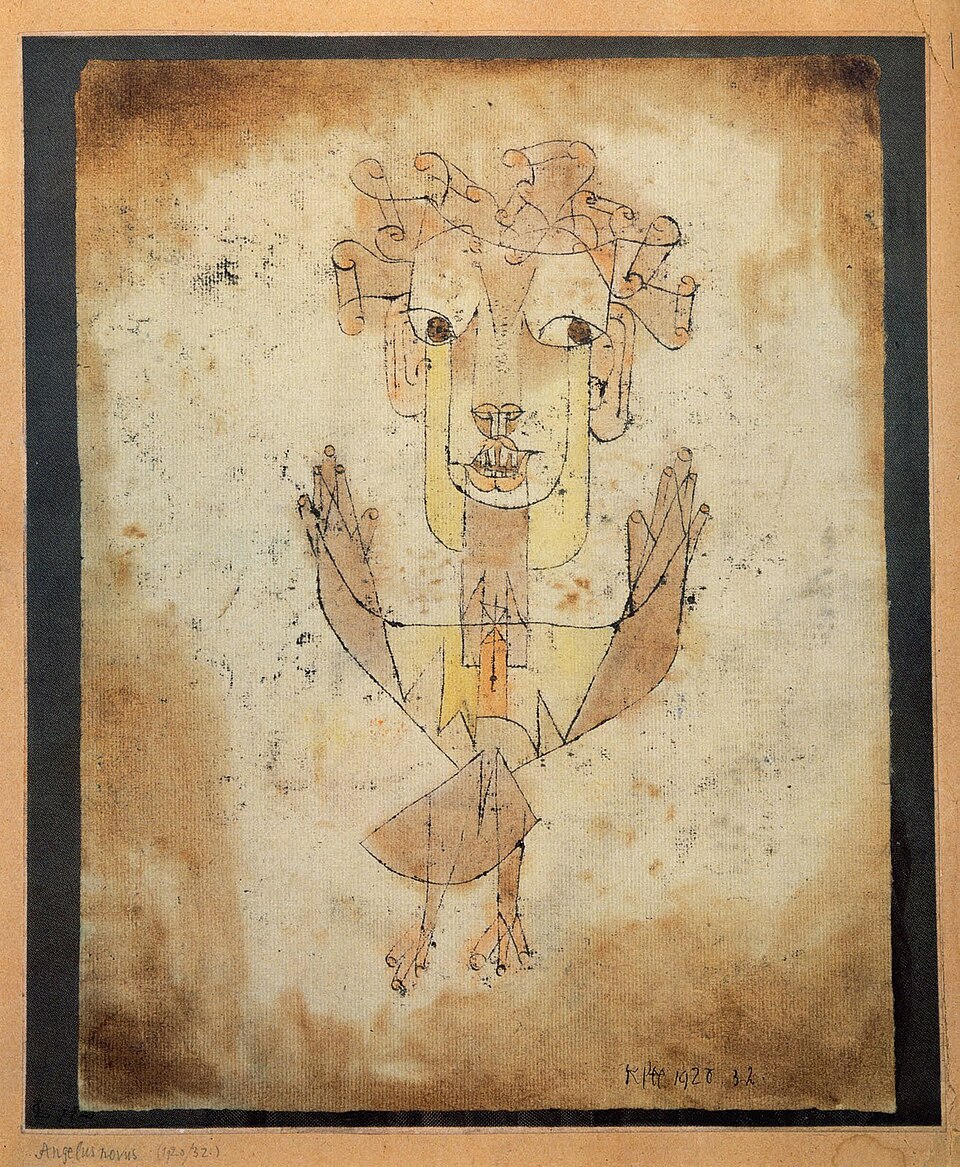
In 1920, the Swiss-German artist Paul Klee produced a strange little monoprint using an oil transfer method of his own invention. He called it Angelus Novus — New Angel. It shows a figure with staring eyes, an open mouth, and wings spread wide, caught in some moment between stillness and flight. It looked, to at least one man who saw it, like nothing less than the face of history itself.
That man was Walter Benjamin, the German critic and philosopher, who bought the print in 1921. He kept it close for over a decade, and when the Nazis rose to power and he was forced to flee Germany in 1933, he carried it with him into exile in Paris. The little angel had become, for Benjamin, something more than art — a personal talisman, almost a companion in flight.
When the Nazis invaded France, Benjamin had to run again. Before he did, he entrusted the print, along with other important papers, to Georges Bataille, who hid it inside the Bibliothèque nationale de France, where he worked. It was a quiet act of custodianship in a moment of chaos — a painting smuggled into the safety of a library while its owner tried to escape a continent at war.
Benjamin did not survive. In September 1940, believing he was about to be deported back to occupied France, he took his own life in Spain. But the angel he had loved kept moving. After the war, Bataille passed the print to Theodor W. Adorno in Frankfurt, who, honoring Benjamin's last wishes, sent it onward to Gershom Scholem — Benjamin's lifelong friend and a scholar of Jewish mysticism who had emigrated to Mandatory Palestine in 1923.
Scholem later explained that Benjamin had felt something like a mystical identification with the Angelus Novus. He wove it into one of his final and most haunting works, the 1940 essay 'Theses on the Philosophy of History.' There, he described the painting as an image of the 'angel of history' — a being whose face is turned toward the past, who sees not a chain of events but one single catastrophe piling wreckage upon wreckage at his feet. The angel wants to stay, Benjamin wrote, to awaken the dead and repair what has been smashed. But a storm from Paradise is caught in his wings, and it hurls him backward into the future he cannot see. That storm, Benjamin said, is what we call progress.
More from Art

The Painting With No Foreground
A single robed figure stares out at an empty grey sea — and the emptiness itself became a scandal. When it was unveiled in Berlin in 1810, no one knew quite what to do with it.

The Painter Who Chased the Light
For a few purple minutes each evening, an American exile knelt in an English garden and raced the dying sun to paint two little girls lighting lanterns. It took him two years to finish.

When a President Became a God
Look straight up inside the U.S. Capitol dome and you will find George Washington enthroned among the clouds, surrounded by goddesses — the founding father transformed into myth.

Marble Brought Back to Life
A corpse asleep, a wing barely brushing her skin — and marble somehow learns to breathe. This is the moment Antonio Canova dared to carve.

The World Turned Upside Down
Look closely at a sixteenth-century Flemish village and you'll find a man biting a pillar, another carrying daylight in a basket, and a wife slipping a blue cloak over her husband's shoulders. Every gesture is a joke — if you know the language.

The Girl in the Glass Case
She stood two-thirds life size, dressed in a real tutu and human hair — and the critics who saw her in 1881 recoiled as if she were something obscene.