The Angel That Silenced a Master
Legend says one brushstroke by a teenage apprentice made his master lay down the paintbrush forever. The evidence is stranger, and more human, than the myth.
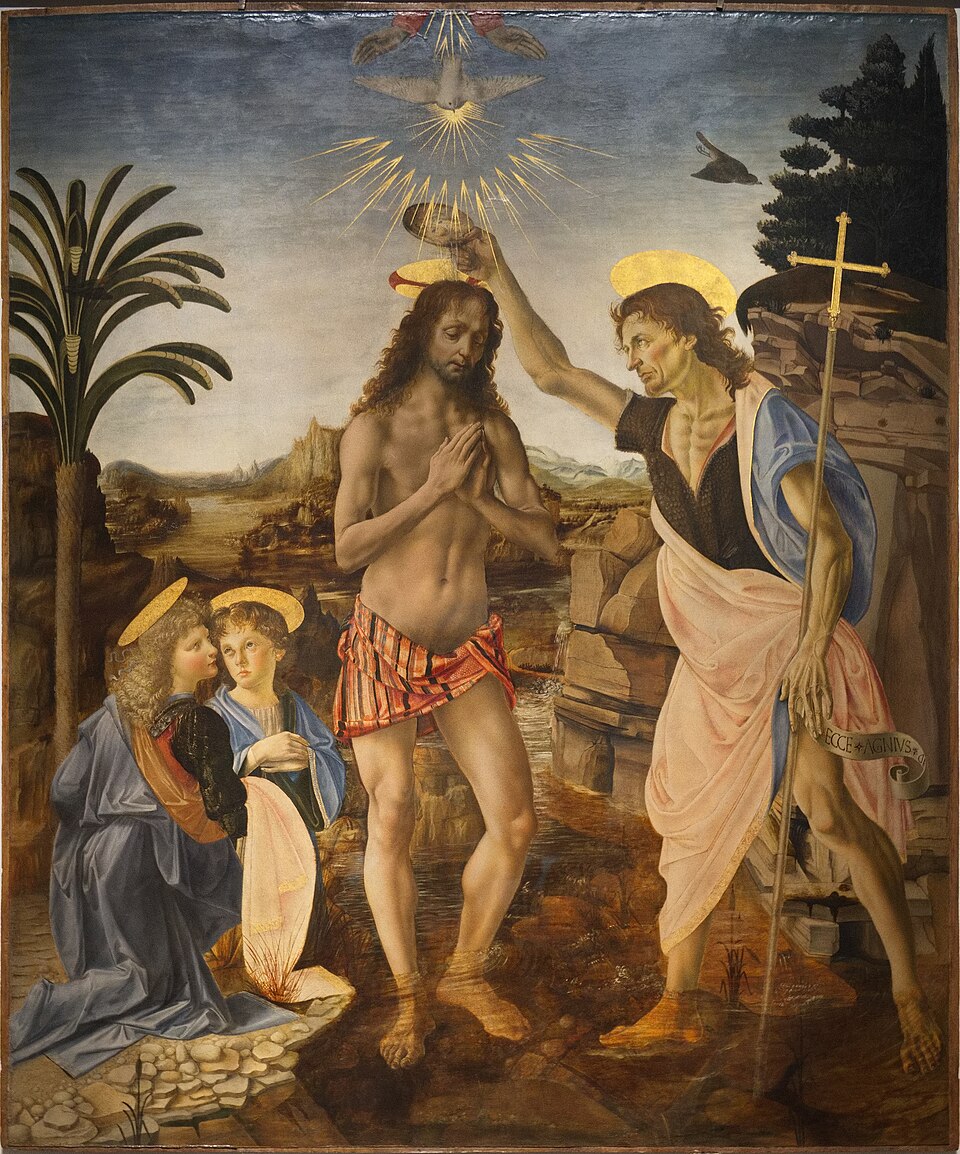
Around 1468, in a bustling Florentine workshop run by the sculptor and goldsmith Andrea del Verrocchio, a wooden panel was begun that would quietly change the course of art history. Verrocchio, though celebrated chiefly for his sculpture, had taken on a religious commission: an altarpiece depicting the Baptism of Christ, ordered by his own brother, Don Simone, head of the monastic Church of San Salvi. It was to show John the Baptist pouring water from the Jordan River over the head of a kneeling Jesus, watched by angels, a hovering dove, and the open hands of God breaking through the sky. The finished painting would not be completed until around 1475.
Verrocchio's workshop was less a studio than a school. He trained his apprentices in anatomy, drawing, mechanics, drapery, and the play of light and shadow, and folded in lessons on geography and literature besides. Among those who passed through his rooms were Botticelli, Perugino, Francesco Botticini, Lorenzo di Credi — and a young man named Leonardo da Vinci. Verrocchio was known to leave sections of his own compositions unfinished, reserved deliberately for his students to complete under his eye.
The Baptism panel became one such shared canvas. Verrocchio painted the core figures — Christ, John the Baptist, and the surrounding landscape — early in the process, working in tempera, the standard medium for Florentine panel painting at the time. Botticini, one of his assistants, also contributed to the central landscape. Then, at some point, Verrocchio set the work aside for several years.
When he returned to it in the 1470s, he handed his young pupil Leonardo a specific task: paint one of the two kneeling angels, the one on the left. Leonardo chose oil paint — a technique still new to Florence, recently introduced by Dutch and Flemish painters, prized for its luminous depth compared to tempera. It is probable that he painted much of the background landscape as well, since that portion is also rendered in oil, giving it a hazy, atmospheric quality distinct from Verrocchio's tempera passages.
The difference, according to the 16th-century biographer Giorgio Vasari, was staggering. Vasari claimed that Leonardo's angel displayed such mastery of color and form that Verrocchio, seeing it, abandoned painting altogether. Vasari never actually met Leonardo, so the story cannot be taken as eyewitness fact — but there is a telling coincidence: Verrocchio's painted output does seem to have stopped soon after, his final known picture, the Virgin and Child with Two Angels, left to be finished by his assistant Lorenzo di Credi.
More from Art

The Painting With No Foreground
A single robed figure stares out at an empty grey sea — and the emptiness itself became a scandal. When it was unveiled in Berlin in 1810, no one knew quite what to do with it.

The Painter Who Chased the Light
For a few purple minutes each evening, an American exile knelt in an English garden and raced the dying sun to paint two little girls lighting lanterns. It took him two years to finish.

When a President Became a God
Look straight up inside the U.S. Capitol dome and you will find George Washington enthroned among the clouds, surrounded by goddesses — the founding father transformed into myth.

Marble Brought Back to Life
A corpse asleep, a wing barely brushing her skin — and marble somehow learns to breathe. This is the moment Antonio Canova dared to carve.

The World Turned Upside Down
Look closely at a sixteenth-century Flemish village and you'll find a man biting a pillar, another carrying daylight in a basket, and a wife slipping a blue cloak over her husband's shoulders. Every gesture is a joke — if you know the language.

The Girl in the Glass Case
She stood two-thirds life size, dressed in a real tutu and human hair — and the critics who saw her in 1881 recoiled as if she were something obscene.