The Backward Glance That Made a Masterpiece
A headless marble torso, rediscovered in Rome centuries ago, became one of the most famous — and most scandalous — statues of antiquity, all because of a restorer's decision about where to point her gaze.
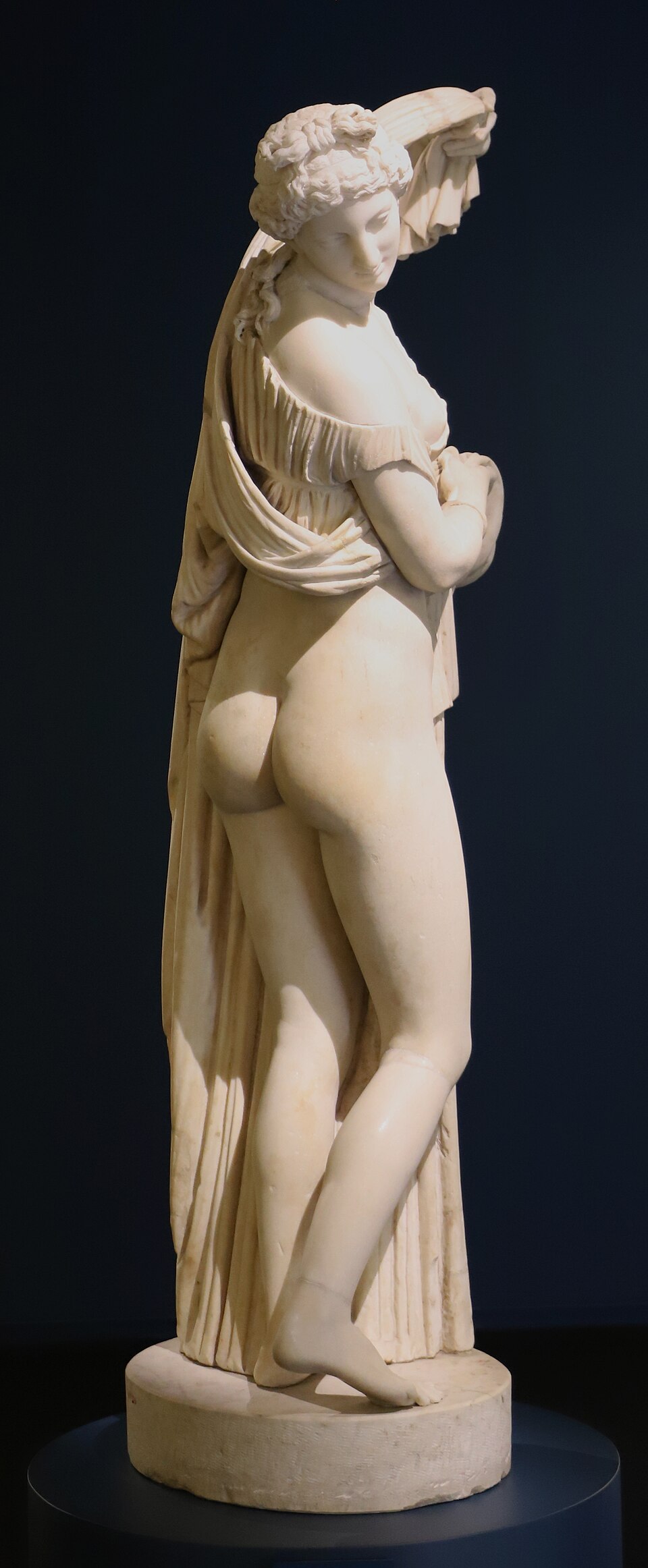
In the late 1st century BC, a Roman sculptor carved a partially draped woman in marble, lifting the edge of her light peplos to reveal her hips and buttocks. She was likely copying an older Greek work, thought to have been cast in bronze around 300 BC, near the dawn of the Hellenistic age. That Greek original has vanished entirely, known to us only through this Roman echo — and even the echo arrived incomplete.
When the statue resurfaced in Rome by at least the 16th century, it was missing its head. Legend once placed its discovery among the ruins of Nero's Domus Aurea, but the fragments found there show no trace of artistry this fine, making that origin story unlikely. Whoever carved the original body, and wherever it truly lay buried, remains unknown.
The missing head posed a problem, and the solution a 16th-century restorer chose would shape the statue's identity for centuries. Rather than facing forward, the reconstructed head was turned to look back over the shoulder, down at her own uncovered buttocks — as if evaluating them herself. This single decision transformed a damaged fragment into something far more provocative and memorable.
By 1594, the statue belonged to the Farnese family and stood in the Palazzo Farnese, later kept in the Sala dei Filosophi among busts of eighteen ancient philosophers. In 1731, Charles of Bourbon inherited the Farnese estate and moved the marble across the Tiber to the Villa Farnesina. Decades later, in 1786, as the Bourbons prepared to relocate the entire Farnese Collection to Naples, the statue was sent first to sculptor Carlo Albacini for restoration.
Albacini, responding to criticisms of certain features, replaced the head, arms, and one leg — but he kept faith with the earlier restorer's choice, having the figure look back over her shoulder once more. By 1792 the statue stood in the Museo di Capodimonte, and by 1802 it had settled into what is now the Naples National Archaeological Museum, where it remains today as part of the Farnese Collection.
More from Art

The Painting With No Foreground
A single robed figure stares out at an empty grey sea — and the emptiness itself became a scandal. When it was unveiled in Berlin in 1810, no one knew quite what to do with it.

The Painter Who Chased the Light
For a few purple minutes each evening, an American exile knelt in an English garden and raced the dying sun to paint two little girls lighting lanterns. It took him two years to finish.

When a President Became a God
Look straight up inside the U.S. Capitol dome and you will find George Washington enthroned among the clouds, surrounded by goddesses — the founding father transformed into myth.

Marble Brought Back to Life
A corpse asleep, a wing barely brushing her skin — and marble somehow learns to breathe. This is the moment Antonio Canova dared to carve.

The World Turned Upside Down
Look closely at a sixteenth-century Flemish village and you'll find a man biting a pillar, another carrying daylight in a basket, and a wife slipping a blue cloak over her husband's shoulders. Every gesture is a joke — if you know the language.

The Girl in the Glass Case
She stood two-thirds life size, dressed in a real tutu and human hair — and the critics who saw her in 1881 recoiled as if she were something obscene.