The Bard Who Never Was: The Ossian Deception That Conquered Europe
A blind Highland bard, singing of mist and grief and dead heroes, captivated Napoleon, Jefferson, and Goethe — but the man who 'found' his poems may have written them himself.
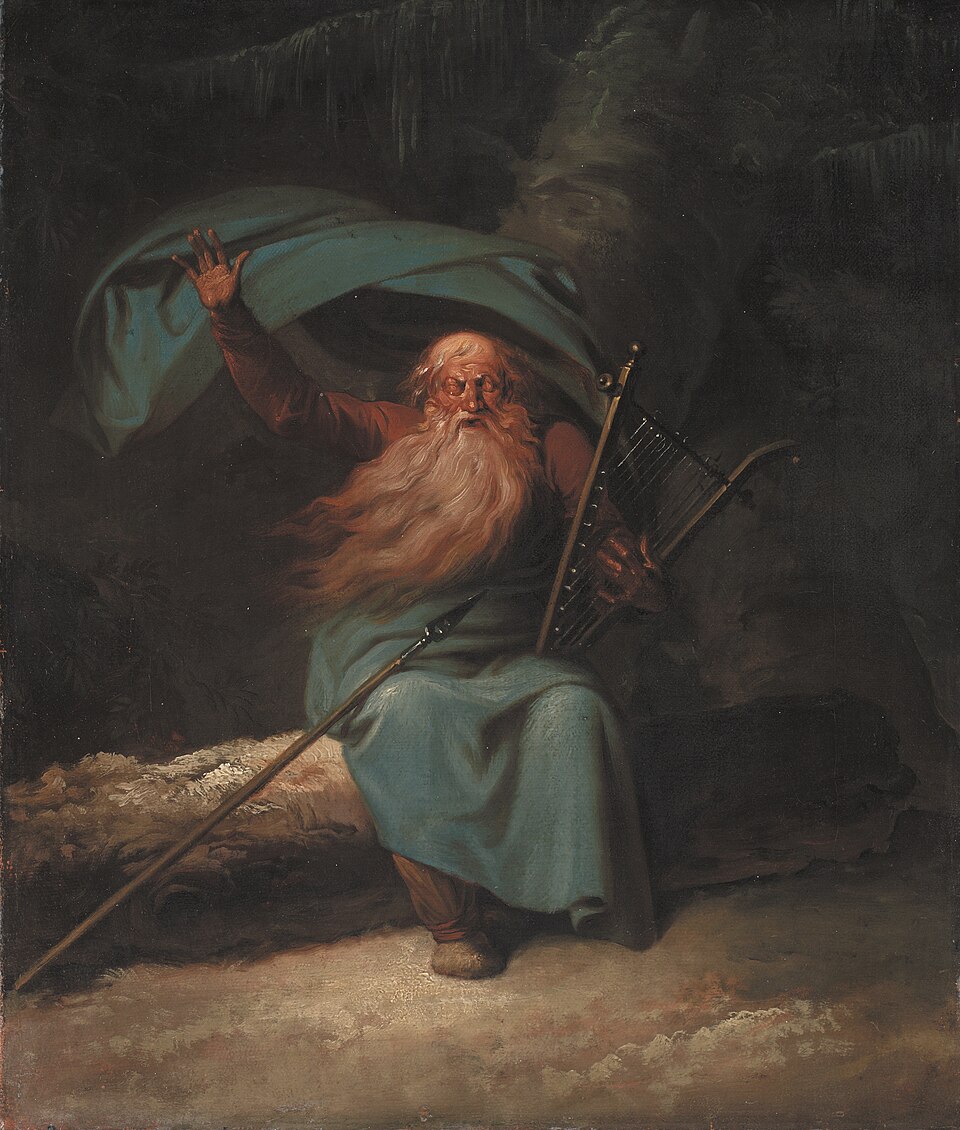
In 1760, a young Scottish poet named James Macpherson published something extraordinary: Fragments of ancient poetry, collected in the Highlands of Scotland, and translated from the Gaelic or Erse language. He claimed these fragments were relics of oral tradition, remnants of a lost Gaelic epic tradition passed down for centuries. The response was immediate curiosity, and Macpherson, sensing opportunity, said he had obtained further manuscripts. By 1761 he announced he had found a full epic about the hero Fingal, composed by a blind bard named Ossian.
Ossian, as Macpherson presented him, was an old, blind poet reciting the tales of his dead son Oscar, his father Fingal, and Oscar's grieving lover Malvina — a name Macpherson himself invented. Fingal was loosely modeled on the Irish legendary hero Fionn mac Cumhaill, and Ossian himself echoed Oisín, son of Fionn in Irish mythology. Macpherson insisted his publisher required English translation since there was supposedly no market otherwise, and over the following years he issued what he called translations, culminating in The Works of Ossian in 1765. Fingal, dated 1762, became the most celebrated of these.
The poems themselves were strange and hypnotic: poetic prose in short, simple sentences, without a single continuous narrative but recurring characters. The stories dwelt on endless battles and unhappy loves, yet gave almost no context for the conflicts or the enemies involved. Characters killed loved ones by accident and died of grief or even joy. There was scarcely any description of religion, culture, society, or buildings — only a landscape of eternal mist, decrepit suns, and ephemeral meteors. Fingal ruled a corner of south-west Scotland resembling the historical kingdom of Dál Riata, and the setting seemed to be the 3rd century, with references — Macpherson and his supporters claimed — to the Roman emperors Caracalla ('Caracul') and Carausius ('Caros, king of ships').
Whatever their true origin, the poems became a sensation across Europe. Napoleon and Diderot admired them; Voltaire wrote parodies; Thomas Jefferson called Ossian 'the greatest poet that has ever existed' and even planned to learn Gaelic to read the originals. Enthusiasts placed Ossian alongside Homer as a Celtic answer to the Classical canon — Thoreau himself judged the 'genuine remains of Ossian' comparable in stamp to the Iliad. Walter Scott counted among the writers influenced, and painters and composers turned to Ossianic subjects across the continent.
The Hungarian national poet Sándor Petőfi went so far as to write a poem titled Homer and Ossian, setting the two side by side. More broadly, historians agree that the Ossian cycle, however dubious its authenticity, popularized Celtic mythology throughout Europe and became one of the earliest and most influential texts to inspire romantic nationalism in the century that followed — a mythical vision of Scotland that helped spur enlightened patriotism and modern European nationalism itself.//
More from Mythology

The Doctor Who Sang a Nation Into Being
A country doctor rode into the forests of Karelia armed with nothing but a notebook — and rode out with the soul of a nation.

The Boat That Carried the Sun
Every sunset, the ancient Egyptians believed, the sun climbed into a boat and sailed straight into the realm of the dead — only to fight a monstrous serpent before dawn could return.

The Wild Man of the Snows
At 21,000 feet, a colonel found tracks in the snow that he blamed on a wolf — but his guides knew better, and gave the world a name that would echo for a century.

The Knight Who Went Mad for Love: Orlando Furioso
A hero so devoted to duty he was Charlemagne's greatest paladin loses his mind—not to a sword wound, but to heartbreak. To cure him, a friend must ride a flying horse to the Moon.

The Book That Turned the World Into Myth
A poet condemned to exile spent his final years in Rome finishing a poem that would outlive empires—a poem about nothing standing still, not gods, not lovers, not even the shape of a man.

Paradise Lost: Milton's Rebel Angel
A blind poet, dictating verses in the dark, dared to explain the ways of God to men — and in doing so, made Hell's ruler unforgettable.