The Barefoot God of Prima Porta
Buried in a dead empress's garden for eighteen centuries, a marble emperor waited to be dug up and stare down eternity again.
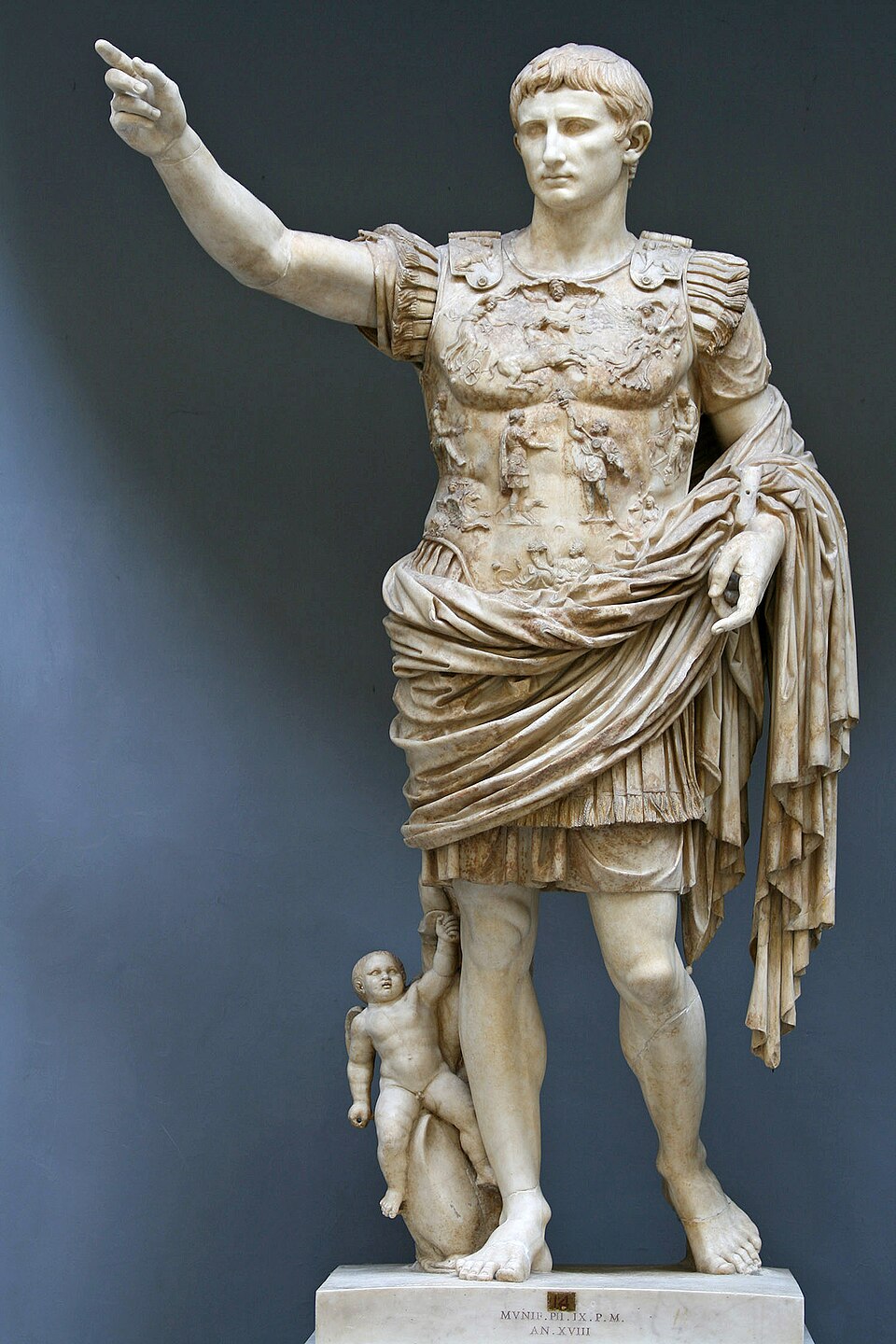
On April 20, 1863, workers digging under Giuseppe Gagliardi's direction near the ninth milestone of the Via Flaminia broke into the ruins of the Villa ad Gallinas Albas — the country retreat where Livia Drusilla, widow of Augustus, had withdrawn after her husband's death in AD 14. What emerged from the soil was a marble man over two meters tall, arm raised, armor gleaming even in stone. The German archaeologist Wilhelm Henzen announced the find that same year, and the statue would go on to become the most recognizable face of the first Roman emperor.
The statue stands 2.08 meters tall and weighs roughly 1,000 kilograms. Carved from marble in the 1st century AD, likely by Greek-trained hands, it is widely believed to be a copy of a lost bronze original once displayed in Rome. Its face is unmistakably Augustus — the somber gaze, the familiar fringe of hair — rendered with the sober realism of Republican portraiture. But the body tells a different story: idealized, heroic, borrowed wholesale from Greek sculptural tradition.
That body's pose was lifted almost directly from the Doryphoros, the Spear-Bearer carved by Polykleitos in the 5th century BC. The contrapposto stance — one leg taut and bearing weight, the other relaxed, as if the figure is stepping forward — was a hallmark of classical Greek sculpture. Romans of the era had even misidentified the Doryphoros as a portrait of Achilles, which made the borrowed pose all the more fitting for an emperor being cast as a warrior-hero.
Augustus appears here as imperator, the supreme commander, wearing a cuirass and raising his right hand in the adlocutio gesture — the pose of a general addressing his troops. He may originally have held a spear or a consular baton, since lost. His feet are bare, an unusual detail for a military figure, but a deliberate one: bare feet were the visual shorthand classical artists used to signal that a mortal had crossed into the realm of gods and heroes.
The breastplate itself is a small political universe. Carved across the lorica musculata are figures representing Mars, god of war, alongside personifications of the lands Augustus had brought under Roman control — Hispania, Gaul, Germania. At its center is the image that gives the whole statue its meaning: a Parthian handing back Roman military standards to a Roman soldier. This depicted the recovery, in 20 BC, of the eagle standards that Parthia had seized decades earlier from the legions of Marcus Licinius Crassus — one of Augustus's proudest diplomatic victories, and a symbol of the Pax Romana he claimed to have secured. Above it all, the chariot of the Sun rises, illuminating the emperor's deeds.
More from Art

The Painting With No Foreground
A single robed figure stares out at an empty grey sea — and the emptiness itself became a scandal. When it was unveiled in Berlin in 1810, no one knew quite what to do with it.

The Painter Who Chased the Light
For a few purple minutes each evening, an American exile knelt in an English garden and raced the dying sun to paint two little girls lighting lanterns. It took him two years to finish.

When a President Became a God
Look straight up inside the U.S. Capitol dome and you will find George Washington enthroned among the clouds, surrounded by goddesses — the founding father transformed into myth.

Marble Brought Back to Life
A corpse asleep, a wing barely brushing her skin — and marble somehow learns to breathe. This is the moment Antonio Canova dared to carve.

The World Turned Upside Down
Look closely at a sixteenth-century Flemish village and you'll find a man biting a pillar, another carrying daylight in a basket, and a wife slipping a blue cloak over her husband's shoulders. Every gesture is a joke — if you know the language.

The Girl in the Glass Case
She stood two-thirds life size, dressed in a real tutu and human hair — and the critics who saw her in 1881 recoiled as if she were something obscene.