The Barmaid Who Would Not Meet Your Eyes
A young woman stands behind a marble counter, surrounded by chandeliers, oranges, and champagne — and yet she seems utterly alone. What the mirror behind her reveals will unravel the picture entirely.
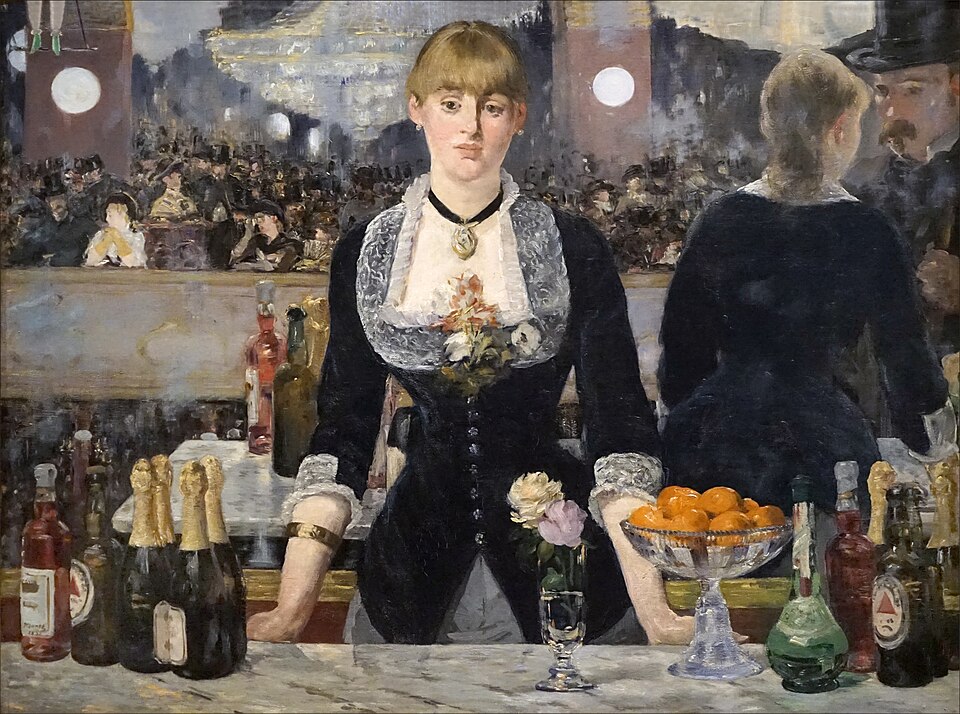
In 1882, a dying man went to his studio instead of the nightclub he wanted to paint. Édouard Manet was too ill to spend his evenings at the Folies-Bergère, the raucous Parisian music hall where trapeze artists swung above champagne-soaked crowds, so he brought the nightclub to him. He hired a real barmaid from the establishment, a woman known to history only as Suzon, and posed her behind a bar he had assembled indoors. The result, A Bar at the Folies-Bergère, would become his last major work, painted and exhibited at the Paris Salon that same year, a little over a year before his death.
The painting shows Suzon standing before a mirror that stretches the entire four-and-a-quarter-foot width of the canvas. Behind her, reflected in gilt-framed glass, the club roars on: chandeliers blaze, a crowd murmurs, and in the upper left corner a pair of green shoes dangle — the feet of a trapeze performer suspended above it all. In front of her sit oranges, flowers, and bottles of Bass Pale Ale, easily identified by the red triangle stamped on their labels.
Because Manet worked from memory for the background, relying on what he recalled of the club's atmosphere rather than direct observation, critics almost immediately accused him of botching the perspective. The mirror, they said, could not possibly reflect what it does — Suzon's reflection appears too far to the right, and a man in a top hat, reflected beside her, seems to occupy a position that shouldn't exist relative to where he'd need to stand to see her that way.
For over a century the debate simmered. Then in 2000, art historian Malcolm Park staged a physical reconstruction of the scene and demonstrated that Manet's perspective was, in fact, entirely possible. The supposed conversation between barmaid and gentleman that generations of viewers assumed they were witnessing turned out to be an optical illusion: the man stands outside the painter's own field of vision, off to the left, looking away from her rather than toward her. The real vantage point belongs to the viewer, standing to the right, closer to the bar than that reflected man ever was.
This sleight of perspective does more than solve a technical puzzle — it exposes something raw about the painting's emotional core. Seen in the mirror, Suzon appears to be leaning into conversation, engaged with a customer. But facing us directly, her expression is closed, remote, self-protective. Manet had originally sketched her positioned off to the right in his preliminary studies; in the final canvas he moved her to the very center, yet left her reflection where it was. The gap between the two Suzons — present and withdrawn — is the painting's quiet ache.
More from Art

The Painting With No Foreground
A single robed figure stares out at an empty grey sea — and the emptiness itself became a scandal. When it was unveiled in Berlin in 1810, no one knew quite what to do with it.

The Painter Who Chased the Light
For a few purple minutes each evening, an American exile knelt in an English garden and raced the dying sun to paint two little girls lighting lanterns. It took him two years to finish.

When a President Became a God
Look straight up inside the U.S. Capitol dome and you will find George Washington enthroned among the clouds, surrounded by goddesses — the founding father transformed into myth.

Marble Brought Back to Life
A corpse asleep, a wing barely brushing her skin — and marble somehow learns to breathe. This is the moment Antonio Canova dared to carve.

The World Turned Upside Down
Look closely at a sixteenth-century Flemish village and you'll find a man biting a pillar, another carrying daylight in a basket, and a wife slipping a blue cloak over her husband's shoulders. Every gesture is a joke — if you know the language.

The Girl in the Glass Case
She stood two-thirds life size, dressed in a real tutu and human hair — and the critics who saw her in 1881 recoiled as if she were something obscene.