The Bather Who Made Nudity Respectable
For a moment in a Yorkshire stream, an English painter found the one loophole that let him paint what polite society forbade him to paint.
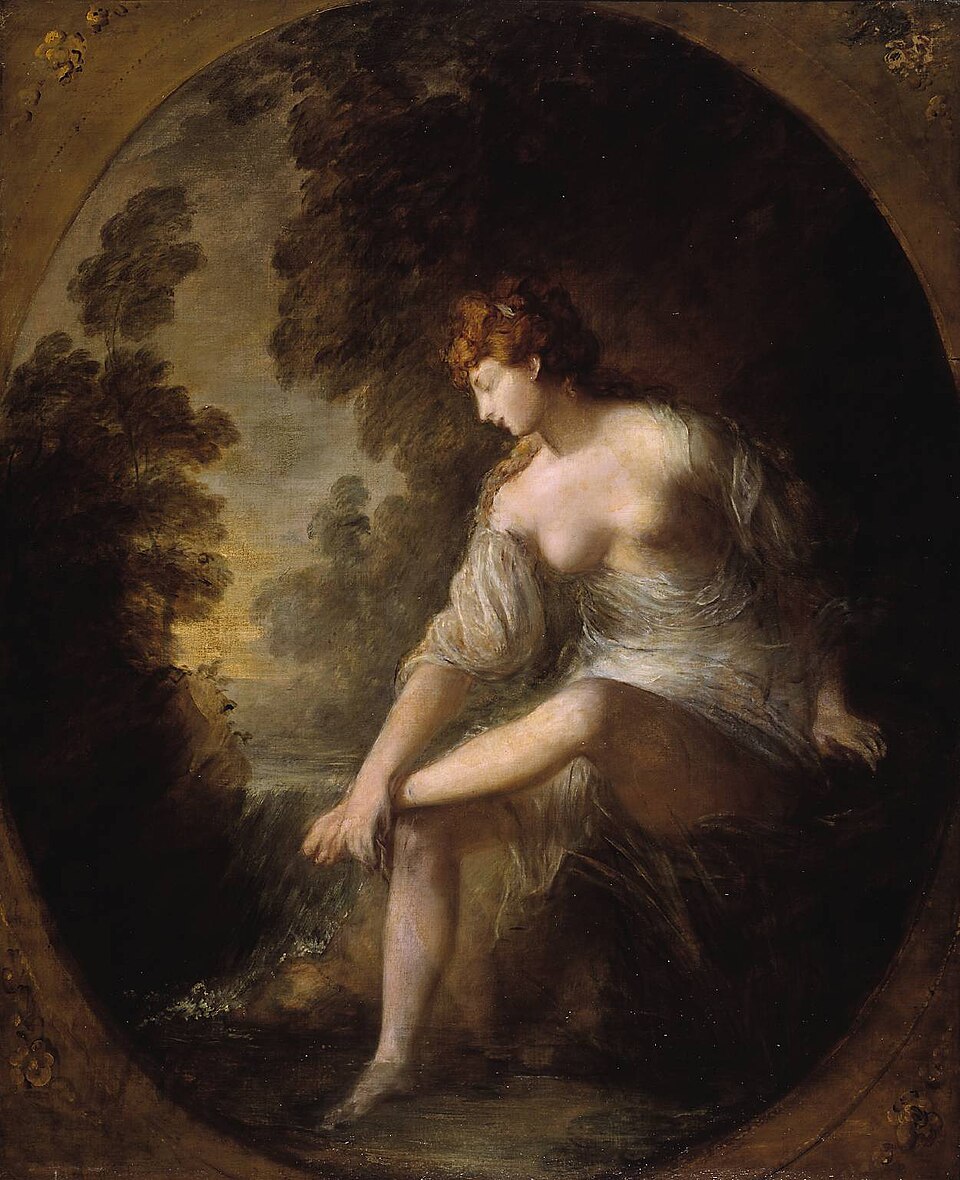
William Etty was born in York in 1787, the seventh child of a baker and miller, and began his working life not with a brush but as an apprentice printer in Hull at the age of eleven. When his seven-year apprenticeship ended, he travelled to London with, as he put it, only a few pieces of chalk crayons, determined to become a history painter in the grand manner of the Old Masters. He studied under Thomas Lawrence and steeped himself in the work of Titian and Rubens, submitting canvas after canvas to the Royal Academy and the British Institution, only to be rejected or ignored.
His fortunes turned in 1821, when the Royal Academy accepted The Arrival of Cleopatra in Cilicia, a large canvas crowded with nude figures. It was a triumph. Fellow artists admired him, and in 1828 he was elected a full Royal Academician, ahead of John Constable. Etty became known above all for his handling of flesh tones and his fascination with the subtle contrasts of skin, and for the next decade he tried to repeat Cleopatra's success by returning again and again to nude figures set within biblical, mythological, or literary scenes. Between 1820 and 1829 alone he exhibited fifteen paintings, fourteen of which included nudity.
This was dangerous ground. England had no real tradition of nude painting for public display, and since the 1787 Proclamation for the Discouragement of Vice, such imagery had been actively suppressed. Etty was the first British artist to specialise in the nude, and critics regularly condemned his female nudes as indecent, even as his male nudes were more warmly received. From 1832 he made a conscious effort to anchor his nudity in moral or literary justification, seeking subjects that would let him paint the body without inviting outright censure.
Musidora gave him exactly that. The subject came from Summer, a 1727 poem by the Scottish writer James Thomson, later folded into his hugely successful collection The Seasons, revised in 1744 and reprinted in over 400 editions across languages by 1870. In the poem, the young Damon sits by a stream on a hot day when Musidora, unaware she is observed, undresses to bathe. Damon is caught between desire and what the poem calls delicate refinement, the sense that he ought to look away. He chooses restraint, leaving a note promising to guard her privacy from any vagrant foot or licentious eye. Musidora, startled at first, reads the note, realises Damon wrote it, and feels both admiration for his conduct and pride that her beauty provoked it. She leaves a note of her own, telling him to stay discreet, for the time may come when he need not flee.
Because the scene came from a respected work of English literature, it offered painters a legitimate excuse to depict a nude female body at a time when such images were otherwise suppressed. Musidora became one of the few subjects mainstream English artists could safely paint, later described as the nation's surrogate Venus.
More from Art

The Painting With No Foreground
A single robed figure stares out at an empty grey sea — and the emptiness itself became a scandal. When it was unveiled in Berlin in 1810, no one knew quite what to do with it.

The Painter Who Chased the Light
For a few purple minutes each evening, an American exile knelt in an English garden and raced the dying sun to paint two little girls lighting lanterns. It took him two years to finish.

When a President Became a God
Look straight up inside the U.S. Capitol dome and you will find George Washington enthroned among the clouds, surrounded by goddesses — the founding father transformed into myth.

Marble Brought Back to Life
A corpse asleep, a wing barely brushing her skin — and marble somehow learns to breathe. This is the moment Antonio Canova dared to carve.

The World Turned Upside Down
Look closely at a sixteenth-century Flemish village and you'll find a man biting a pillar, another carrying daylight in a basket, and a wife slipping a blue cloak over her husband's shoulders. Every gesture is a joke — if you know the language.

The Girl in the Glass Case
She stood two-thirds life size, dressed in a real tutu and human hair — and the critics who saw her in 1881 recoiled as if she were something obscene.