The Bean That Ate the Sky
Chicago picked a giant mirrored bean over a glass playground slide — and got a sculpture that folds the entire skyline into a single seamless drop of liquid mercury.
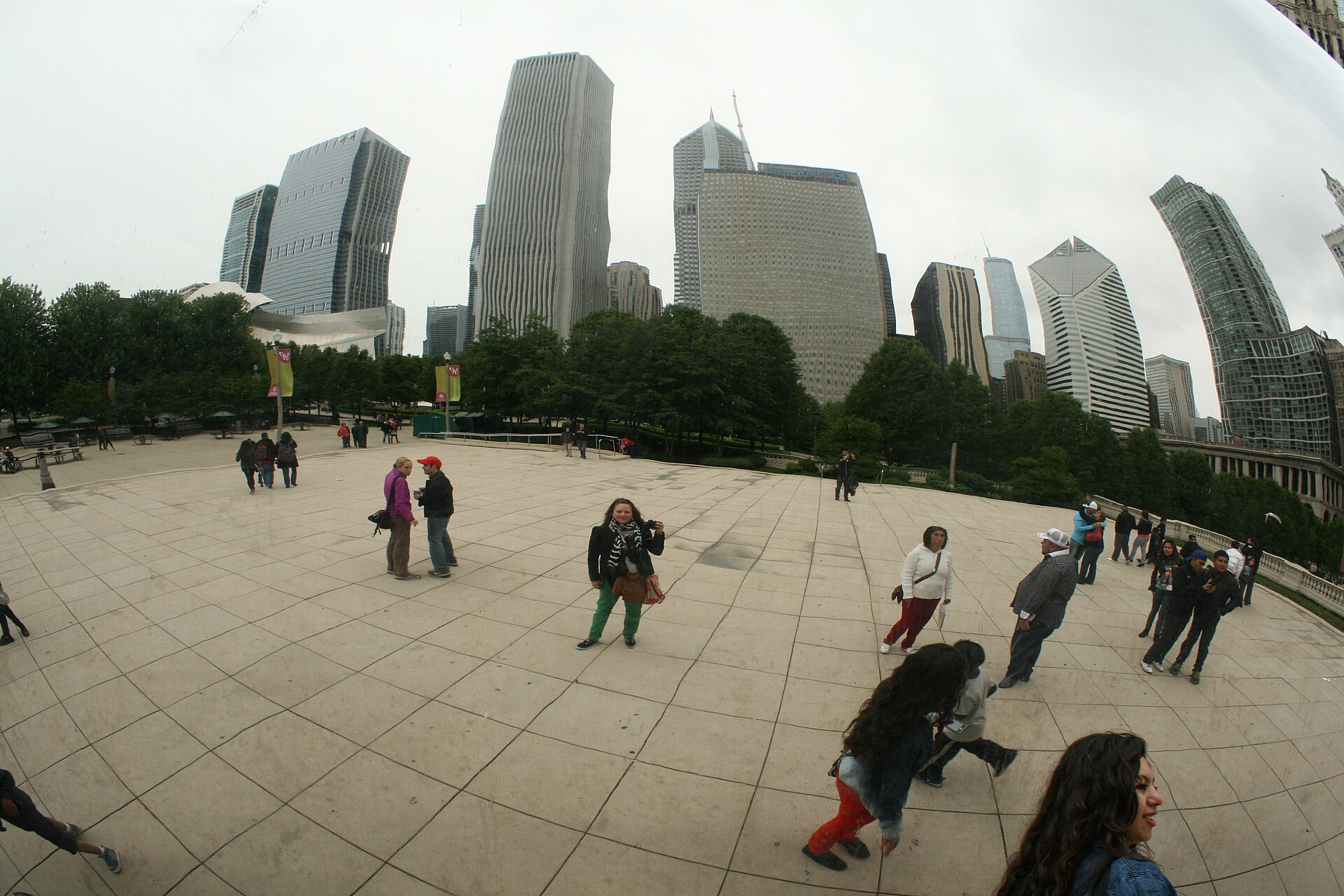
In 1999, officials assembling Chicago's new Millennium Park invited proposals from two acclaimed artists. American sculptor Jeff Koons pitched a 150-foot playground slide in glass and steel, complete with an elevator to a 90-foot observation deck. The committee, however, chose a different vision entirely: a work by internationally acclaimed artist Anish Kapoor, inspired not by amusement rides but by the shimmering, shape-shifting surface of liquid mercury.
Kapoor's design called for a seamless stainless-steel form measuring 33 by 66 by 42 feet and weighing 110 short tons. Its polished skin would mirror the Chicago skyline while its elliptical curves twisted and distorted the reflection — clouds, skyscrapers, and passersby all bending across its surface. The sculpture was originally meant to anchor the Lurie Garden in the park's southeast corner, but officials judged it too large for that space and moved it, over Kapoor's objections, to what became Grainger Plaza, sited above Millennium Hall between the Chase Promenade and McCormick Tribune Plaza & Ice Rink.
Building it was another matter. Architect Norman Foster had once believed a truly seamless steel exterior of this kind was nearly impossible to achieve. Engineers worried about heat retention that could make the surface scorching in summer or cold enough to stick a tongue to in winter, and about seasonal temperature swings weakening the structure. Graffiti, bird droppings, and fingerprints threatened to mar its mirror finish. Various experts were consulted, and some doubted the design could be built at all.
Eventually a workable method was found, but construction fell behind schedule. When Millennium Park held its grand opening celebration in July 2004, the sculpture was unveiled still incomplete — press at the time described its concave underside as a 'spoon-like underbelly' — before being concealed again so the work could continue. It wasn't formally dedicated until May 15, 2006.
The finished piece is made of 168 stainless steel plates, welded together so precisely that no seam is visible anywhere on its surface. Visitors can walk beneath its 12-foot-high arch and stand inside the omphalos — a Greek word meaning 'navel' — a concave chamber on the underside whose apex rises 27 feet above the ground, multiplying and warping reflections of anyone who stands beneath it. Around the structure, skyscrapers along East Randolph Street, including the Smurfit-Stone Building, Two Prudential Plaza, One Prudential Plaza, and Aon Center, appear stretched and folded across its curved sides.
More from Art

The Painting With No Foreground
A single robed figure stares out at an empty grey sea — and the emptiness itself became a scandal. When it was unveiled in Berlin in 1810, no one knew quite what to do with it.

The Painter Who Chased the Light
For a few purple minutes each evening, an American exile knelt in an English garden and raced the dying sun to paint two little girls lighting lanterns. It took him two years to finish.

When a President Became a God
Look straight up inside the U.S. Capitol dome and you will find George Washington enthroned among the clouds, surrounded by goddesses — the founding father transformed into myth.

Marble Brought Back to Life
A corpse asleep, a wing barely brushing her skin — and marble somehow learns to breathe. This is the moment Antonio Canova dared to carve.

The World Turned Upside Down
Look closely at a sixteenth-century Flemish village and you'll find a man biting a pillar, another carrying daylight in a basket, and a wife slipping a blue cloak over her husband's shoulders. Every gesture is a joke — if you know the language.

The Girl in the Glass Case
She stood two-thirds life size, dressed in a real tutu and human hair — and the critics who saw her in 1881 recoiled as if she were something obscene.