The Bell That Kept Ringing
Two peasants bow their heads over a basket of potatoes — and somehow that quiet gesture would spark a bidding war, a vandal's attack, and one of the strangest theories in art history.
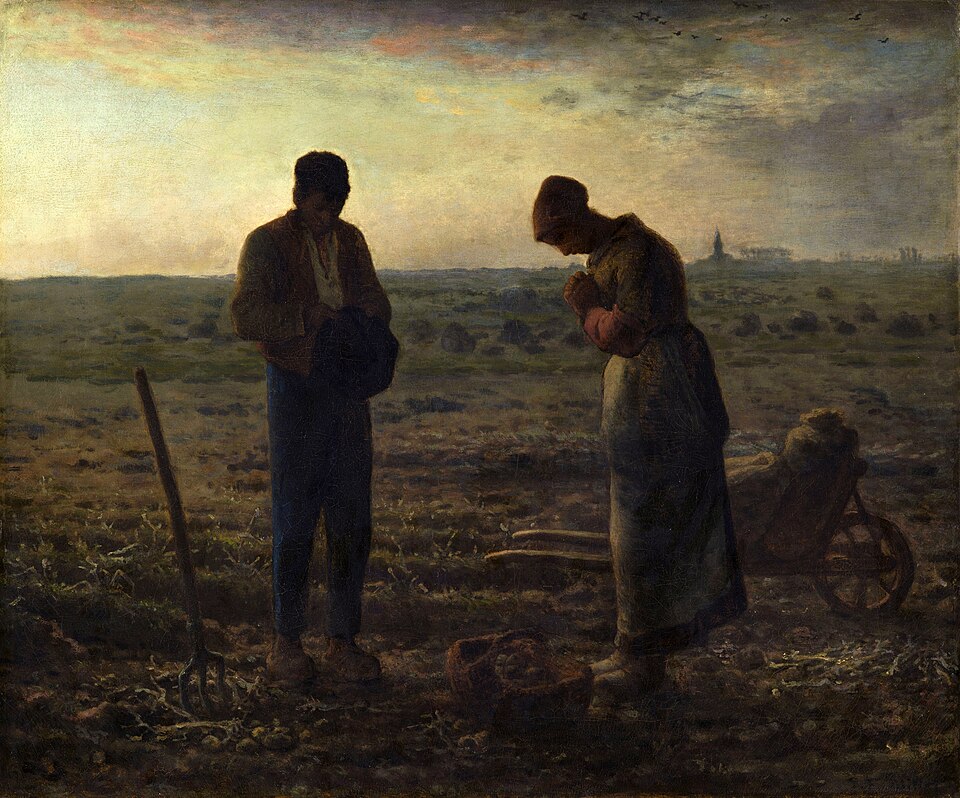
In a field near the French village of Barbizon, a man and a woman stop their work. Their heads are lowered, their hands folded, and at their feet sits a small basket of potatoes, a fork, some sacks, a wheelbarrow. On the horizon, barely visible, stands the steeple of the church at Chailly-en-Bière. This is the moment Jean-François Millet captured in oil between 1857 and 1859 — a painting that began life with a far more prosaic title, Prayer for the Potato Crop.
The change came almost by accident. Millet had been commissioned by an American collector, Thomas Gold Appleton, who never showed up to claim the finished work. Left with the painting on his hands, Millet added the distant church steeple and renamed it The Angelus, after the Catholic prayer said three times daily at the ringing of church bells — dawn, noon, and dusk. Millet later explained the idea's origin simply: his grandmother, hearing the bell while they worked the fields, always made the family stop to say the Angelus for the souls of the departed poor.
The identity of the two figures has never been settled. Some read them as coworkers, others as husband and wife; the French statesman Léon Gambetta, who admired the painting greatly when it was shown in Brussels in 1874, the year before Millet's death, saw a farmer and his maidservant. An 1889 sales catalogue simply called them 'a young peasant and his companion.' Millet himself sold the work for less than half of what he'd received for his earlier masterpiece The Gleaners, despite it being roughly half the size.
After Millet died in 1875, his reputation surged. France had just endured the Franco-Prussian War and the upheaval of the Paris Commune, and in that wounded national mood, people searched for unifying symbols. Millet's peasants, devout and rooted in the soil, fit that longing perfectly. Prints of The Angelus spread into thousands of French households, making it one of the most reproduced religious images of the century.
Yet Millet insisted there was no religious message intended — only nostalgia for a ritual of rural life, a meditative pause at dusk. Not everyone found the ritual moving. In 1864, Belgian minister Jules Van Praët exchanged the painting for Millet's Bergère avec son troupeau (Shepherd and her flock), remarking that the constant imagined tolling of the church bell eventually became tiresome.
More from Art

The Painting With No Foreground
A single robed figure stares out at an empty grey sea — and the emptiness itself became a scandal. When it was unveiled in Berlin in 1810, no one knew quite what to do with it.

The Painter Who Chased the Light
For a few purple minutes each evening, an American exile knelt in an English garden and raced the dying sun to paint two little girls lighting lanterns. It took him two years to finish.

When a President Became a God
Look straight up inside the U.S. Capitol dome and you will find George Washington enthroned among the clouds, surrounded by goddesses — the founding father transformed into myth.

Marble Brought Back to Life
A corpse asleep, a wing barely brushing her skin — and marble somehow learns to breathe. This is the moment Antonio Canova dared to carve.

The World Turned Upside Down
Look closely at a sixteenth-century Flemish village and you'll find a man biting a pillar, another carrying daylight in a basket, and a wife slipping a blue cloak over her husband's shoulders. Every gesture is a joke — if you know the language.

The Girl in the Glass Case
She stood two-thirds life size, dressed in a real tutu and human hair — and the critics who saw her in 1881 recoiled as if she were something obscene.