The Big Piece: Raising Titanic's Hull from the Deep
A fifteen-ton slab of steel, torn from the Titanic's flank and lost once to a hurricane, finally rose from the Atlantic — and became the centerpiece of an exhibition millions would walk through.
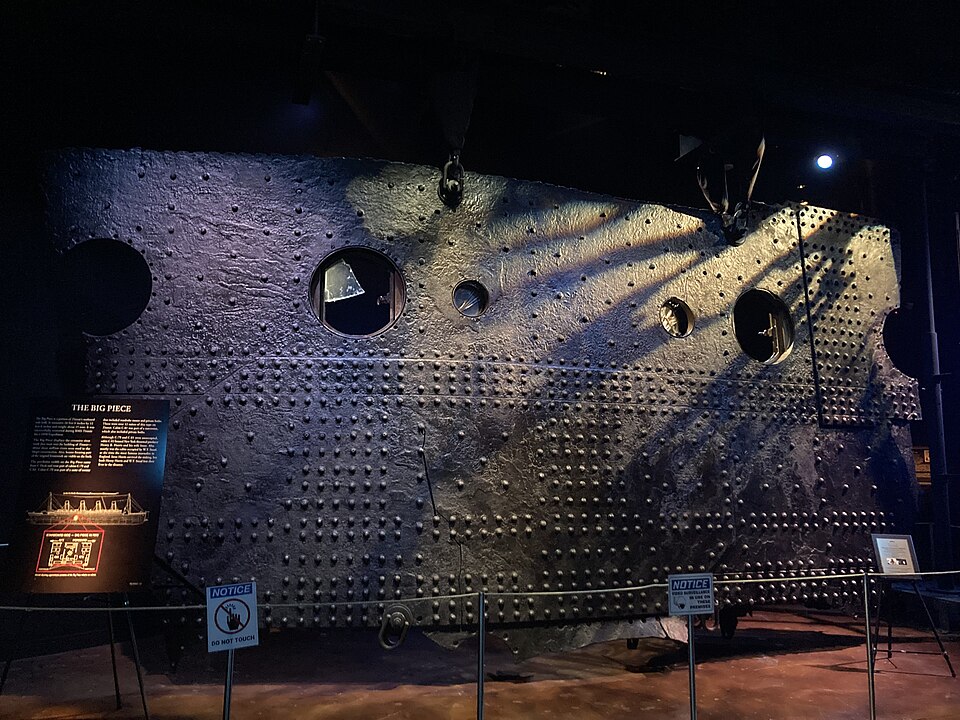
In 1994, deep-sea explorers scanning the wreck of the Titanic spotted something unusual: a massive section of the ship's starboard hull, lying separate from the main structure. It would take another four years, several failed attempts, and one hurricane before that section — later known simply as The Big Piece — was finally pulled from the ocean floor.
The recovery effort was led by RMS Titanic, Inc., under George Tulloch and Paul-Henri Nargeolet. Their goal was ambitious: to bring up a piece large enough to serve as the centerpiece of a planned exhibition, one that would let visitors 'immerse themselves in the Titanic.' The hull section fit that vision perfectly, but getting it to the surface proved far harder than anyone expected.
The first serious attempt came in 1996, when the submersible Nautile attached flotation bags to the hull piece, designed to carry it upward once released. As the massive fragment rose slowly through two hours of ascent, two cruise ships gathered nearby, their passengers watching the strange spectacle unfold on the open sea. Before the piece had even reached the surface, the Canadian vessel MV Jim Kilabuk arrived, intending to haul it to Halifax.
But the Jim Kilabuk lacked a winch capable of handling such weight. As Hurricane Edouard bore down on the operation, the lines securing the hull section snapped, and the piece sank back into the depths of the Atlantic — a costly setback after so much effort.
It wasn't until August 1998 that the recovery finally succeeded. The ship Abeille Supporter managed to lift the hull section fully onto its deck. At the time of recovery, it weighed roughly 20 short tons. Once ashore, concerns about its size for transport and display led conservators to split it into two parts, the second being a smaller extending section.
More from Archaeology

The Bronze Disc That Rewrote the Sky
Two looters with a metal detector dug up something illegal, invisible in value, and older than Stonehenge's final stones — a map of the heavens buried for over three thousand years.

The Faceless Women of the Ice Age
Long before writing, before cities, before the wheel, someone carved a woman's body into stone and ivory — and left no name, no face, no explanation.

The Pebble That Might Be Human
A palm-sized stone found on a Moroccan riverbank may be humanity's oldest attempt to see itself — or simply a trick of erosion.

The Crown That Vanished: Deshret and the Red Land
A crown worn by kings for three thousand years has never once been found in a tomb — not one. So where did it go?

The Face That Traveled Between Empires
A farm worker's shovel struck stone in 1897 and unearthed a face so striking it would be sold to France, seized as war booty, and finally traded back for a Velázquez.

The Boy in the Dark Tunnel
A schoolboy fell into black water inside an ancient tunnel and surfaced with his fingers brushing letters no one had noticed for 2,600 years.