The Biggest Painting in the Louvre
A biblical miracle, staged as a Venetian society party — with a sultan, two kings, and Titian himself hidden among the guests.
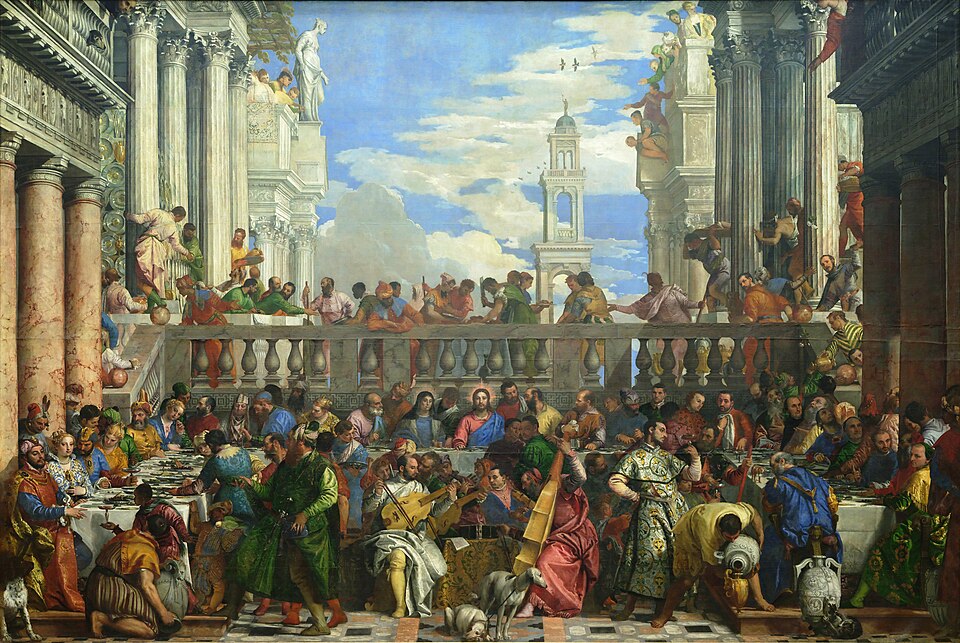
On 6 June 1562, the Black Monks of the Benedictine order in Venice struck a very specific bargain with a painter named Paolo Veronese. They wanted a monumental canvas for the far wall of their new refectory on the island of San Giorgio, a room designed by the architect Andrea Palladio. In exchange for 324 ducats, his living expenses, a barrel of wine, and meals in the refectory itself, Veronese agreed to paint 'the history of the banquet of Christ's miracle at Cana, in Galilee' — and to fill it with as many figures as the canvas could hold, using only the finest pigments, including costly ultramarine ground from lapis lazuli.
Veronese, working with his brother Benedetto Caliari, delivered the finished work in September 1563, just in time for the November Festa della Madonna della Salute. The result was staggering in scale: 6.77 by 9.94 metres, an area of 67.29 square metres, making it the most expansive canvas in the Louvre's collection today. It depicts the moment from the Gospel of John when Jesus, attending a wedding in Cana with his mother and disciples, turns water into wine after the feast runs dry — his first recorded miracle.
Rather than set the scene in ancient Galilee, Veronese dressed it as a lavish 16th-century Venetian banquet, in the garden of a Venetian palace, crowded with the fashions and food of his own era. The canvas holds 132 guests, six musicians, five dogs, a cat, and a parrot. Among the crowd are recognisable faces of the age: King Francis I of France, Queen Mary I of England, the Ottoman Sultan Suleiman the Magnificent, Holy Roman Emperor Charles V, Queen Eleanor of Portugal, the Ottoman grand vizier Sokollu Mehmed Pasha, and the poet Vittoria Colonna.
The musicians in the scene are a private joke of sorts: they are portraits of celebrated Venetian painters of the late Renaissance. Veronese himself appears playing the viola da gamba, Jacopo Bassano plays the flute, Tintoretto the violin, and Titian the cello — rival artists gathered together in paint, performing at a wedding none of them attended.
Veronese built the painting to be seen from below and from a distance, since its lower edge sat 2.5 metres above the refectory floor, positioned behind the abbot's seat at the head table. His command of architecture and perspective — blending real and painted space — made the banquet feel like a continuation of the room itself, an effect intensified by the flattened, elegant distortions typical of Mannerist style, which pushed beyond the balanced ideals of Leonardo, Raphael, and Michelangelo toward something more theatrical.
More from Art

The Painting With No Foreground
A single robed figure stares out at an empty grey sea — and the emptiness itself became a scandal. When it was unveiled in Berlin in 1810, no one knew quite what to do with it.

The Painter Who Chased the Light
For a few purple minutes each evening, an American exile knelt in an English garden and raced the dying sun to paint two little girls lighting lanterns. It took him two years to finish.

When a President Became a God
Look straight up inside the U.S. Capitol dome and you will find George Washington enthroned among the clouds, surrounded by goddesses — the founding father transformed into myth.

Marble Brought Back to Life
A corpse asleep, a wing barely brushing her skin — and marble somehow learns to breathe. This is the moment Antonio Canova dared to carve.

The World Turned Upside Down
Look closely at a sixteenth-century Flemish village and you'll find a man biting a pillar, another carrying daylight in a basket, and a wife slipping a blue cloak over her husband's shoulders. Every gesture is a joke — if you know the language.

The Girl in the Glass Case
She stood two-thirds life size, dressed in a real tutu and human hair — and the critics who saw her in 1881 recoiled as if she were something obscene.