The Blind Man's Guitar: Picasso's Blue Period Masterpiece
Beneath the hunched, sightless figure hunched over his guitar lies a secret — quite literally, another painting entirely, buried in the layers of blue.
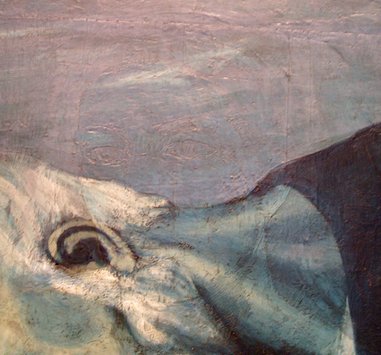
In the winter straddling 1903 and 1904, Pablo Picasso painted a beggar musician on a Barcelona street: gaunt, ragged, blind, folded almost impossibly over the one possession that keeps him alive — his guitar. There is no color here to speak of, only blues, greys and near-blacks, a palette so severe it seems to drain the man out of time altogether. Today the painting hangs in the Art Institute of Chicago, part of the Helen Birch Bartlett Memorial Collection, one of the most recognized images of Picasso's Blue Period.
That period, running from 1901 to 1904, was born from real anguish. Picasso and his close friend Carlos Casagemas had left Spain for Paris chasing fame, casting off their classical training in search of something new. A year in, Casagemas, undone by a failed love affair, took his own life. Picasso, already poor and living among beggars, prostitutes and other outcasts of the city, was plunged into grief and identification with the destitute. Modernism, Impressionism, Post-Impressionism and Symbolism were shaping his eye at the time, but it was El Greco's influence, his own hardship, and Casagemas's death that gave the Blue Period its particular ache: flat expanses of cold color, melancholy figures lost in thought, a quiet, pervasive tragedy.
Every choice in The Old Guitarist seems engineered to unsettle. The monochrome flattens the man into two dimensions, severing him from any specific time or place — he could be any beggar, anywhere. Oil paint lets the blues bleed into one another without losing their brightness, deepening the theatrical gloom. The guitarist's body, though still muscular, shows almost no sign of life; he seems balanced on the edge of death. His limbs are elongated past natural proportion, lending him an eerie elegance and an air of silent, almost spiritual contemplation.
Against all that blue, one shape breaks the spell: the guitar itself, rendered in warm brown, the only object in the composition that seems to belong to another world. It becomes the emotional center of the painting — the guitarist's sole means of survival, the small income earned from street playing standing between him and nothing at all. Some art historians read the painting as an allegory for the artist's life itself: music, or art, as both a calling that isolates its maker from society and a rope that still ties him to it for his very survival. Picasso, destitute and grieving in Barcelona, seems to have painted his own predicament into this stranger's body.
The painting has resonated well beyond the canvas. Paul Mariani, biographer of the American poet Wallace Stevens, argued that Stevens's 1937 poem The Man With the Blue Guitar was shaped by this very image, despite the poet's denials — an old man, distorted, cross-legged, playing his guitar, blind to the world but seeing more deeply into it. Picasso himself may have drawn on an earlier source: George Frederic Watts's 1886 painting Hope, which shows a similarly hunched, helpless musician rendered in blue tones.
More from Art

The Painting With No Foreground
A single robed figure stares out at an empty grey sea — and the emptiness itself became a scandal. When it was unveiled in Berlin in 1810, no one knew quite what to do with it.

The Painter Who Chased the Light
For a few purple minutes each evening, an American exile knelt in an English garden and raced the dying sun to paint two little girls lighting lanterns. It took him two years to finish.

When a President Became a God
Look straight up inside the U.S. Capitol dome and you will find George Washington enthroned among the clouds, surrounded by goddesses — the founding father transformed into myth.

Marble Brought Back to Life
A corpse asleep, a wing barely brushing her skin — and marble somehow learns to breathe. This is the moment Antonio Canova dared to carve.

The World Turned Upside Down
Look closely at a sixteenth-century Flemish village and you'll find a man biting a pillar, another carrying daylight in a basket, and a wife slipping a blue cloak over her husband's shoulders. Every gesture is a joke — if you know the language.

The Girl in the Glass Case
She stood two-thirds life size, dressed in a real tutu and human hair — and the critics who saw her in 1881 recoiled as if she were something obscene.