The Blood That Signed a Masterpiece
In a Maltese chapel, a fugitive painter left behind a canvas so vast and so dark that it seems to swallow the room — and hidden in a pool of painted blood, he signed his name for the only time in his life.
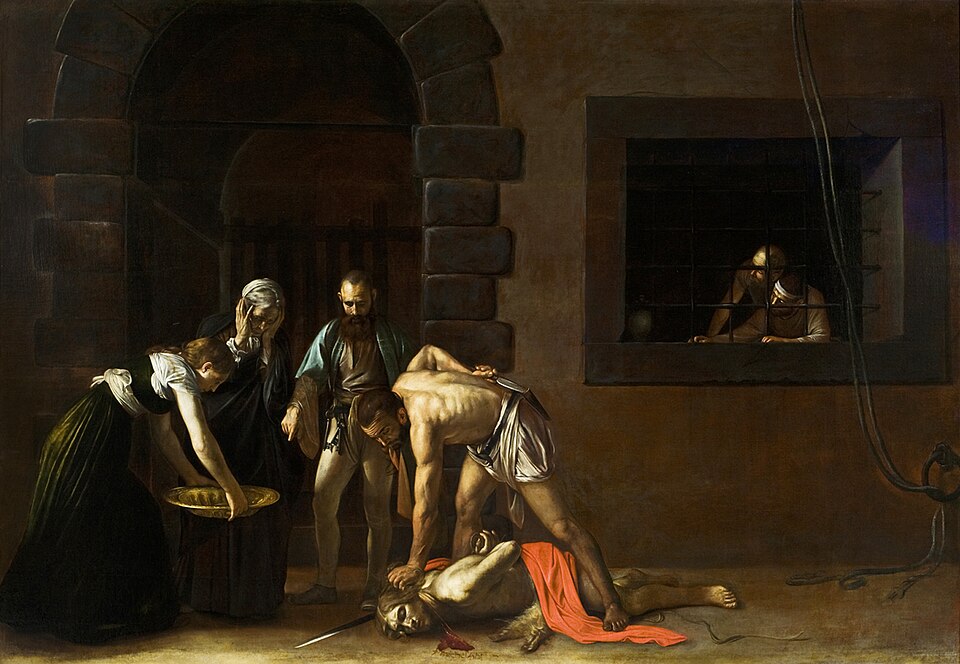
The painting is enormous: twelve feet wide by seventeen feet tall, a wall of shadow and flesh. At its center, an executioner kneels over the fallen body of John the Baptist, drawing his dagger to finish what a first blow apparently failed to complete. A servant girl waits with a golden platter, ready to receive the head. Another woman stands frozen, her hands pressed to her face, while a jailer issues orders as if this were routine business. The scene is not lifted directly from the Gospels but from the Golden Legend, a medieval collection of saints' tales that gave Caravaggio room to imagine the moment with brutal, theatrical precision.
What strikes viewers first is the emptiness. For a canvas so large, so much of it is bare wall, dim and ochre-toned, pressing the human figures into a narrow band of action near the bottom. That vast negative space does something strange to the eye: it makes the violence feel smaller and lonelier, swallowed by architecture indifferent to human suffering. The figures themselves are rendered nearly life-sized, so that a viewer standing before the work in Malta confronts the scene almost as a witness would.
Caravaggio completed the piece in 1608, in Malta, having been commissioned by the Knights of Malta to create what would become the largest altarpiece he ever painted. It was destined for the Oratory of St. John's Co-Cathedral in Valletta, the very building where Caravaggio himself had been inducted into the Order of the Knights and briefly served as one of their own.
His membership did not last. Within about six months of joining, Caravaggio was a fugitive, having escaped from imprisonment for an unrecorded crime. The Knights responded by defrocking him in absentia, denouncing him as a 'foul and rotten member' — and they held that ceremony in the Oratory, in front of this very painting, the one he had just given them.
It is in the blood spilling from the Baptist's throat that Caravaggio left his signature — the only work in his career that he ever signed. The inscription reads f. Michelang.o, the 'f' marking his brotherhood in the Order. Popular legend has long insisted he wrote something closer to a confession — 'I, Caravaggio, did this' — perhaps a veiled admission tied to the killing of Ranuccio Tomassoni in Rome two years earlier, the act that had sent him running from the city in the first place. Whether the signature was penance, pride, or something else entirely remains disputed.
More from Art

The Painting With No Foreground
A single robed figure stares out at an empty grey sea — and the emptiness itself became a scandal. When it was unveiled in Berlin in 1810, no one knew quite what to do with it.

The Painter Who Chased the Light
For a few purple minutes each evening, an American exile knelt in an English garden and raced the dying sun to paint two little girls lighting lanterns. It took him two years to finish.

When a President Became a God
Look straight up inside the U.S. Capitol dome and you will find George Washington enthroned among the clouds, surrounded by goddesses — the founding father transformed into myth.

Marble Brought Back to Life
A corpse asleep, a wing barely brushing her skin — and marble somehow learns to breathe. This is the moment Antonio Canova dared to carve.

The World Turned Upside Down
Look closely at a sixteenth-century Flemish village and you'll find a man biting a pillar, another carrying daylight in a basket, and a wife slipping a blue cloak over her husband's shoulders. Every gesture is a joke — if you know the language.

The Girl in the Glass Case
She stood two-thirds life size, dressed in a real tutu and human hair — and the critics who saw her in 1881 recoiled as if she were something obscene.