The Blow That Could Not Be Unpainted
A father's staff falls, a son's temple bleeds, and three centuries later a painter cannot stop his hand from returning to the wound.
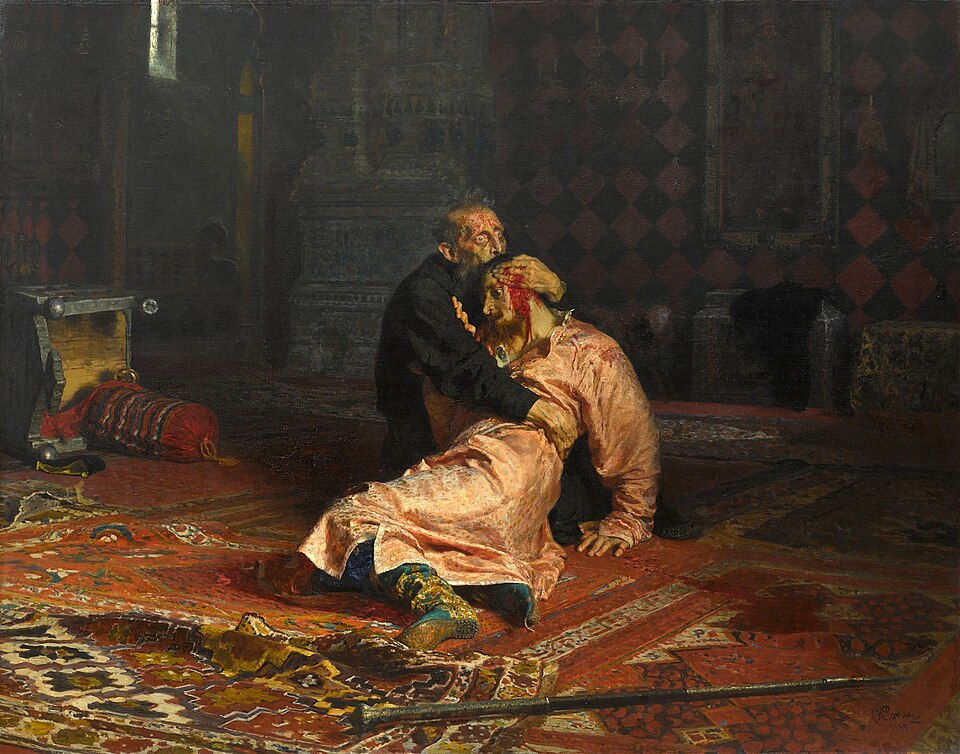
In mid-February 1881, Ilya Repin traveled to Saint Petersburg for the opening of the Wanderers' exhibition. He was in the city on 13 March when Tsar Alexander II was assassinated by a bomb thrown by Ignacy Hryniewiecki, a member of the revolutionary group Narodnaya Volya. The blast also mortally wounded its bomber, who died hours later. Repin returned in April and attended the execution of the attack's perpetrators and their accomplices, the Pervomartovtsy — Zhelyabov, Perovskaya, Kibalchich, Mikhailov, and Rysakov — hanged on 13 April. He never forgot the boards hung on their chests reading 'regicide,' nor Zhelyabov's gray trousers, nor Perovskaya's black hat, details he recounted years later to his friend the poet Vasily Kamensky.
That violence seeped into Repin's art. Refusal of Confession, Arrest of a Propagandist, and They Did Not Expect Him all trace back to the shock of 1881. But it was another memory, exactly three centuries older, that gave Repin his most famous and controversial canvas: on 16 November 1581, Ivan the Terrible had struck his own son, the Tsarevich Ivan Ivanovich, a fatal blow to the head in a fit of rage.
Repin later wrote that the connection came to him while listening in Moscow to Nikolai Rimsky-Korsakov's symphonic suite Antar — a work built of four movements: an opening, vengeance, power, and love. It was the second movement, Vengeance, that struck him hardest, its sound conjuring a state of soul he felt he could only express by returning to history. 'This sound wave took possession of me,' he recalled, 'and I thought that I could not embody the state of soul I had known under the influence of this music in a painting. I then remembered Tsar Ivan.' A trip through Western Europe in 1883, where he watched bullfights and saw gallery after gallery hung with bloody canvases, pushed him further. 'Misfortune, death, murder and blood make up a hole that draws you into it with force,' he wrote. 'On my return home, I started the bloody scene of Ivan the Terrible with his son.'
For the historical scene itself, Repin drew on the account of historian Nikolay Karamzin: a father who had burst into the room of his pregnant daughter-in-law, Yelena, beaten her for being immodestly dressed, and caused her to miscarry; a son who confronted him the next day, was accused of disloyalty over the ongoing Livonian War, and was struck across the temple with his father's staff when he argued for defending the city of Pskov. Boris Godunov, then a minister, tried to intervene and was struck himself. According to this account, the dying Tsarevich told his father he was dying 'a faithful son and simple subject,' and lingered until his death on 19 November 1581.
The painting itself took years of anguish to complete, from a first sketch in 1882 to its finished state between 1883 and 1885. 'I painted in tears,' Repin wrote, 'I was tortured, I tormented myself, I corrected again and again what I had painted, I hid it... Every minute was terrible to me.' The setting was based on a room in the Chambers of the Romanov Boyars, with the throne, mirror, and kaftan studied at the Kremlin Armoury and a chest borrowed from the Rumyantsev Museum's collections.
More from Art

The Painting With No Foreground
A single robed figure stares out at an empty grey sea — and the emptiness itself became a scandal. When it was unveiled in Berlin in 1810, no one knew quite what to do with it.

The Painter Who Chased the Light
For a few purple minutes each evening, an American exile knelt in an English garden and raced the dying sun to paint two little girls lighting lanterns. It took him two years to finish.

When a President Became a God
Look straight up inside the U.S. Capitol dome and you will find George Washington enthroned among the clouds, surrounded by goddesses — the founding father transformed into myth.

Marble Brought Back to Life
A corpse asleep, a wing barely brushing her skin — and marble somehow learns to breathe. This is the moment Antonio Canova dared to carve.

The World Turned Upside Down
Look closely at a sixteenth-century Flemish village and you'll find a man biting a pillar, another carrying daylight in a basket, and a wife slipping a blue cloak over her husband's shoulders. Every gesture is a joke — if you know the language.

The Girl in the Glass Case
She stood two-thirds life size, dressed in a real tutu and human hair — and the critics who saw her in 1881 recoiled as if she were something obscene.