The Book of Kells: A Gospel Written in Fire and Knotwork
Ten monks' lifetimes of vellum, iron-gall ink, and pigments dragged from distant lands went into a single gospel book — and no one is entirely sure where it was made.
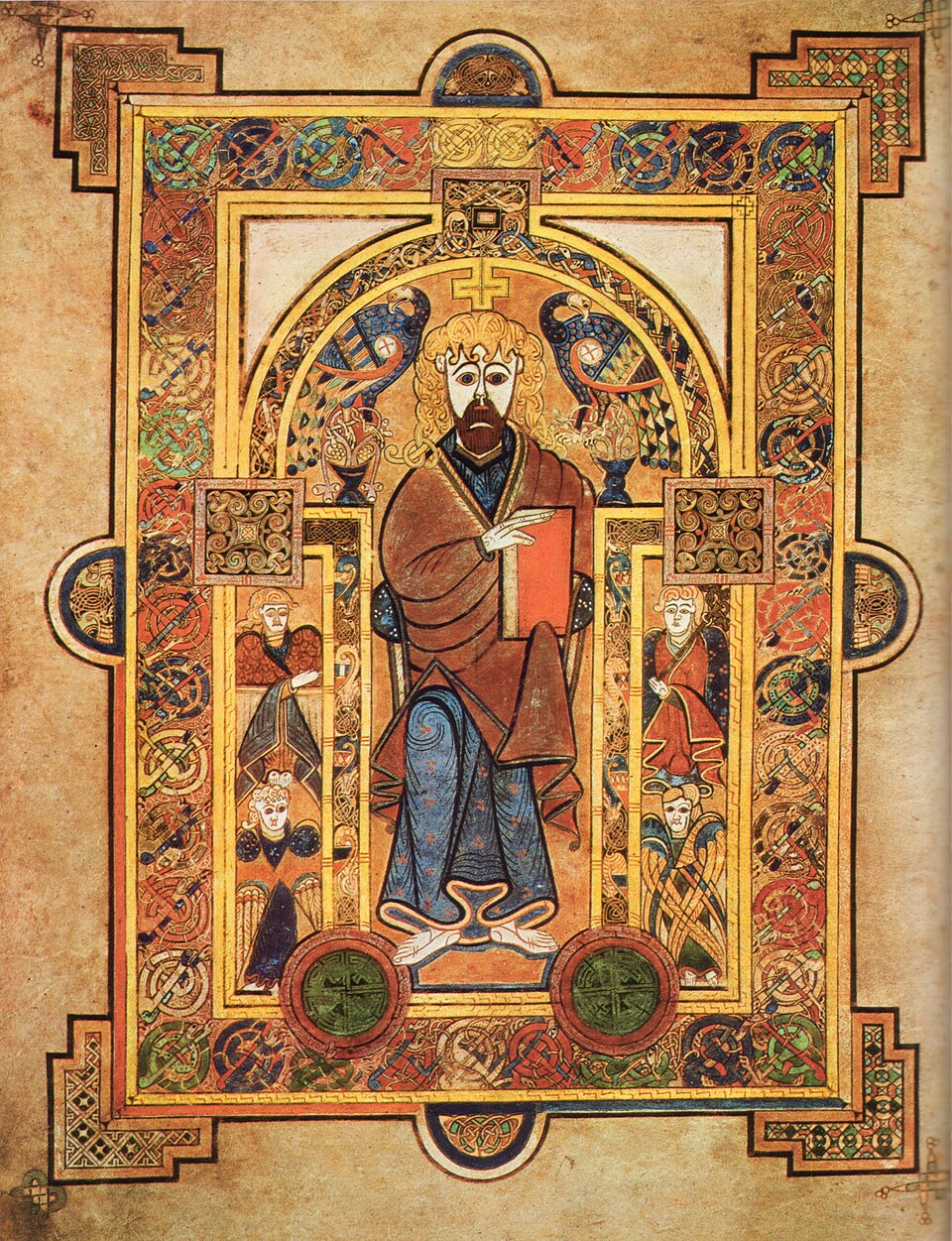
Somewhere around the year 800, in a monastery touched by the Columban tradition, a team of at least three scribes bent over sheets of calfskin vellum and began the slow work of copying the four Gospels. What emerged, centuries later known as the Book of Kells, would become one of the most extravagant manuscripts to survive from early medieval Europe — 340 leaves, 680 pages, bound today in four volumes measuring 330 by 250 millimetres.
The text itself draws mostly from the Vulgate, the standard Latin Bible, though scribes occasionally slipped in passages from the older Vetus Latina translations. But it is not the words that made the book famous — it is what surrounds them. Ten full-page illustrations and countless decorated initials transform the gospel text into something closer to a visual labyrinth: human figures, animals, and mythical beasts tangle with Celtic knots and interlacing patterns rendered in vivid color.
Every decorative flourish, however small, carried Christian symbolism, reinforcing the themes of the larger illustrations. The scribes wrote in iron gall ink and drew on pigments sourced from remarkably far afield — a reminder that even in an age without easy travel, monastic networks stretched across enormous distances to secure the materials a masterpiece required.
The manuscript belongs to a broader family of Insular-style gospel books produced from the late 6th through early 9th centuries in monasteries across Britain, Ireland, and continental foundations with Hiberno-Scottish or Anglo-Saxon roots. Its relatives include the Cathach of St. Columba, the Book of Durrow, the Durham Gospels, the Echternach Gospels, the Lindisfarne Gospels, and the Lichfield Gospels. Scholars group these works by shared artistic style, script, and textual tradition — and the Book of Kells, with its fully matured ornamentation, sits at the very end of that lineage, likely from the late 8th or early 9th century.
Where exactly it was created remains genuinely contested. It may have been started at Iona and finished at Kells; it may have been made entirely at Iona; it may have been produced wholly within the scriptorium at Kells itself; a theory involving Pictish Scotland lacks supporting evidence. The Abbey of Kells in County Meath, from which the book eventually took its name, was founded or refounded from Iona Abbey, with construction running from 807 to the church's consecration in 814 — a timeline that overlaps suggestively with the manuscript's likely completion.
More from Art

The Painting With No Foreground
A single robed figure stares out at an empty grey sea — and the emptiness itself became a scandal. When it was unveiled in Berlin in 1810, no one knew quite what to do with it.

The Painter Who Chased the Light
For a few purple minutes each evening, an American exile knelt in an English garden and raced the dying sun to paint two little girls lighting lanterns. It took him two years to finish.

When a President Became a God
Look straight up inside the U.S. Capitol dome and you will find George Washington enthroned among the clouds, surrounded by goddesses — the founding father transformed into myth.

Marble Brought Back to Life
A corpse asleep, a wing barely brushing her skin — and marble somehow learns to breathe. This is the moment Antonio Canova dared to carve.

The World Turned Upside Down
Look closely at a sixteenth-century Flemish village and you'll find a man biting a pillar, another carrying daylight in a basket, and a wife slipping a blue cloak over her husband's shoulders. Every gesture is a joke — if you know the language.

The Girl in the Glass Case
She stood two-thirds life size, dressed in a real tutu and human hair — and the critics who saw her in 1881 recoiled as if she were something obscene.