The Books That Fled Timbuktu
For centuries they slept in trunks and mudbrick chests, guarded by families who never stopped believing in them. Then war came, and thousands of pages had to run for their lives.
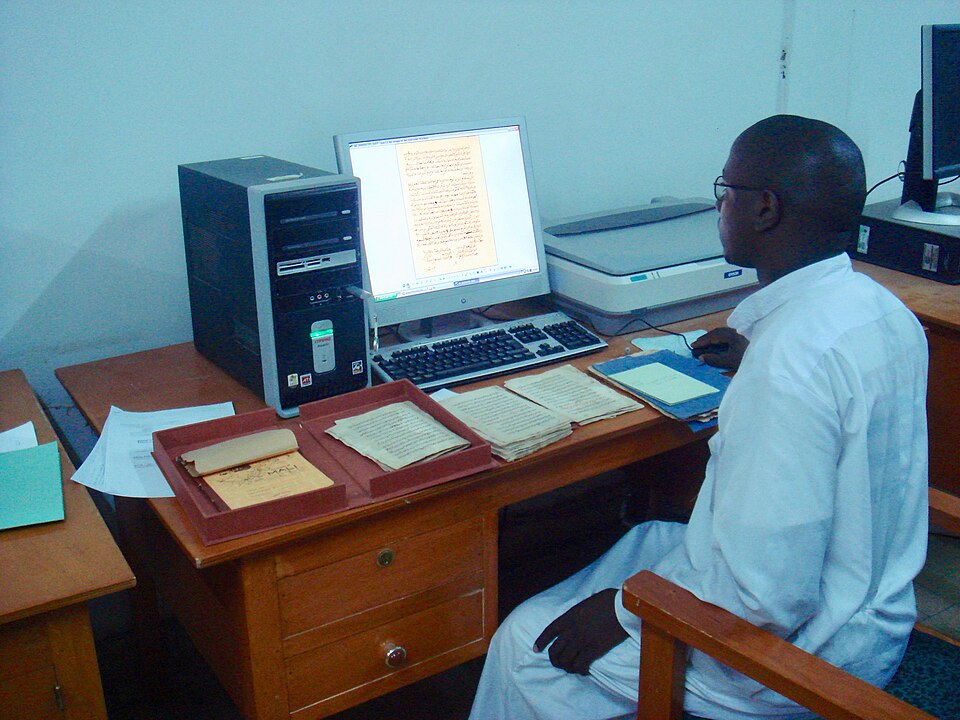
In the homes of Timbuktu, a city on the edge of the Sahara in northern Mali, generations of families quietly kept something the outside world had almost forgotten: hundreds of thousands of handwritten manuscripts, some dating back to the late 13th century, when Islam first reached the Mali Empire. Written mostly in Arabic script — sometimes in African languages like Fula, Songhay, Tamasheq, Bambara, and Soninke rendered in that same script, a practice called Ajami — these pages held everything from Quranic copies to translated works by Plato, Hippocrates, and Avicenna, alongside a 28-volume Arabic dictionary called The Mukham, originally composed by an Andalusian scholar in the mid-11th century.
The scribes of Timbuktu were not merely copyists. They wrote their own histories, legal treatises, religious commentary, philosophy, and poetry. Legal scholars compiled deep records on Islamic jurisprudence, or fiqh, and on obligatory alms, zakat. Others turned their eyes to the sky: manuscripts tracked the movement of stars for calendar and seasonal purposes, and the chronicler Mahmud Kati even recorded what was likely the Perseid meteor shower in August 1583, describing stars flying 'as if fire had been kindled in the whole sky' until after dawn.
The range of subjects was startling. Some manuscripts detailed the nutritional and therapeutic properties of desert plants. Others debated polygamy, moneylending, and slavery. Still others catalogued spells, astrology, fortune-telling, black magic, necromancy, geomancy, and hydromancy — reading the future from ripples in water. One volume, titled Advising Men on Sexual Engagement with Their Women, offered guidance on aphrodisiacs, infertility remedies, and how to 'win back' a wife.//
Despite this richness, most manuscripts remained uncatalogued and unstudied, passed down within families and often in poor condition. Nobody knows exactly how many exist; estimates are rough at best. As Arabic education declined under French colonial rule, appreciation for the manuscripts faded, and many were sold off cheaply — Time magazine told of an imam who bought four for just $50 each. In October 2008, a flood in one household destroyed 700 manuscripts outright.
Recognition came slowly. UNESCO founded a preservation-focused body in 1970, but it went unfunded until 1977. It was Harvard professor Henry Louis Gates's 1998 visit for the PBS series Wonders of the African World that stirred public and academic attention, unlocking new funding. Between 1999 and 2007, the University of Oslo ran the Timbuktu Manuscripts Project, backed by Luxembourg's government, NORAD, the Ford Foundation, NUFU, and the U.S. Ambassadors Fund for Cultural Preservation. It revived traditional bookbinding, trained local specialists, and built an electronic catalogue at the Institut des Hautes Études et de Recherche Islamique – Ahmad Baba.
More from Art

The Painting With No Foreground
A single robed figure stares out at an empty grey sea — and the emptiness itself became a scandal. When it was unveiled in Berlin in 1810, no one knew quite what to do with it.

The Painter Who Chased the Light
For a few purple minutes each evening, an American exile knelt in an English garden and raced the dying sun to paint two little girls lighting lanterns. It took him two years to finish.

When a President Became a God
Look straight up inside the U.S. Capitol dome and you will find George Washington enthroned among the clouds, surrounded by goddesses — the founding father transformed into myth.

Marble Brought Back to Life
A corpse asleep, a wing barely brushing her skin — and marble somehow learns to breathe. This is the moment Antonio Canova dared to carve.

The World Turned Upside Down
Look closely at a sixteenth-century Flemish village and you'll find a man biting a pillar, another carrying daylight in a basket, and a wife slipping a blue cloak over her husband's shoulders. Every gesture is a joke — if you know the language.

The Girl in the Glass Case
She stood two-thirds life size, dressed in a real tutu and human hair — and the critics who saw her in 1881 recoiled as if she were something obscene.