The Box in the King's Grave
A workman's brush uncovered a sliver of shell in a looted tomb — and beneath it lay four and a half thousand years of war and peace, frozen in lapis lazuli.
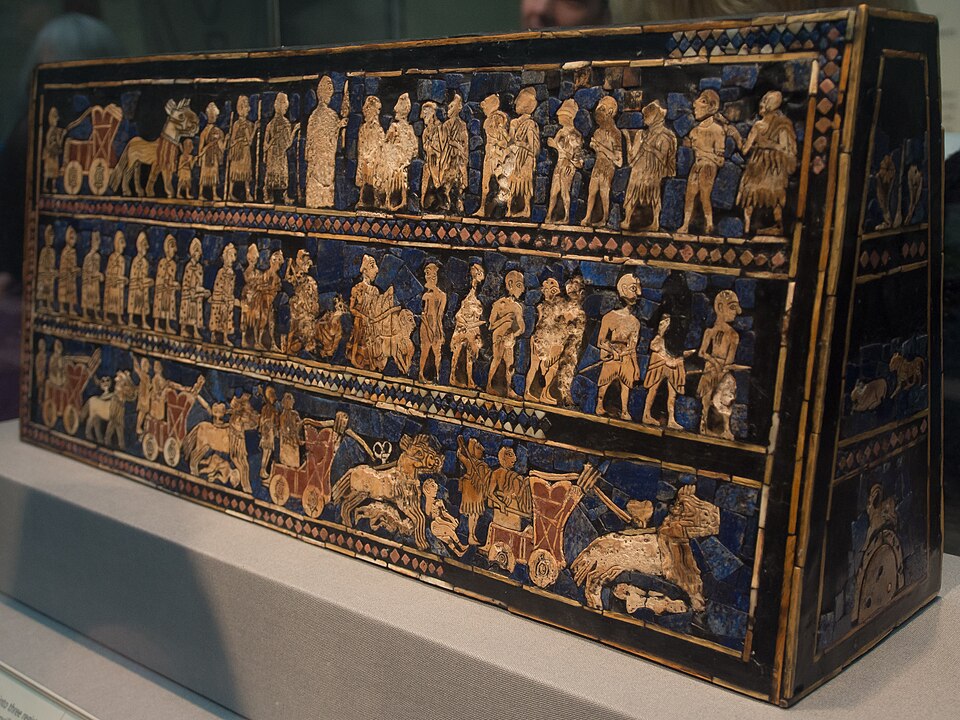
In 1927, in the ruins of the ancient city of Ur, west of Nasiriyah in modern Iraq, archaeologist Sir Leonard Woolley was excavating a royal cemetery already stripped bare by ancient robbers. In one corner of a chamber known as tomb PG 779, associated with a king named Ur-Pabilsag who died around 2550 BC, a workman spotted a fragment of shell inlay. Woolley later recalled that 'the next minute the foreman's hand, carefully brushing away the earth, laid bare the corner of a mosaic in lapis lazuli and shell.'
What emerged was a Sumerian artifact roughly 4,600 years old, dating to the First Dynasty of Ur during the Early Dynastic III period. It lay close to the shoulder of a man's skeleton, leading Woolley to guess it had been carried on a pole — hence its now-famous name, the Standard of Ur, though what it actually was remains unknown. Nearby lay another skeleton, entirely covered in thousands of tiny lapis-lazuli beads, as if he had worn a beaded cap; a shell cylinder seal bearing the name 'é-zi' was found with his body.
The object itself had not survived intact. Over four thousand years, the wooden frame and bitumen glue holding its mosaic pieces in place had rotted away, and the weight of the soil had crushed and fragmented it. Woolley's team, aware of the challenge, searched for hollows left by decayed materials and filled them with wax or plaster to preserve their shapes — a method recalling the plaster casts made of Pompeii's victims. Small sections of mosaic, each about 3 square centimeters, were carefully coated in wax and lifted while their original design held together.
When first displayed in 1928, the fragile inlays were consolidated with paraffin, a treatment that ultimately caused further deterioration. It wasn't until 1973 that the Standard was fully dismantled and reassembled, with the end panels' inlays adjusted at that time. What visitors see today in the British Museum is therefore a careful reconstruction — a best guess at the original form of a hollow wooden box, 21.59 cm wide and 49.53 cm long, its irregular shape narrower at the top than the bottom, covered in shell, red limestone, and lapis lazuli mosaic.
Two long panels dominate the object, nicknamed 'War' and 'Peace' for their imagery, while the trapezoidal end pieces bear fantastical scenes that have drawn far less attention. Both long sides are arranged in three registers — upper, middle, and lower — and both use a hierarchy of scale, where the most important figures are drawn larger than everyone else.
More from Art

The Painting With No Foreground
A single robed figure stares out at an empty grey sea — and the emptiness itself became a scandal. When it was unveiled in Berlin in 1810, no one knew quite what to do with it.

The Painter Who Chased the Light
For a few purple minutes each evening, an American exile knelt in an English garden and raced the dying sun to paint two little girls lighting lanterns. It took him two years to finish.

When a President Became a God
Look straight up inside the U.S. Capitol dome and you will find George Washington enthroned among the clouds, surrounded by goddesses — the founding father transformed into myth.

Marble Brought Back to Life
A corpse asleep, a wing barely brushing her skin — and marble somehow learns to breathe. This is the moment Antonio Canova dared to carve.

The World Turned Upside Down
Look closely at a sixteenth-century Flemish village and you'll find a man biting a pillar, another carrying daylight in a basket, and a wife slipping a blue cloak over her husband's shoulders. Every gesture is a joke — if you know the language.

The Girl in the Glass Case
She stood two-thirds life size, dressed in a real tutu and human hair — and the critics who saw her in 1881 recoiled as if she were something obscene.