The Boy Who Broke the Rules of Bronze
A naked shepherd boy, a winged helmet, and a giant's severed head at his feet — this statue shattered a thousand years of sculptural silence.
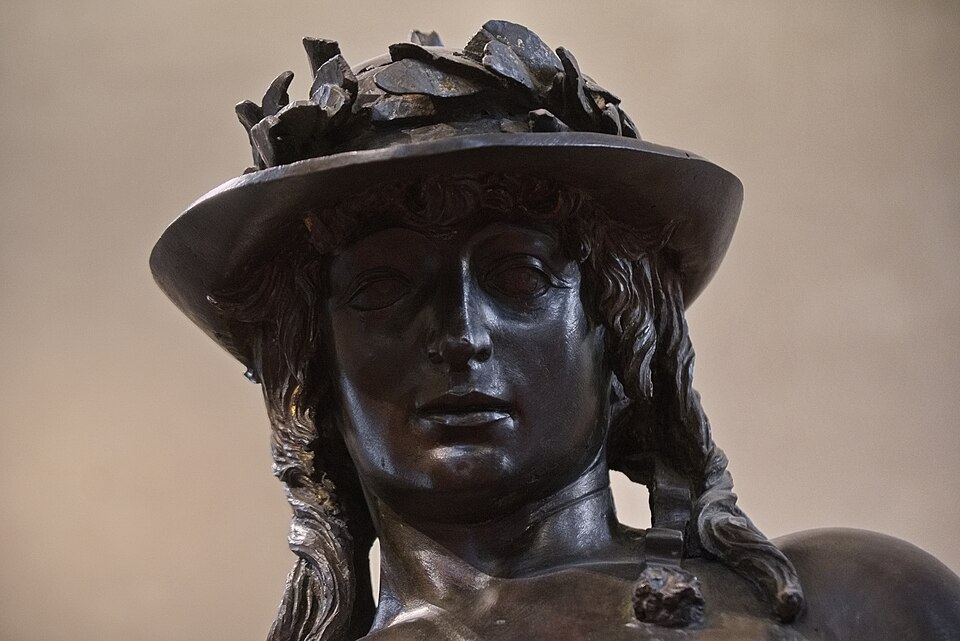
In a Florentine courtyard sometime in the 1440s, a bronze youth stood on a column, smiling an expression nobody could quite explain. He wore nothing but boots and a laurel-crowned hat, one foot resting casually on the bearded, severed head of a giant. This was David, cast by Donatello, and it was unlike anything Europe had seen in a thousand years: the first freestanding nude male sculpture made since antiquity, and the first unsupported standing bronze cast during the Renaissance.
The story behind the boy was ancient, drawn from 1 Samuel 17. The Israelites faced the Philistines, whose champion Goliath challenged anyone to single combat. No trained soldier dared face him — until David, a shepherd too young to be a warrior, stepped forward. He refused Saul's armor and weapons, choosing instead his sling. He struck Goliath in the head with a stone, felled him, then seized the giant's own sword and cut off his head. It was a story about divine strength triumphing over brute force, and it was that theology of triumph-without-might Donatello set out to render in metal.
The commission itself is a mystery. No documents survive to confirm who ordered it or when. Most scholars believe Cosimo de' Medici commissioned the work, but proposed dates range wildly from the 1420s to the 1460s — Donatello died in 1466 — with recent consensus favoring the 1440s, around the time the new Medici Palace, designed by Michelozzo, was rising in Florence.
Donatello had already sculpted David once before, in marble, decades earlier; both versions now share a home in the Museo Nazionale del Bargello. But the bronze was something else entirely — commissioned for a secular setting, for the Medici family's private world rather than a church. While the iconography followed the marble original — young hero, weapon in hand, enemy's head underfoot — the visual effect was startling: a figure delicate, androgynous, seemingly modeled more on classical images of Antinous, the beautiful favorite of Emperor Hadrian, than on any expected image of a biblical warrior.
The contrast Donatello built into the piece was deliberate: a slight, unarmored boy holding an enormous sword, having defeated a heavily armored giant not through physical strength but, the sculpture implies, through the presence of God. David is depicted uncircumcised, following the convention for male nudes in Italian Renaissance art, and Goliath's beard curls around David's sandaled foot, as if the boy were absentmindedly running his toes through his fallen enemy's hair. Goliath himself wears a winged helmet — David's right foot rests firmly on its short right wing, while the longer left wing extends up along his leg toward his groin.
More from Art

The Painting With No Foreground
A single robed figure stares out at an empty grey sea — and the emptiness itself became a scandal. When it was unveiled in Berlin in 1810, no one knew quite what to do with it.

The Painter Who Chased the Light
For a few purple minutes each evening, an American exile knelt in an English garden and raced the dying sun to paint two little girls lighting lanterns. It took him two years to finish.

When a President Became a God
Look straight up inside the U.S. Capitol dome and you will find George Washington enthroned among the clouds, surrounded by goddesses — the founding father transformed into myth.

Marble Brought Back to Life
A corpse asleep, a wing barely brushing her skin — and marble somehow learns to breathe. This is the moment Antonio Canova dared to carve.

The World Turned Upside Down
Look closely at a sixteenth-century Flemish village and you'll find a man biting a pillar, another carrying daylight in a basket, and a wife slipping a blue cloak over her husband's shoulders. Every gesture is a joke — if you know the language.

The Girl in the Glass Case
She stood two-thirds life size, dressed in a real tutu and human hair — and the critics who saw her in 1881 recoiled as if she were something obscene.