The Boy Who Outshone Reynolds
A single canvas, painted over an earlier sketch, would end up dressed as a myth — one artist's silent rebuttal to another, or so the story went.
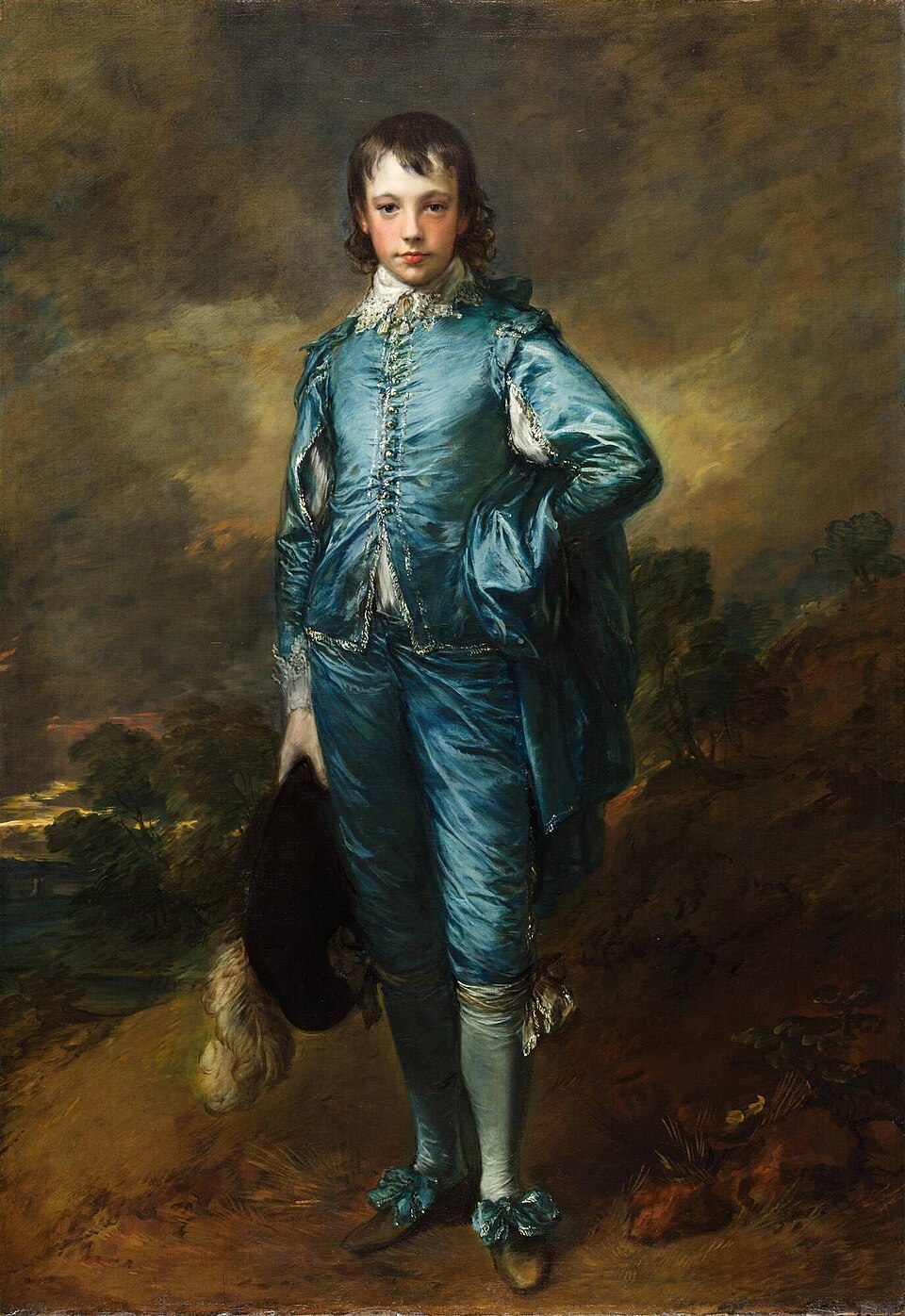
Around 1770, Thomas Gainsborough set his brush to a nearly life-size canvas — 48 inches wide, 70 inches tall — on which he had already drawn something before painting it over. What emerged was a young man in shimmering blue silk, dressed not in the fashion of his own century but in the style of a hundred years earlier, echoing the elegant boys and lords painted by Anthony van Dyck. The costume was deliberate homage: Gainsborough had long admired van Dyck's double portrait of the brothers George Villiers, 2nd Duke of Buckingham, and Lord Francis Villiers, and the pose and finery of The Blue Boy borrow directly from that lineage.
For generations, the boy in blue was assumed to be Jonathan Buttall, son of a wealthy hardware merchant, largely because Buttall was known to have owned the painting early on. Yet this identification was never proven. In 2013, the art historian Susan Sloman made a compelling case that the true sitter was likely Gainsborough Dupont, the artist's own nephew, born in 1754. The mystery of the model has never fully been resolved, and perhaps never will be.
The painting's fame owes as much to a story as to its brushwork. In 1821, printmaker John Young published the first widely circulated reproduction of The Blue Boy and, with it, a tale: that Gainsborough had painted the boy in cool blue tones specifically to defy Sir Joshua Reynolds, president of the Royal Academy, who had preached in his Eighth Discourse that a picture's brightest passages should be warm — yellow, red, mellow tones — never blue or grey. Reversing that rule, Reynolds warned, would defeat even Rubens or Titian.
It was a delicious story, pitting the disciplined academic Reynolds — knighted, lecturing, curating exhibitions — against the aloof, correspondence-writing Gainsborough who never sought royal favor. There was just one problem: Gainsborough had completed The Blue Boy some eight years before Reynolds ever delivered that lecture. The chronology made the challenge impossible. But the story was too irresistible to abandon, and its repetition — false as it was — helped catapult the painting to international celebrity.
Meanwhile the painting's real journey was more mundane, if aristocratic. It stayed with Buttall until his bankruptcy in 1796, then passed to politician John Nesbitt, and by 1802 to portrait painter John Hoppner. Around 1809 it entered the collection of Earl Grosvenor, remaining with his descendants for over a century. The Grosvenor family displayed it in their London home and lent it to major exhibitions — the 1857 Art Treasures Exhibition in Manchester, the 1862 International Exhibition, the Royal Academy in 1870 and 1896 — each time reinforcing its reputation, with The Times in 1896 calling it 'the most famous of all his pictures.'
More from Art

The Painting With No Foreground
A single robed figure stares out at an empty grey sea — and the emptiness itself became a scandal. When it was unveiled in Berlin in 1810, no one knew quite what to do with it.

The Painter Who Chased the Light
For a few purple minutes each evening, an American exile knelt in an English garden and raced the dying sun to paint two little girls lighting lanterns. It took him two years to finish.

When a President Became a God
Look straight up inside the U.S. Capitol dome and you will find George Washington enthroned among the clouds, surrounded by goddesses — the founding father transformed into myth.

Marble Brought Back to Life
A corpse asleep, a wing barely brushing her skin — and marble somehow learns to breathe. This is the moment Antonio Canova dared to carve.

The World Turned Upside Down
Look closely at a sixteenth-century Flemish village and you'll find a man biting a pillar, another carrying daylight in a basket, and a wife slipping a blue cloak over her husband's shoulders. Every gesture is a joke — if you know the language.

The Girl in the Glass Case
She stood two-thirds life size, dressed in a real tutu and human hair — and the critics who saw her in 1881 recoiled as if she were something obscene.